
Industrial Dimmers & Variac for Controlled AC Voltage
Samtronix Dimmers, also known as Variable Auto Transformers or Variacs, are engineered for smooth and controlled AC voltage adjustment. They provide a practical solution where electrical testing, machinery, automation and power-control systems require adjustable voltage.
- Smooth AC voltage adjustment
- Precision-wound copper construction
- Single-phase & three-phase configurations
- Manual or motorized operation
- Industrial-duty mechanical assemblies
- Suitable for custom applications

More Than a Dimmer & A Controlled Voltage Source
An industrial Dimmer or Variac changes the output voltage by moving a contact across a specially wound toroidal coil. Instead of switching between fixed voltage levels, it allows the output to be adjusted gradually within its designed range.
Variable Output
Provides adjustable AC voltage for controlled electrical applications.
Copper Winding
Precision-wound electrical paths support controlled voltage adjustment.
Mechanical Control
Brush movement determines the effective output point on the winding.
Industrial Integration
Can be incorporated into stabilizers, test equipment and custom power systems.
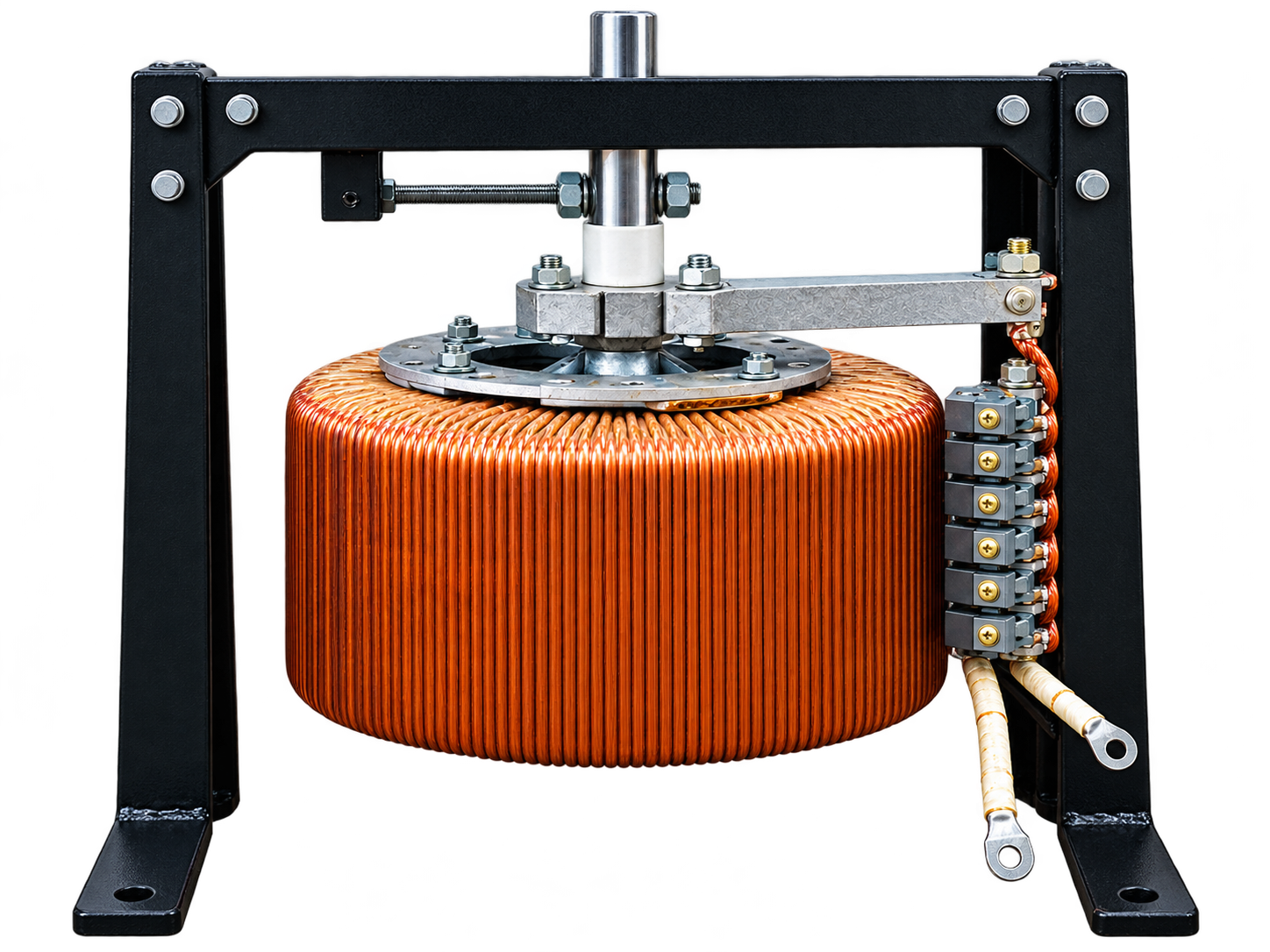
Servo Stabilizer Dimmer / Variac
The Dimmer is an important variable-voltage element in many servo-based voltage regulation systems. It works with the mechanical drive arrangement to change the effective voltage supplied to the connected circuit.
- Provides continuously variable AC output within the designed voltage range.
- Uses a wound toroidal core with a movable contact and brush arrangement.
- Can be integrated with motor-driven mechanisms for automatic voltage correction.
- Suitable for precision variable-voltage requirements in power-control equipment.
- Configuration can be selected according to phase, voltage and current requirements.
Precision-Wound Copper Coil
The winding is at the heart of a Variac. The quality of the copper winding, contact arrangement and mechanical movement directly influences how smoothly the voltage can be adjusted.
- Copper winding provides the conductive path for controlled voltage adjustment.
- Toroidal construction keeps the winding compact while providing a large usable contact path.
- Carefully arranged turns support smooth brush movement across the winding.
- Mechanical mounting helps maintain alignment during operation.
- Suitable for applications where repeatable voltage adjustment is important.

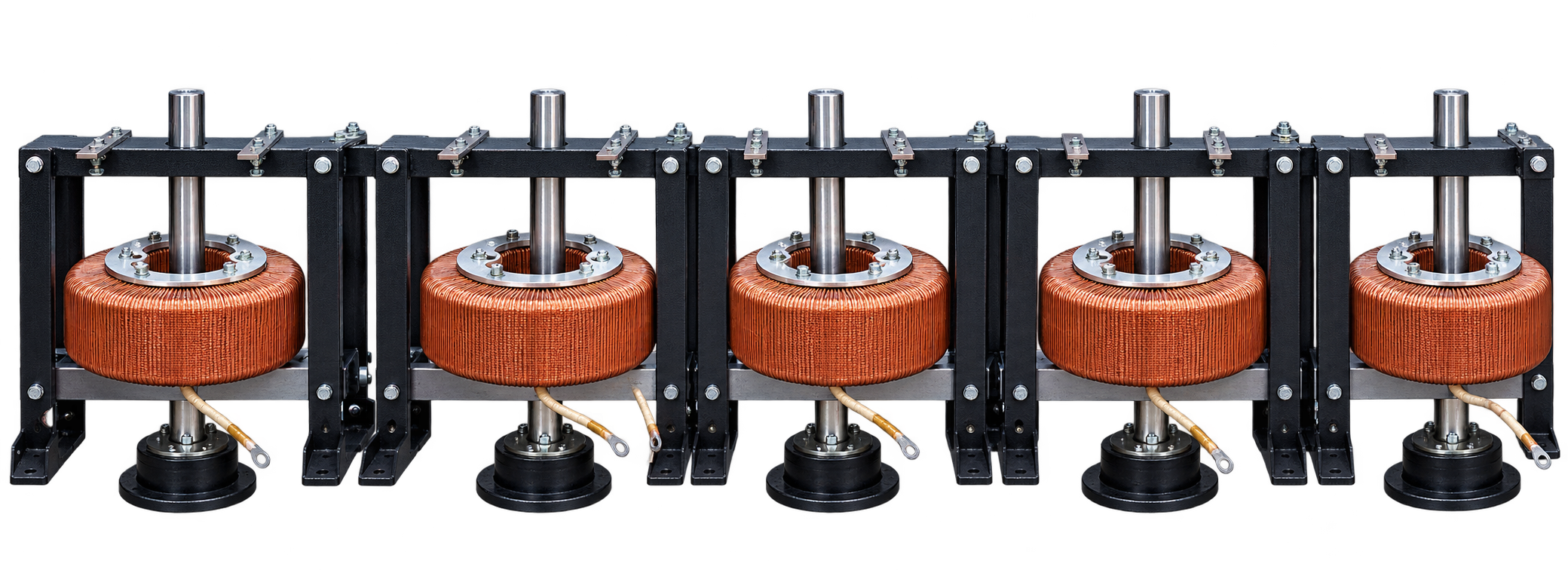
Multi-Unit Industrial Assemblies
Higher-capacity electrical systems can require multiple variable-voltage sections operating together. These assemblies can be arranged according to the phase configuration and electrical requirements of the system.
- Multiple Dimmer units can be combined for three-phase voltage control.
- Individual phase sections can be mechanically arranged inside a common frame.
- Suitable for integration with control panels and automatic regulation systems.
- Heavy-duty structures provide mechanical support for larger assemblies.
- Layout can be adapted around installation, electrical and service requirements.
Three-Phase Voltage Adjustment
Three-phase Dimmer assemblies are used when an application requires coordinated variable voltage across a three-phase electrical system.
- Three individual variable-voltage sections can be arranged as a coordinated system.
- Useful in three-phase testing, regulation and industrial power applications.
- Heavy frames support the coil assemblies and moving mechanisms.
- Connection points can be positioned for practical integration into the final equipment.
- Voltage range and current capacity can be selected around the intended application.


Built for Industrial Environments
An industrial Dimmer is more than a copper winding. The winding, brush, shaft, terminals, insulation and mechanical structure must work together as one dependable assembly.
- Strong metal structures support the electrical and mechanical assembly.
- Mechanical movement is designed around stable brush positioning.
- Accessible construction can simplify inspection and maintenance.
- Electrical connection points can be arranged according to application requirements.
- Suitable for integration into larger stabilizer and power-control systems.
Single-Unit Variable Voltage Control
A single Dimmer section can be used when one controlled AC voltage path is required. This configuration is useful for dedicated equipment and systems requiring adjustable voltage.
- Compact variable-voltage arrangement for dedicated applications.
- Manual or motorized movement can be selected according to the system design.
- Useful in laboratory, testing and production equipment.
- Output adjustment is achieved through controlled brush movement over the winding.
- Can be incorporated into a larger enclosure or electrical control system.

What Makes a Good Industrial Dimmer?
Reliable variable-voltage control depends on the combined performance of the electrical winding, brush mechanism, drive system and mechanical structure.
Precision Copper Winding
- Provides the variable electrical path through the toroidal winding.
- Supports controlled contact movement.
- Designed around the required electrical range and current capacity.
Brush Assembly
- Moves across the winding to select the required output point.
- Provides the physical contact required for variable output.
- Mechanical stability is important for consistent operation.
Drive Mechanism
- Can provide controlled movement when motorized operation is required.
- Can be integrated into automatic servo systems.
- Helps move the contact according to the control requirement.
Mechanical Frame
- Supports the electrical and moving components.
- Helps maintain alignment during operation.
- Provides the structural foundation for industrial assemblies.
How a Variac / Dimmer Works
A Variac controls voltage through the position of a movable electrical contact on a continuously wound autotransformer.
AC Input
AC input is supplied to the wound autotransformer.
Contact Movement
A movable brush makes contact with different points on the winding.
Turns Selection
Brush position changes the effective turns used by the output.
Voltage Adjustment
The output AC voltage changes smoothly within the designed range.
Motorized Control
In automatic systems, a motor can change the brush position according to the control signal.
Where Dimmers & Variacs Are Used
Variable AC voltage is useful wherever electrical equipment needs controlled testing, adjustment or process operation.
Testing & Calibration
- Controlled AC supply for electrical testing.
- Gradual voltage increase during equipment checks.
Servo Stabilizers
- Variable-voltage element in automatic regulation systems.
- Motor-driven correction mechanism.
Industrial Machinery
- Controlled voltage for dedicated machinery systems.
- Useful where adjustable AC supply is required.
Laboratories
- Adjustable voltage source for experiments.
- Useful for controlled electrical testing.
Automation Systems
- Can be integrated into automated voltage-control equipment.
- Supports repeatable adjustment mechanisms.
Custom Power Equipment
- Suitable for application-specific electrical assemblies.
- Configuration can be engineered around system requirements.

Designed Around the Electrical Requirement
Industrial Dimmer assemblies are selected according to the electrical load, voltage range, phase configuration and intended operating conditions.
- Input voltage and required output voltage range.
- Single-phase or three-phase configuration.
- Required current or kVA capacity.
- Manual or motorized operation.
- Duty cycle and application environment.
- Mechanical mounting and enclosure requirements.
- Electrical connection and integration requirements.
Industrial Dimmer Assemblies
Examples of Dimmer, Variac and servo-related assemblies used for industrial voltage-control applications.
Choosing the Right Dimmer Configuration
The appropriate Dimmer or Variac configuration depends on the electrical and mechanical requirements of the final application. A properly selected assembly provides controlled voltage adjustment while allowing integration with the surrounding electrical system.
- Define the required input voltage.
- Determine the required output voltage range.
- Identify the required current or kVA capacity.
- Select single-phase or three-phase construction.
- Determine whether manual or motorized adjustment is required.
- Consider duty cycle and operating environment.
- Plan the required mounting and enclosure arrangement.
- Ensure the Dimmer is suitable for integration with the complete electrical system.