
Reliable Voltage Control for Industrial Machines
Voltage fluctuations can create serious problems for factories, production units, workshops and commercial facilities. When the incoming voltage changes frequently, machines may stop unexpectedly, control panels can show errors, and sensitive electrical components may get damaged. For businesses that depend on continuous production, stable power is an important part of daily operations. Choosing a reliable Digital Servo Voltage Stabilizer Manufacturer in Haryana can help businesses find suitable voltage control equipment according to their electrical requirements.
Samtronix Power Equipments provides servo voltage stabilizer solutions for industrial and commercial applications where consistent voltage supply is required. Our focus is on helping businesses identify the correct stabilizer capacity, phase configuration, voltage correction range and cooling arrangement for their equipment. Whether you operate a small workshop or a large manufacturing facility, selecting a properly designed servo voltage stabilizer can help support smoother machine operation.
A digital servo stabilizer offers voltage monitoring through a digital display and uses a servo-controlled mechanism to correct voltage variations. The actual performance depends on the model, input voltage range, connected load and installation conditions. Therefore, understanding your factory’s electrical requirements is necessary before selecting a unit.
Why Industrial Units Need a Digital Servo Voltage Stabilizer

Industrial electrical supplies do not always remain constant. Voltage may rise or fall because of changing demand, long electrical distribution lines, heavy motors starting, or other loads connected to the same supply. These fluctuations can affect machines differently depending on their design and voltage tolerance.
A Digital Servo Voltage Stabilizer Manufacturer in Haryana should understand these operating conditions before recommending a suitable solution. For example, a machine designed to operate at 415V three-phase may experience operating problems when its incoming voltage falls outside the permitted range. A properly selected stabilizer can regulate the supply within its specified correction capability.
Consider a factory where several machines operate for 8 to 12 hours daily. Even a short voltage interruption can delay production or require machines to restart. A Digital Servo Voltage Stabilizer Manufacturer in Haryana can help businesses identify suitable voltage regulation solutions for continuous operations.
Digital monitoring helps operators check voltage readings and detect unusual conditions. However, proper earthing, overload protection, short-circuit protection and correctly rated electrical components are also essential for reliable operation.
How a Digital Servo Voltage Stabilizer Works
A servo voltage stabilizer uses a servo motor, a variable autotransformer and a buck-boost transformer arrangement to correct voltage variations. A Digital Servo Voltage Stabilizer Manufacturer in Haryana can help customers identify suitable models based on their electrical requirements. A control circuit detects input voltage changes and adjusts the servo mechanism to regulate the output within the equipment’s designed operating range.
For example, if a three-phase stabilizer receives 350V and the equipment requires around 415V, it must have a suitable input correction range and sufficient capacity. When the incoming voltage rises above normal, the stabilizer adjusts it according to its design. The digital panel displays electrical readings, while the control system performs the correction. Before purchasing, customers should confirm the input range, output voltage tolerance, response characteristics and overload capacity with a Digital Servo Voltage Stabilizer Manufacturer in Haryana to ensure the model suits their installation.
Selecting the Correct KVA Capacity for Your Factory
Capacity selection is essential when choosing a servo voltage stabilizer. A Digital Servo Voltage Stabilizer Manufacturer in Haryana can help identify the suitable capacity based on the combined load, power factor, starting current and future expansion plans. An undersized unit may overload, while an unnecessarily large unit may not suit the installation requirements.
For example, a small workshop with a few electrical machines may have different requirements from a factory operating CNC equipment, compressors, pumps and production motors at the same time.
The following table provides illustrative guidance for initial planning. It is not a substitute for a load calculation or an engineering assessment.
| Stabilizer capacity | Possible application |
|---|---|
| 5 kVA | Small compatible electrical or electronic loads |
| 10 kVA | Small workshop equipment and selected machinery |
| 15–25 kVA | Light industrial machines and small production units |
| 30–50 kVA | Multiple compatible machines or medium-sized workshop loads |
| 60–100 kVA | Larger production equipment and selected industrial loads |
| 150–200 kVA | Higher-demand manufacturing installations |
| 250–300 kVA | Heavy industrial loads requiring an engineered capacity assessment |
Actual suitability depends on the load type, phase arrangement, voltage conditions and machine starting requirements. A motor-driven load may require a higher capacity than a similar-rated load with a stable power demand.
When contacting a Digital Servo Voltage Stabilizer Manufacturer in Haryana, provide the machine nameplate details, total connected load and the number of machines that may operate simultaneously. This makes it easier to identify an appropriate stabilizer capacity.
Three Phase Servo Stabilizer for Heavy Loads
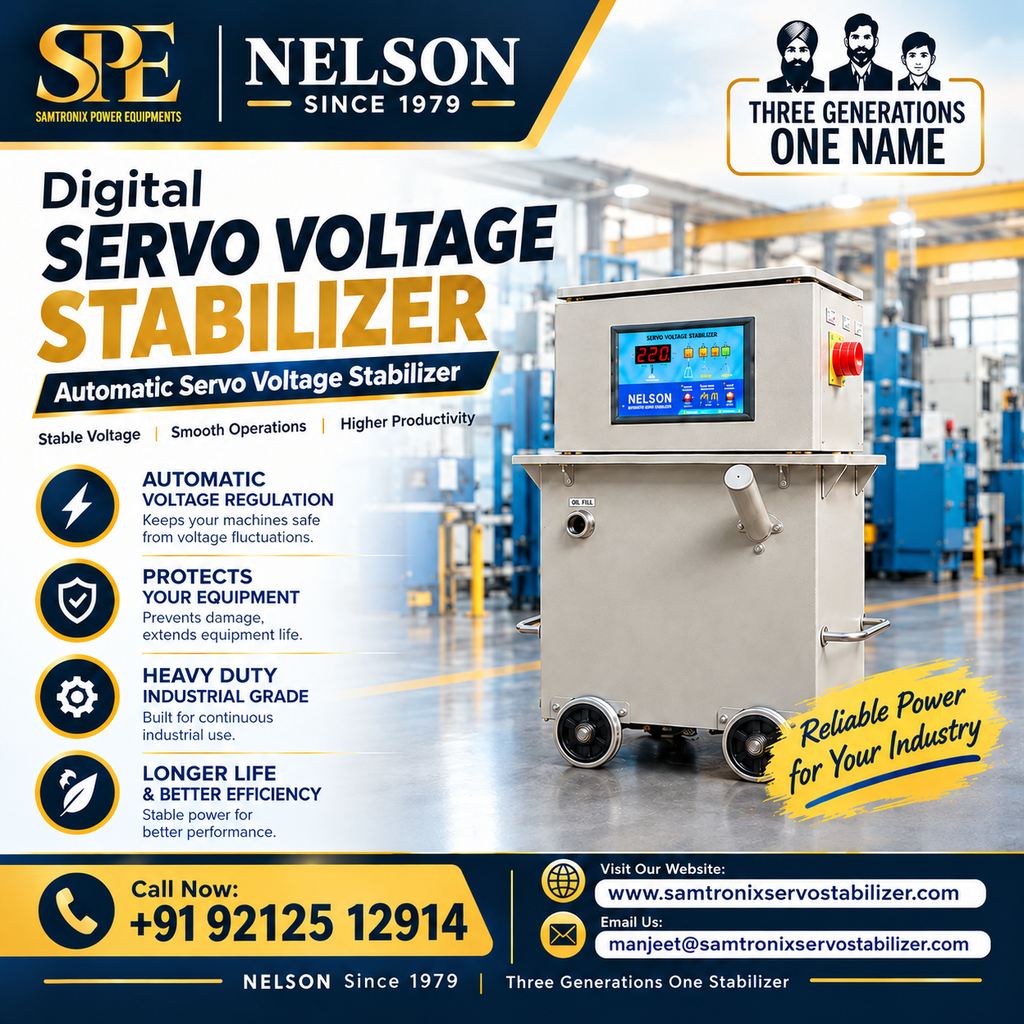
Many manufacturing facilities use three-phase electrical supplies for motors, CNC machines, compressors, industrial pumps and production lines. These applications may require an industrial three phase voltage stabilizer designed for the facility’s electrical load and input voltage conditions.
A 3 phase servo stabilizer regulates voltage across a three-phase supply using a common control arrangement or individual phase regulation, depending on its design. A Digital Servo Voltage Stabilizer Manufacturer in Haryana can help identify the right configuration for your equipment and voltage conditions.
Heavy loads require careful selection because motors draw higher current during startup. When several machines start together, the temporary demand may exceed their normal running load, making proper capacity assessment essential.
For example, a factory operating a 15 kW motor, a 7.5 kW compressor and smaller machines must consider starting current, power factor and simultaneous operation, not just the combined motor ratings.
A suitable voltage stabilizer for heavy machinery helps maintain voltage within its specified range when correctly sized. Proper cabling, ventilation, protective devices and commissioning are equally important for reliable operation. A Digital Servo Voltage Stabilizer Manufacturer in Haryana can help assess these requirements.
Servo Stabilizer for CNC Machine Applications
CNC machines rely on electronic controls, servo drives, motors and other sensitive components. Depending on the machine design, voltage variations may contribute to drive faults, control alarms, unexpected shutdowns or interruptions during machining.
A servo stabilizer for CNC machine applications should match the machine’s electrical specifications. A Digital Servo Voltage Stabilizer Manufacturer in Haryana can help identify suitable options for CNC routers, turning centres and machining centres based on their voltage requirements.
Before selecting a servo voltage stabilizer for CNC machines, check the input voltage, permissible voltage variation, phase configuration and full-load current. Also consider spindle drives, coolant pumps, hydraulic systems and other connected equipment.
If a CNC machine displays a voltage-related alarm, record the error code and measure the incoming voltage during normal operation and startup. This helps identify whether the problem comes from the power supply, internal drive, wiring or another component.
A Digital Servo Voltage Stabilizer Manufacturer in Haryana can assess these details to help determine the required stabilizer capacity and configuration for your CNC machine.
A Digital Servo Voltage Stabilizer Manufacturer in Haryana should receive these details before suggesting a model for a CNC installation. Stabilizer selection should also account for the machine’s peak demand and the possibility of future equipment additions.
Oil Cooled Stabilizer for Industrial Loads
Cooling arrangement is another important consideration for industrial installations. An oil cooled stabilizer for industrial loads uses insulating oil to assist with heat transfer and cooling in the components designed for that arrangement. Such equipment may be considered for applications where the rated capacity, duty cycle and installation environment support an oil-cooled design.
Oil-cooled stabilizers are suitable for certain industrial applications involving substantial electrical loads. A Digital Servo Voltage Stabilizer Manufacturer in Haryana can help identify a suitable model based on capacity, operating temperature, installation location and maintenance requirements.
Before installation, check the required clearances, ventilation, oil inspection requirements and site safety conditions. Oil levels and condition should be checked according to the manufacturer’s maintenance instructions.
Not every heavy-duty application requires oil cooling. The right configuration depends on the stabilizer’s design and operating conditions. A Digital Servo Voltage Stabilizer Manufacturer in Haryana can assess your ambient temperature, daily running hours and load requirements to help determine a suitable solution.
Digital Servo Voltage Stabilizer for Manufacturing Industry
A servo stabilizer for manufacturing industry applications may be used in engineering workshops, packaging units, plastic processing facilities, printing operations, textile units and other production environments. Each industry has a different combination of motors, heating elements, electronic controls and auxiliary systems.
For instance, a plastic processing unit may operate heaters, hydraulic motors and control electronics. An engineering workshop may use welding equipment, compressors and machining tools. A packaging facility may depend on conveyor motors, sensors and automated control systems.
A stabilizer should be selected according to the combined electrical requirements of the equipment, not just the industry type. Machines with high starting currents or nonlinear electronic loads may need additional assessment. A Digital Servo Voltage Stabilizer Manufacturer in Haryana can help determine the suitable configuration.
A voltage stabilizer for factory applications should be installed at the correct point in the electrical distribution system. Depending on the plant layout, it may support one machine, several machines or an entire production section, based on load distribution and operational requirements.
Samtronix Power Equipments helps customers assess their industrial voltage regulation needs. Sharing accurate machine specifications and load details helps identify a suitable stabilizer for the intended application.
Important Technical Specifications Before Ordering
Customers should review several specifications before confirming a servo voltage stabilizer. These details help establish whether the equipment is compatible with the electrical supply and connected machines.
| Specification | What the customer should confirm |
|---|---|
| Rated capacity | Required kVA based on actual load calculations |
| Supply configuration | Single-phase or three-phase |
| Input voltage range | Minimum and maximum incoming voltage |
| Output voltage | Required regulated voltage |
| Output tolerance | Permitted variation for connected equipment |
| Frequency | Compatibility with the available electrical supply |
| Load characteristics | Motors, drives, electronics and starting currents |
| Cooling arrangement | Air-cooled or oil-cooled design, as appropriate |
| Protection | Available overload, short-circuit and other specified protections |
| Installation | Indoor or outdoor conditions and required clearances |
For a three-phase installation, engineers may also need to examine phase imbalance and neutral requirements, depending on the system design. If the facility experiences frequent voltage drops during motor startup, voltage measurements should be taken during those events instead of relying only on readings when the factory is idle.
A Digital Servo Voltage Stabilizer Manufacturer in Haryana can use these details to understand the operating conditions and help identify a suitable configuration. The final model and ratings should always be confirmed from the equipment specification and site assessment.
Servo Stabilizer Manufacturers: Installation and Maintenance
Correct installation is necessary for reliable operation. Even a well-selected stabilizer can experience problems if the cables are undersized, connections are loose, airflow is restricted or the earthing system is inadequate.
Before commissioning, the installer should check the input and output connections, phase sequence, protective devices and earthing. A Digital Servo Voltage Stabilizer Manufacturer in Haryana can help customers understand the installation requirements and verify that the equipment operates within its specified limits.
Routine maintenance should follow the manufacturer’s instructions. This may include tightening terminals, inspecting electrical connections, cleaning air passages and checking for unusual noise or overheating.
Oil-cooled models also require checks for oil levels, leakage and oil condition. These inspections should be performed by qualified personnel according to the recommended procedure.
If the stabilizer trips repeatedly, never bypass its protection devices. Record the displayed voltage, load conditions and fault timing, then arrange a qualified inspection. A Digital Servo Voltage Stabilizer Manufacturer in Haryana can help identify whether the issue involves overloading, unstable input voltage, faulty wiring or an internal component.
Businesses evaluating servo stabilizer manufacturers in Delhi or Haryana should ask for the technical datasheet, installation requirements, applicable warranty details and maintenance guidance. These documents help the purchasing team plan installation and operation properly.
Understanding 5 kVA Servo Stabilizer Requirements
A 5 kVA servo stabilizer may suit certain small electrical loads, but it is not automatically suitable for every machine rated below 5 kW. kVA and kW measure different aspects of electrical load, and the usable capacity depends on power factor and other operating characteristics.
Customers searching for a 5kVA servo stabilizer should first check their actual load and input voltage conditions. A small motor-driven machine may draw higher starting current than its normal running current. A 5 kVA stabilizer operating at a power factor of 0.8 corresponds to approximately 4 kW of real power, but the permitted load must be verified against the stabilizer’s ratings and operating conditions.
For installations with several devices, list their rated power, voltage, current and expected simultaneous usage. Do not simply add the wattage and assume that the result gives the final stabilizer size. A qualified electrician can calculate the appropriate capacity and protective device ratings.
Finding a Suitable Servo Voltage Stabilizer Manufacturer in Haryana
When selecting a supplier, industrial buyers should focus on technical suitability, clear communication and the availability of correct product documentation. The manufacturer’s ability to understand the application is especially important when the installation includes heavy motors, CNC machines or multiple production lines.
Samtronix Power Equipments welcomes enquiries from factories, workshops, production units and commercial facilities looking for voltage regulation equipment. Customers can share their required kVA capacity, input voltage range, phase configuration and machine details so the requirements can be assessed more accurately.
As a Digital Servo Voltage Stabilizer Manufacturer in Haryana search result, your product page or article should clearly explain the intended applications, available configurations and technical information. Customers should not have to guess whether a model is suitable for their load.
If your facility needs a servo voltage stabilizer, prepare a list of connected machines and note any existing voltage-related alarms or shutdowns. Include the available supply voltage, whether the load is single-phase or three-phase, and whether motors start together or separately. This information makes a technical enquiry more useful and helps the supplier understand your actual requirement.
For enquiries, contact Samtronix Power Equipments at +91 92125 12914 or email manjeet@samtronixservostabilizer.com. You can also visit www.samtronixservostabilizer.com to explore the available product information and request assistance for your industrial voltage stabilizer requirement.
FAQs | Digital Servo Voltage Stabilizer Manufacturer in Haryana
1. How do I size a stabilizer for several machines starting together?
Record the running current and starting characteristics of each machine, then calculate the maximum simultaneous demand with an electrical engineer. Do not size the stabilizer from running load alone.
2. Why does my CNC machine show a voltage alarm even when the display looks normal?
The voltage may dip briefly during spindle or motor startup. Use a suitable meter or power-quality logger to capture the voltage during the alarm and check the machine manufacturer’s permitted input range.
3. Can one servo stabilizer support an entire factory?
Yes, if its capacity, phase configuration and correction range suit the combined load. Large factories may need separate stabilizers for different production sections.
4. What information is needed to select a three-phase stabilizer?
Provide the rated kVA or current, input voltage range, required output voltage, load details and motor-starting conditions. Phase imbalance should also be checked where relevant.
5. When should an oil-cooled stabilizer be inspected?
Follow the manufacturer’s maintenance schedule and inspect for abnormal heating, leakage or changes in oil level. Any suspected internal issue should be checked by qualified personnel.
6. Is a 5 kVA stabilizer sufficient for a 5 kW machine?
Not necessarily. Power factor, starting current and the stabilizer’s continuous rating must be checked before deciding.
7. What should I do if the stabilizer trips repeatedly under heavy load?
Record the displayed voltage and load conditions, then arrange a qualified inspection. Do not repeatedly reset or bypass the protection without identifying the cause.
Connect with Samtronix on LinkedIn for Industrial Power Expertise.