
Understanding Manual Variable Dimmer and Its Industrial Uses
A Manual Variable Dimmer is an electrical device used to adjust output voltage according to the requirements of a machine or electrical application. It is useful in industrial workshops, testing laboratories, maintenance departments, and production units where controlled voltage is required. Operators can rotate the handwheel to change the contact position over the winding and adjust the output voltage gradually.
Samtronix Power Equipments provides electrical equipment solutions for industrial and commercial applications. As a Manual Variable Dimmer Manufacturer in Noida, we understand that customers need equipment that is practical to operate, durable in daily use, and suitable for their working requirements.
In many industrial environments, machines do not always need to operate at the same voltage during testing and adjustment. A variable dimmer helps the operator control the voltage according to the task. However, the required voltage range, current rating, connected load, and duty cycle must be checked before selecting a suitable unit.
What Is a Manual Variable Dimmer?
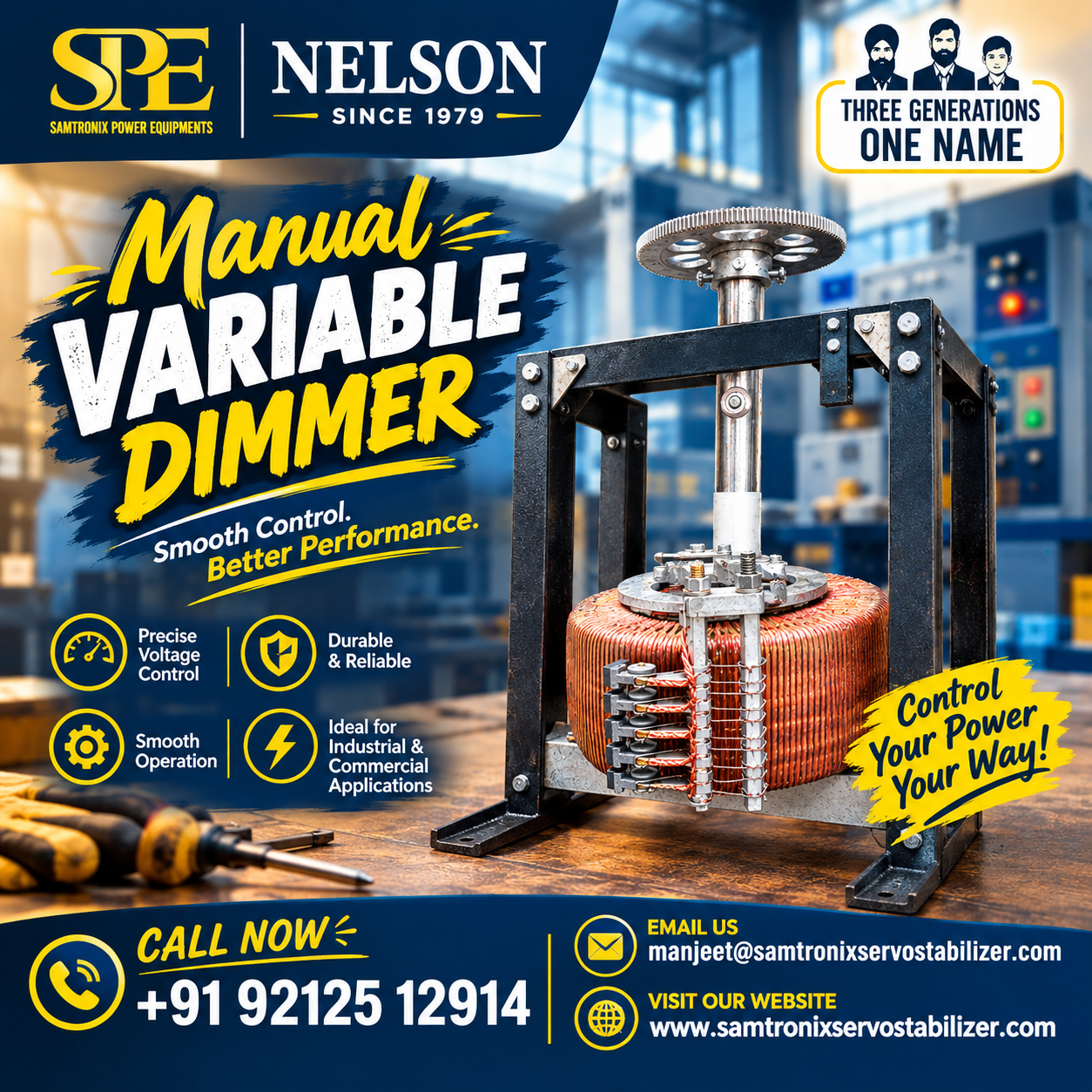
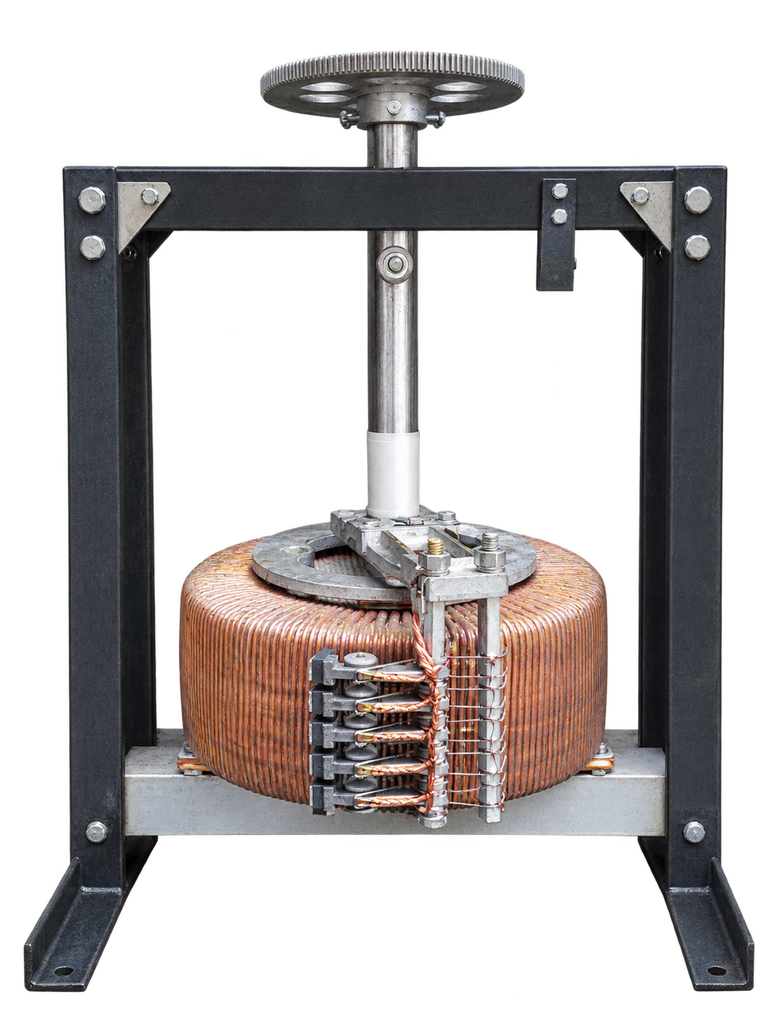
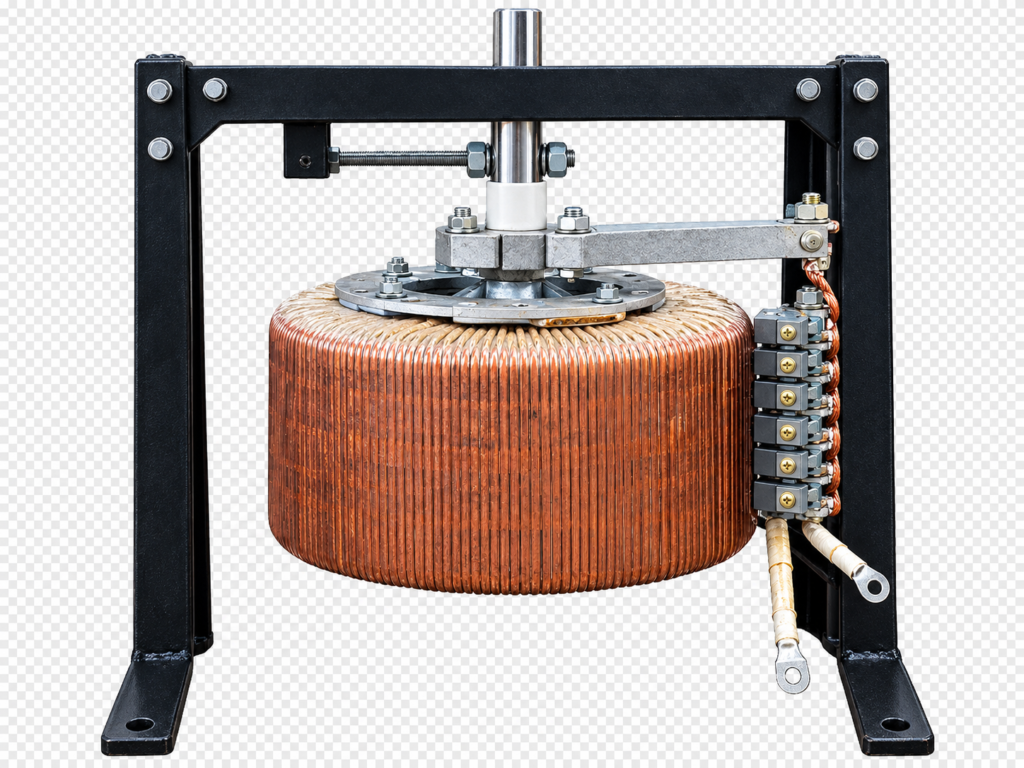
A manual variable dimmer, also known as a Variac or variable autotransformer, consists of a magnetic core, copper winding, movable carbon brush or contact assembly, shaft, and handwheel. When the operator turns the handwheel, the contact moves along the winding, changing the output voltage. As a Manual Variable Dimmer Manufacturer in Noida, Samtronix Power Equipments understands the importance of these components in voltage adjustment.
The machine shown in the product image has an exposed copper winding and a hand-operated adjustment mechanism. This type of construction allows the operator to adjust the output manually while the equipment is installed in a suitable electrical setup. A Manual Variable Dimmer Manufacturer in Noida can help customers identify equipment according to their application requirements.
A Manual Variable Dimmer is commonly used where smooth voltage adjustment is needed rather than a fixed output voltage. For example, an electrical testing technician may need to increase the voltage gradually from a low level to a specified test voltage. The operator can adjust the output while monitoring a suitable voltmeter. Choosing a Manual Variable Dimmer Manufacturer in Noida helps buyers discuss the required voltage range and technical specifications.
The actual voltage range depends on the design of the equipment. A dimmer should never be assumed to provide a particular voltage range or current capacity without checking its nameplate and technical specifications.
How Does a Manual Variable Dimmer Work?
The operating principle of a manual dimmer is straightforward. The input supply energises the winding, and the movable contact picks up voltage from a selected point on that winding. Moving the handwheel changes the contact position and therefore changes the output voltage. A Manual Variable Dimmer Manufacturer in Noida can help customers understand the operating mechanism and select suitable equipment.
Consider a laboratory setup that requires a gradual voltage increase for testing an electrical component. Instead of applying the full supply immediately, the operator can begin at a lower setting and increase the voltage in controlled steps. This process allows the technician to monitor the output and make adjustments according to the testing requirements.
As a Manual Variable Dimmer Manufacturer in Noida, Samtronix Power Equipments understands the importance of controlled voltage adjustment in industrial and laboratory applications. The following table shows an illustrative example of voltage adjustment. These figures explain the operating concept only; they are not the guaranteed output settings of every dimmer.
| Adjustment stage | Illustrative output | Typical purpose |
|---|---|---|
| Stage 1 | 50 V | Initial low-voltage testing |
| Stage 2 | 100 V | Intermediate testing |
| Stage 3 | 150 V | Further voltage adjustment |
| Stage 4 | 200 V | Higher-voltage testing |
| Stage 5 | 230 V | Testing near the rated supply level |
The permitted input and output ranges depend on the particular model. Operators should use appropriate measuring instruments and avoid exceeding the equipment’s rated current or voltage.
As a Manual Variable Dimmer Manufacturer in Noida, Samtronix Power Equipments recognises the importance of selecting a design according to the application rather than relying on appearance alone.
Important Components of a Manual Variable Dimmer
The performance of a manual dimmer depends on several mechanical and electrical components working together. Each part has a specific purpose, and a problem with one component can affect voltage regulation or safe operation.
| Component | Function |
|---|---|
| Copper winding | Provides the conductive path for voltage adjustment |
| Magnetic core | Supports the magnetic circuit |
| Carbon brush or contact | Transfers electrical contact from the winding |
| Handwheel | Allows the operator to adjust the output manually |
| Shaft assembly | Transfers handwheel movement to the contact mechanism |
| Metal frame | Supports the equipment and its moving parts |
| Terminals | Provide input and output electrical connections |
| Insulation | Helps prevent unintended electrical contact |
The contact assembly needs particular attention because it moves across the winding during operation. Dust, excessive wear, poor contact pressure, or damaged winding surfaces may cause unstable output or local heating.
Routine inspection helps identify these problems before they interrupt work. Any internal inspection or repair should be carried out by a qualified electrical technician after the supply has been isolated.
Applications of Manual Variable Dimmer in Industrial Work
A Manual Variable Dimmer is useful in applications where the operator needs direct control over voltage. The exact suitability depends on the electrical characteristics of the connected equipment and the required adjustment range.
Electrical Testing Laboratories: Testing laboratories may need to increase or decrease voltage while examining electrical components. A manual dimmer can support controlled voltage application during suitable tests, provided the test arrangement includes the necessary meters, protection, and isolation where required.
For instance, when checking the response of a component at several voltage levels, the technician can adjust the handwheel and record the readings at each stage.
Industrial Maintenance Departments: Maintenance teams sometimes need adjustable voltage for troubleshooting, equipment testing, or specific repair procedures. A variable dimmer can be useful when the task calls for manual voltage adjustment and the connected load is compatible with its electrical rating.
The technician should confirm whether the application requires an isolated output, because an ordinary autotransformer does not provide electrical isolation between input and output.
Manufacturing and Production Units: Certain production processes require a controlled electrical supply during testing or calibration. A suitable dimmer can help the operator make gradual adjustments instead of repeatedly switching between fixed voltage settings.
In a busy workshop, the unit should be installed where the operator can reach the handwheel safely and read the output meter clearly. Proper mounting also reduces unwanted movement during adjustment.
Educational and Research Institutions: Electrical training facilities use variable voltage equipment to demonstrate electrical principles and perform controlled experiments. A manual unit allows students and technicians to observe how changing the contact position affects output voltage.
Protective covers, proper earthing, suitable fusing, and supervision are important, especially in training environments.
Selecting the Correct Manual Variable Dimmer
Choosing the correct unit requires more than knowing the input supply voltage. The connected equipment’s current demand, operating duration, and type of load can affect the selection.
A Manual Variable Dimmer Manufacturer in Noida should understand the intended application before recommending a suitable specification. Buyers should provide accurate electrical details to avoid selecting an undersized or unsuitable unit.
| Selection factor | What needs to be checked |
|---|---|
| Input voltage | Confirm the available supply, such as 230 V single-phase |
| Output voltage | Identify the minimum and maximum voltage required |
| Current rating | Check the maximum continuous load current |
| Load type | Identify whether the load is resistive, inductive, or electronic |
| Duty cycle | Confirm whether operation is occasional or continuous |
| Mounting | Check available bench or floor space |
| Protection | Identify earthing, fusing, guarding, and other safety requirements |
| Metering | Determine whether an output voltmeter and ammeter are required |
For example, a 10 A load at 230 V requires approximately 2.3 kVA in a single-phase system. A Manual Variable Dimmer Manufacturer in Noida can help identify suitable specifications based on the load, power factor, and starting current.
Heavy loads require careful selection. The winding, contacts, terminals, wiring, and protection must support the required current. Consult a Manual Variable Dimmer Manufacturer in Noida to confirm suitability for your application.
Manual Variable Dimmer and Servo Voltage Stabilizer Systems
A manual dimmer and a servo voltage stabilizer are related to voltage control, but their functions are not identical. A manual unit depends on an operator turning the handwheel. A servo stabilizer uses a control system and motorised mechanism to correct voltage variations automatically.
A servo voltage stabilizer is used in industrial installations where supply voltage fluctuates. The required capacity depends on the connected load and starting current. A Manual Variable Dimmer Manufacturer in Noida can help customers understand suitable voltage control solutions.
In a typical servo stabilizer, a dimmer mechanism works with a motor and control circuit to correct voltage automatically. Unlike a standalone manual dimmer, the mechanism adjusts according to the control system’s signals.
The servo stabilizer dimmer mechanism varies by design and rating. Samtronix Power Equipments can help customers understand their equipment requirements when choosing a Manual Variable Dimmer Manufacturer in Noida.
Linear and Dimmer Technology in Servo Stabilizer
The phrase linear and dimmer technology in a servo stabilizer may refer to different voltage-adjustment arrangements. Buyers should confirm the actual construction, control mechanism, and performance specifications. A Manual Variable Dimmer Manufacturer in Noida can help customers understand the required voltage control setup.
The correction range, response time, output accuracy, and load characteristics should be checked before selecting a servo stabilizer for industrial machinery. A dimmer type servo stabilizer may use a variable autotransformer mechanism to adjust voltage automatically. The motor moves the contact assembly according to the control circuit’s instructions, helping maintain the required output voltage. Samtronix Power Equipments, a Manual Variable Dimmer Manufacturer in Noida, can help customers discuss their application requirements.
Manual Dimmer and Heavy Electrical Loads
Heavy loads can create problems when the electrical equipment is not selected correctly. Motors, compressors, pumps, heating systems, and industrial machines may draw different amounts of current during starting and normal operation.
A Manual Variable Dimmer must be rated for the actual application. A load operating at 230 V may still draw excessive current during startup or under abnormal conditions. A Manual Variable Dimmer Manufacturer in Noida can help buyers understand the required specifications, but voltage adjustment should never replace proper load protection.
Before connecting heavy loads, check the rated current, maximum output, winding temperature limits, and operating duty. If the load contains a motor or electronic power supply, confirm that the equipment is suitable for that load type. Consulting a Manual Variable Dimmer Manufacturer in Noida helps clarify these requirements.
A dimmer is not automatically a voltage stabilizer. If the incoming supply changes while the handwheel remains in the same position, the output may change too. Automatic correction requires an appropriate control system. Samtronix Power Equipments, a Manual Variable Dimmer Manufacturer in Noida, encourages buyers to share their machine details before selecting equipment for demanding industrial applications.
Dimmer Mechanism in 125 KVA and 150 KVA Servo Stabilizers
Large servo stabilizers may use motorised dimmer assemblies as part of their voltage regulation mechanism. Their construction and motor requirements depend on the stabilizer design, correction range, and mechanical arrangement.
A dimmer motor for a 150 KVA servo stabilizer must match the original assembly’s shaft dimensions, mounting points, voltage rating, and operating requirements. The same applies to a dimmer motor for a 125 KVA servo stabilizer, where compatibility is essential for proper operation.
A replacement motor should not be selected by KVA rating alone. Stabilizers with the same capacity may use different motor assemblies, control circuits, and mounting arrangements. Buyers should consult a Manual Variable Dimmer Manufacturer in Noida to clarify their equipment requirements.
The phrase dimmer motor for servo stabilizer motor for servo stabilizer is often used when searching for replacement parts. Technicians should check the stabilizer nameplate, motor details, shaft dimensions, and control connections before ordering.
Searches for dimmer motor for servo stabilizer for 125 kva stabilizer price may indicate a need for a compatible replacement. The original motor specifications and stabilizer model are essential for correct selection.
Buyers searching for a servo stabilizer dimmer motor in hyd or other locations should share the required specifications with the supplier. A Manual Variable Dimmer Manufacturer in Noida can also help clarify the application requirements and reduce the risk of selecting an incompatible motor.
Servo Stabilizer Dimmer Stages and Voltage Correction
The phrase servo stabilizer dimmer stades is sometimes used to search for the operating stages of a stabilizer’s dimmer mechanism. In an automatic system, the voltage-sensing circuit detects an output deviation and sends a control signal to the motor.
The motor then moves the variable-voltage mechanism in the required direction. The control system continues monitoring the output and adjusts the position until the voltage reaches the required range, subject to the stabilizer’s design and response limits.
The number of control steps or the way the mechanism moves depends on the design. It should not be assumed that every servo stabilizer uses the same number of stages or follows an identical operating sequence.
Correct calibration, healthy electrical contacts, and suitable motor operation are important. If the output remains unstable, the issue may involve the sensing circuit, control wiring, motor, contact assembly, or connected load. A qualified technician should inspect the complete system rather than replacing parts without diagnosis.
Maintenance Tips for Manual Variable Dimmer
Regular inspection helps reduce unexpected interruptions and supports consistent operation. The required maintenance interval depends on the working environment, frequency of adjustment, load, and manufacturer’s instructions.
The winding should be checked for visible damage, contamination, or signs of overheating. The contact assembly should move smoothly without sticking or unusual vibration. Loose terminals and damaged insulation need immediate attention.
Dust and metal particles can affect the contact surface, particularly in workshops where grinding, machining, or fabrication takes place. Cleaning should only be performed after the equipment is disconnected and made safe for maintenance.
If the output fluctuates unexpectedly, check the measuring instrument and connected wiring before assuming the dimmer itself is faulty. A worn contact or loose connection can also cause unstable readings.
Operators should avoid forcing the handwheel when the mechanism becomes difficult to move. Excessive force can damage the shaft, contact assembly, or winding surface. Internal servicing should be left to a qualified technician.
Why Choose Samtronix Power Equipments?
Samtronix Power Equipments works with electrical equipment requirements for industrial and commercial applications. Customers looking for a Manual Variable Dimmer Manufacturer in Noida can discuss their intended use, electrical specifications, mounting requirements, and operational needs before selecting a suitable unit.
Our focus is on helping buyers identify equipment that fits the actual application. This includes understanding whether a customer needs a standalone manual dimmer, a component for a servo stabilizer, or an automatic voltage correction solution for industrial machinery.
When requesting information, customers should share the input voltage, required output range, current rating, load type, and expected operating hours. Photographs of the existing equipment and its nameplate can also help clarify the requirement.
Businesses searching for servo stabilizer manufacturers, servo stabilizer manufacturers in Delhi, or a servo voltage stabilizer manufacturer should confirm the required capacity and operating conditions before finalising their equipment specification. The same principle applies to buyers looking for a variac/dimmer type servo stabilizer manufacturer.
For enquiries about a Manual Variable Dimmer, contact Samtronix Power Equipments to discuss the application and identify the appropriate technical requirements.
FAQs | Manual Variable Dimmer Manufacturer in Noida
1. What is a Manual Variable Dimmer used for?
It is used to adjust output voltage manually for suitable electrical testing, laboratory work, and industrial applications.
2. Can a manual dimmer operate heavy loads?
Only when its current rating, winding, terminals, and duty cycle are suitable for the connected load.
3. Does a manual dimmer provide automatic voltage correction?
No. Automatic correction requires a suitable control system, such as the one used in a servo voltage stabilizer.
4. Can a manual dimmer be used for motor testing?
It may be suitable for specific tests, but motor starting current and load compatibility must be checked first.
5. Why does a dimmer produce unstable output?
Possible causes include worn contacts, loose connections, damaged winding surfaces, or unstable input voltage.
6. How do I select a dimmer motor for a servo stabilizer?
Check the original motor rating, shaft dimensions, mounting arrangement, control connections, and stabilizer model.
7. What details should I share when requesting a dimmer?
Provide the input voltage, required output range, current rating, load type, and intended application.
Connect with Samtronix on LinkedIn for Industrial Power Expertise.