
Voltage fluctuation is one of those problems that may look small at first, but it can create serious trouble when sensitive electrical equipment runs for many hours continuously. A sudden increase or drop in voltage can affect motors, control panels, electronic circuits, CNC systems and production machines. A properly selected Single Phase Voltage Stabilizer helps maintain a more controlled output voltage so connected equipment can operate with greater stability.
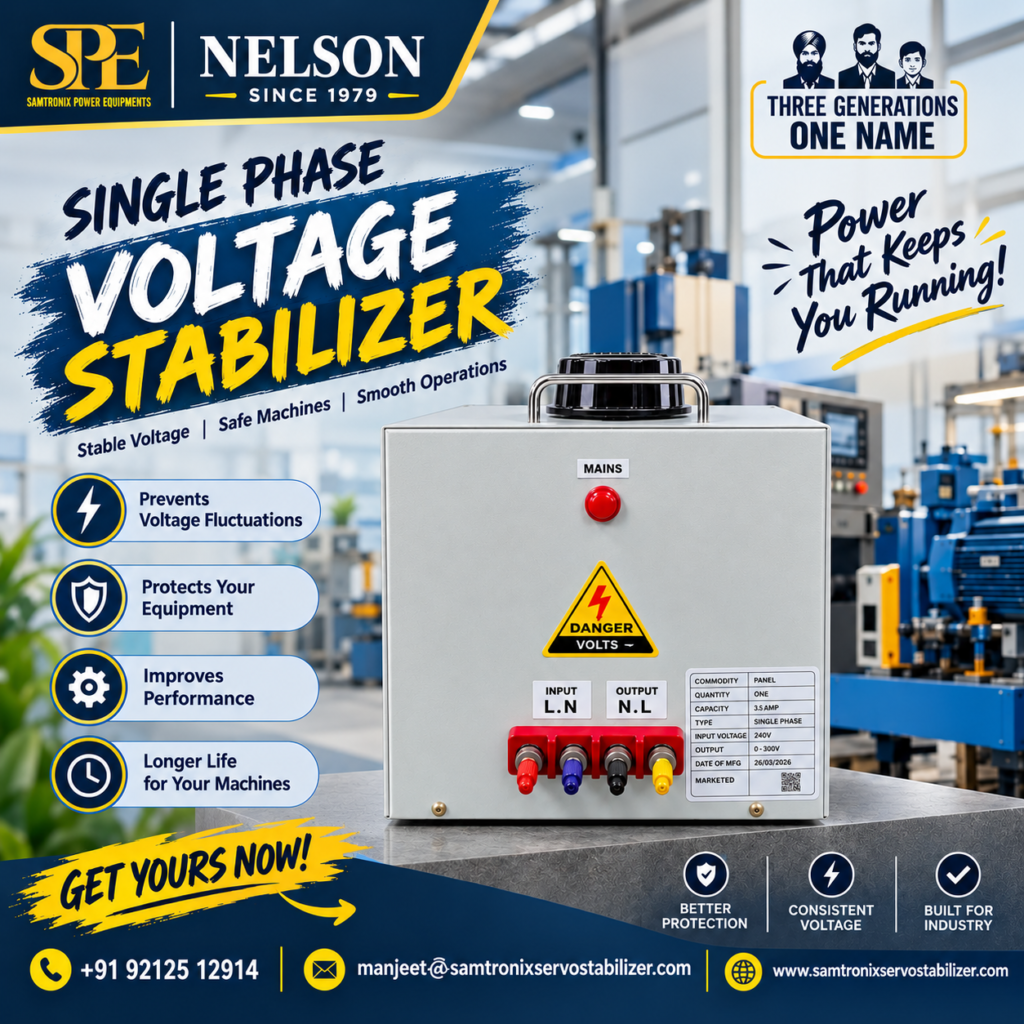
Samtronix Power Equipments provides voltage stabilizing solutions for different industrial and commercial requirements where inconsistent power supply is creating operational problems. The right stabilizer depends on the connected load, input voltage range, required output, starting current and application. This is important because simply selecting a stabilizer based on the machine’s nameplate capacity may not always give the expected protection.

What Is a Single Phase Voltage Stabilizer?
A Single Phase Voltage Stabilizer is an electrical device designed to regulate fluctuating input voltage and provide a more stable output to connected equipment. When the incoming voltage moves above or below the desired level, the stabilizer adjusts the output within its designed operating range.
For example, suppose a machine requires approximately 230 V and the incoming supply keeps moving between 180 V and 250 V. Such variation can create stress on electrical components. A properly designed Single Phase Voltage Stabilizer can sense the variation and regulate the supply according to its working range.
This becomes more important in areas where voltage fluctuation happens regularly during peak load hours. Industrial machines may continue running for 8, 10 or even 12 hours a day, so repeated voltage variation should not be ignored.
| Parameter | Typical consideration |
|---|---|
| Supply type | Single phase |
| Common nominal output | 220–240 V |
| Input variation | Depends on stabilizer design |
| Application | Machines, equipment, electronics and commercial loads |
| Capacity selection | Based on connected and starting load |
| Protection | Depends on model and configuration |
| Control technology | Relay, servo or other designed control systems |
The exact input and output range should always be selected according to the actual site requirement rather than assuming that every Single Phase Voltage Stabilizer works over the same voltage range.
Why Voltage Fluctuation Creates Problems
Electrical equipment does not always respond well to unstable voltage. Low voltage can cause motors to draw higher current in some operating conditions, while excessive voltage can place additional stress on electrical and electronic components. Repeated fluctuation may also cause unexpected machine trips.
For a factory running several machines, even a short interruption can affect production. If a machine stops in the middle of a process, the operator may need to reset the system, inspect the control panel and restart the operation. This takes time and sometimes affects material as well.
A Single Phase Voltage Stabilizer is therefore used where maintaining a controlled supply is important for reliable machine operation. It can be particularly useful for equipment having sensitive control circuits or equipment where voltage stability directly affects performance.
Single Phase Voltage Stabilizer for Industrial Machines
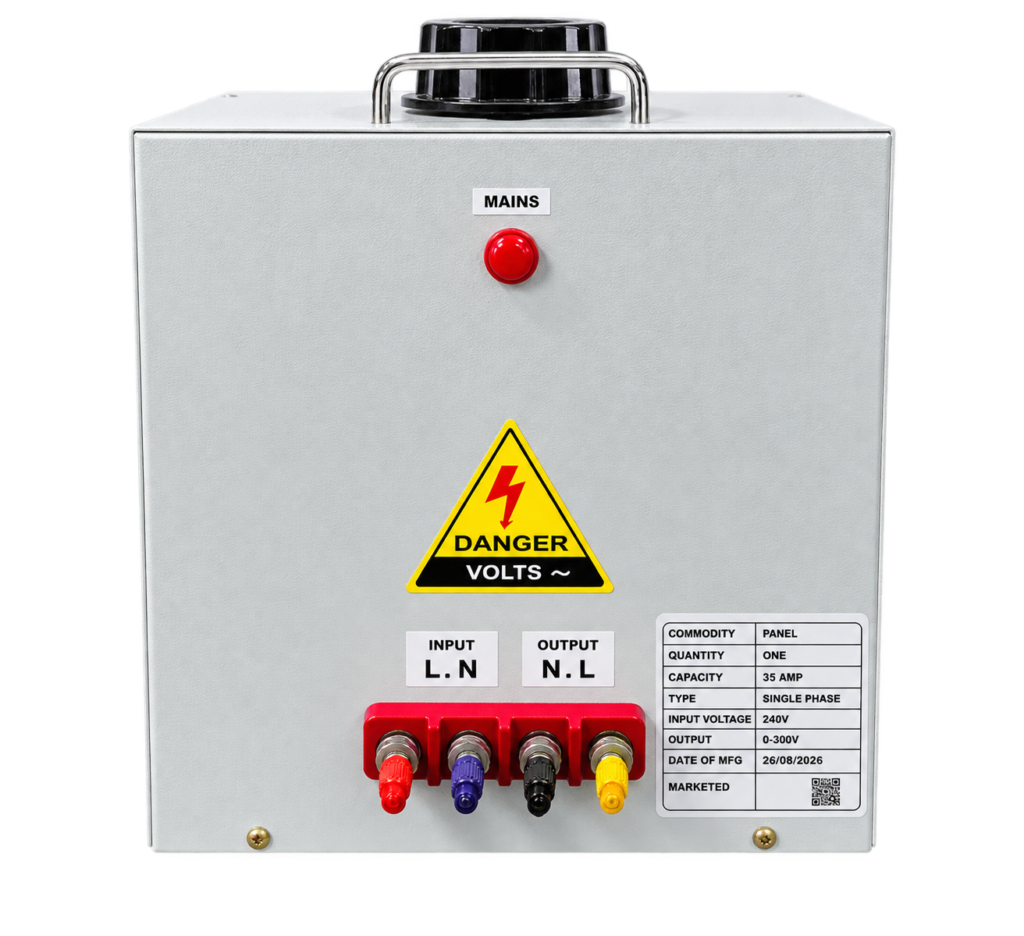
Industrial machines often have different electrical requirements. Some equipment may have electronic controllers while other machines may contain motors, heaters, transformers or a combination of electrical loads.
A servo voltage stabilizer is commonly considered when accurate voltage correction is required. A servo stabilizer uses a motor-driven correction mechanism to regulate voltage, making it suitable for applications where controlled voltage output is important.
A servo controlled voltage stabilizer can be designed for different capacities and applications. The selection depends on the input voltage range, output requirement, connected load and machine characteristics.
For a machine with a rated load of 5 kVA, for example, the stabilizer should not automatically be selected only because the nameplate says 5 kVA. Starting current, power factor, duty cycle and future load requirements should also be checked. This small calculation can prevent an undersized stabilizer from becoming an operational headache later.
Understanding KVA Before Selecting the Stabilizer
KVA is one of the most important values when selecting a stabilizer. It represents apparent power and is commonly used for sizing electrical equipment.
Suppose a machine has a load of 4 kW and operates at a power factor of 0.8. The approximate apparent power can be calculated as:
| Calculation | Approximate value |
|---|---|
| Load | 4 kW |
| Power factor | 0.8 |
| Approximate KVA | 5 kVA |
This does not mean that a 5 kVA stabilizer is automatically the correct selection. If the machine has a motor with a high starting current, additional capacity may be required.
This is why customers searching for a 5 kva servo stabilizer should provide the actual machine details before finalizing the equipment. The same applies when someone searches for 5kva price servo stabilizer or servo stabilizer price online. The technical requirement should come first because the capacity, input range, cooling method and protection configuration can change the specification.
Servo Voltage Stabilizer for CNC Machines
CNC machines can be sensitive to unstable electrical supply because they may contain controllers, drives, sensors, motors and other electronic systems.
A servo voltage stabilizer for CNC machine applications is generally selected where consistent voltage is important for machine operation. Voltage fluctuation may cause unwanted alarms, drive problems, control interruptions or unexpected shutdowns depending on the machine and its electrical design.
A servo voltage stabilizer for CNC machines should be selected after checking the CNC machine’s input voltage, phase requirement, total KVA, starting characteristics and recommended supply conditions.
For example, a CNC machine operating around 10 kVA should not be evaluated only by looking at its running consumption. The electrical engineer should also check peak current and the connected auxiliary equipment. A correct sizing approach gives the stabilizer enough working capacity without unnecessarily stressing its components.
Servo Stabilizer for Manufacturing Industry

Manufacturing facilities may operate several machines simultaneously. Presses, cutting equipment, CNC machines, packaging systems, compressors and control panels can all place different types of demand on the electrical system.
A servo stabilizer for manufacturing industry applications can help regulate supply voltage where fluctuations are affecting machine operation. In a production environment, stable voltage can be particularly important because machine downtime has a direct effect on productivity.
Samtronix Power Equipments works with industrial requirements where customers need stabilizing solutions for machinery and production equipment. A suitable Single Phase Voltage Stabilizer can be configured according to the actual application instead of using a one-size-fits-all approach.
When a Three Phase Stabilizer Is Required
Not every industrial application requires a single-phase system. Larger machinery and industrial plants often operate on three-phase power.
A 3 phase servo stabilizer is designed for three-phase applications and can be used where the connected machinery requires three-phase regulated supply. Customers searching for an industrial voltage stabilizer three phase, industrial three phase voltage stabilizer or 3 phase servo stabilizer should first confirm the electrical configuration of the equipment.
The distinction is important because a single-phase supply and three-phase supply have different electrical requirements. If a factory has several heavy machines connected across a three-phase network, an industrial three phase voltage stabilizer may be more suitable for that particular installation.
| Application | Typical requirement |
|---|---|
| Small single-phase machine | Single-phase stabilizing system |
| CNC machine | Capacity based on machine and auxiliary load |
| Manufacturing equipment | Single or three phase depending on supply |
| Multiple heavy machines | Often requires three-phase evaluation |
| Factory distribution | Three-phase system may be considered |
Voltage Stabilizer for Factory Applications
Factories can experience voltage changes due to heavy electrical loads switching ON and OFF. Large motors, compressors, welding equipment and other machinery can influence the electrical supply.
A voltage stabilizer for factory applications should therefore be selected after understanding the actual incoming voltage pattern. If the input falls significantly during certain hours, the stabilizer needs an appropriate correction range.
For example, if the measured supply varies between 170 V and 250 V, a stabilizer designed for a much narrower range may not provide the required performance. Taking voltage readings during different operating conditions is a better approach.
A Single Phase Voltage Stabilizer can be useful for dedicated single-phase equipment, while larger production systems may require a properly engineered three-phase arrangement.
Voltage Stabilizer for Heavy Machinery
Heavy machinery can create demanding electrical conditions because motors and other inductive loads may draw substantial current during starting.
A voltage stabilizer for heavy machinery must therefore be selected with attention to starting current and not only continuous running load. A machine rated at 15 kVA, for example, can behave differently from a purely resistive 15 kVA load.
This is where technical assessment becomes valuable. The stabilizer capacity, correction range, response characteristics, protection system and cooling arrangement should match the machine.
For larger industrial applications, an oil cooled stabilizer for industrial loads may also be considered where the required configuration and operating conditions make oil cooling appropriate.
Oil Cooled Stabilizer for Industrial Loads
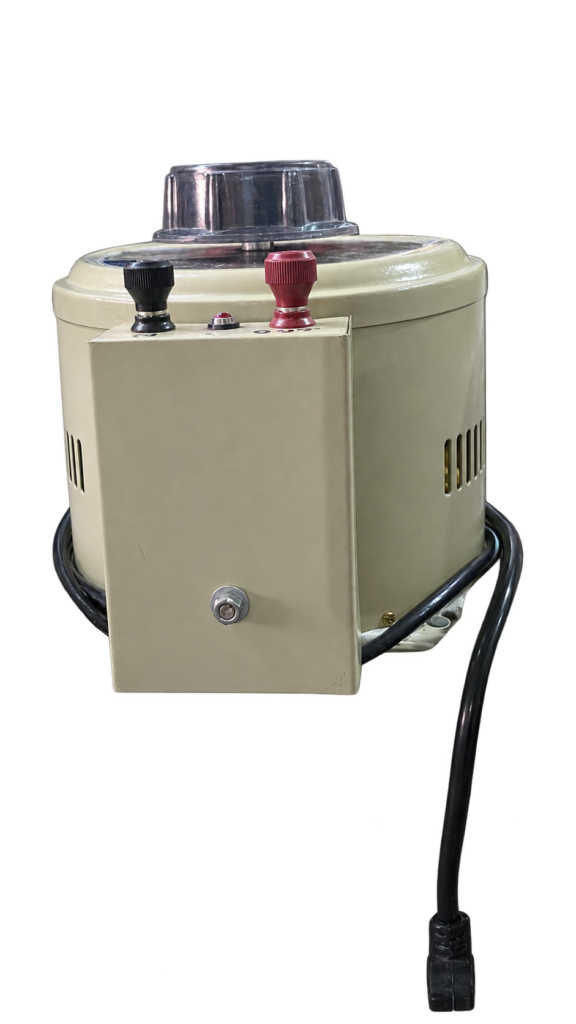
Industrial environments can require stabilizers capable of operating continuously under demanding conditions. An oil cooled stabilizer for industrial loads uses oil as part of its cooling arrangement and can be suitable for certain higher-capacity industrial applications.
Cooling requirements depend on capacity, operating hours, ambient temperature and installation conditions. A stabilizer running continuously in a warm industrial room needs adequate heat management.
Samtronix Power Equipments can provide stabilizing solutions based on the application, load and required configuration. Customers should share machine details and input voltage conditions so the appropriate specification can be identified.
Servo Stabilizer Manufacturers and Technical Selection
Customers often search for servo stabilizer manufacturers when they are looking for a reliable source for industrial voltage regulation equipment. Searches such as servo stabilizer manufacturers in Delhi, servo voltage stabilizer manufacturer and servo stabilizer manufacturers generally indicate a commercial buying requirement.
For industrial applications, the manufacturer should be able to understand the customer’s electrical requirement rather than simply supplying a standard capacity.
Samtronix Power Equipments focuses on voltage stabilizing requirements for machinery, factories and industrial applications. The selection process should consider input voltage, output voltage, phase, KVA capacity, load type and operating conditions.
Why Machine Load Information Matters
One of the most common mistakes is selecting a stabilizer only from the machine’s stated KVA. Real operating conditions can be different.
A motor-driven machine may have a starting current several times higher than its normal running current. Similarly, a CNC system may include auxiliary devices that increase the total connected load.
The following information can make the selection much easier:
| Required information | Why it matters |
|---|---|
| Machine KVA or KW | Helps determine capacity |
| Input voltage | Determines correction requirement |
| Phase | Establishes single or three phase design |
| Starting current | Important for motor loads |
| Power factor | Helps calculate apparent power |
| Operating hours | Helps evaluate thermal requirements |
| Machine type | Determines application-specific needs |
Providing these details before ordering a Single Phase Voltage Stabilizer can reduce the chance of selecting an unsuitable capacity.
Single Phase Voltage Stabilizer for Continuous Operation
Some equipment operates only for short periods, while industrial machinery may operate continuously for 8 to 16 hours. Continuous operation places greater importance on correct capacity and thermal management.
If a stabilizer is operated close to its maximum capacity for long periods, heat generation and component stress can increase. Selecting an appropriate capacity provides a more practical operating margin.
For example, if the calculated load is approximately 7.5 kVA, the final stabilizer selection should consider starting load and operating conditions instead of simply choosing the smallest available rating.
This approach is especially useful for factories where production cannot stop frequently for electrical troubleshooting.
Servo Stabilizer for Industrial Machines
A servo stabilizer for industrial machines is generally used where voltage regulation is needed for equipment operating under varying supply conditions. Depending on the application, it can support machinery where stable electrical input is important for consistent operation.
A Single Phase Voltage Stabilizer can be specified for single-phase machinery, while three-phase machinery requires a suitable three-phase configuration.
Samtronix Power Equipments can help customers identify the suitable configuration based on machine capacity and site requirements. Customers can share the machine nameplate, input voltage readings and required capacity for technical discussion.
Installation and Site Requirements
Correct installation is as important as selecting the right stabilizer. The installation area should have adequate ventilation and sufficient space around the equipment for inspection and maintenance.
The cable size, protective devices, earthing arrangement and connection method should be selected according to the electrical load and applicable installation requirements.
Before commissioning, the input and output voltage should be checked under actual operating conditions. It is also useful to check the voltage while the connected machine starts because this can reveal voltage conditions that are not visible when the machine is idle.
Choosing the Right Single Phase Voltage Stabilizer
The right Single Phase Voltage Stabilizer should be selected from actual electrical data instead of only the product name. Input voltage variation, machine capacity, starting current, output requirement and operating duration all matter.
For a 5 kVA application, a 5 kva servo stabilizer may be suitable in one installation but not necessarily in another. A motor-driven machine and an electronic load can behave differently even when their rated KVA appears similar.
Customers looking for a servo stabilizer for industrial machines, voltage stabilizer for factory equipment or protection for heavy loads can contact Samtronix Power Equipments with their machine details.
FAQs | Single Phase Voltage Stabilizer
1. Why does my machine trip when voltage suddenly drops?
A sudden voltage drop can affect motors, drives and control circuits. A correctly sized Single Phase Voltage Stabilizer can regulate the incoming supply and help maintain a more stable output.
2. My machine works normally in the morning but stops during peak hours. Why?
Heavy electrical demand can cause supply voltage to fall during certain hours. Before selecting a Single Phase Voltage Stabilizer, record the input voltage during both normal and peak operating periods.
3. Can I use the same stabilizer if my machine load increases later?
It depends on the available capacity margin. If future expansion is expected, the Single Phase Voltage Stabilizer should be selected after considering the present load plus the planned additional equipment.
4. Why is my stabilizer getting hot during continuous machine operation?
High loading, poor ventilation, unsuitable capacity or demanding starting conditions can increase heat generation. Check the actual running current and ventilation before continuing operation.
5. My machine is rated 5 kVA, so should I buy a 5 kVA stabilizer?
Not automatically. Starting current, power factor and the type of load can change the actual stabilizer requirement. A Single Phase Voltage Stabilizer should be sized from the machine’s real electrical conditions.
6. Will a stabilizer solve repeated CNC machine alarms?
It may help when unstable voltage is contributing to the problem, but the alarm itself should first be diagnosed. Measure the incoming voltage and check the CNC manufacturer’s required supply range before selecting a Single Phase Voltage Stabilizer.
7. What if my voltage fluctuates between very low and very high levels?
A narrow-range stabilizer may not be suitable. Measure the minimum and maximum input voltage and select a Single Phase Voltage Stabilizer with an appropriate correction range for the site.
Connect with Samtronix on LinkedIn for Industrial Power Expertise.