
Modern industrial equipment depends on a stable electrical supply to operate accurately, efficiently, and continuously. In manufacturing plants, production facilities, commercial installations, workshops, processing units, and other power-intensive environments, voltage fluctuations can create problems that are not always immediately visible. Motors may heat up, control systems may malfunction, machines may stop unexpectedly, and sensitive electrical components can experience unnecessary stress.
A Three Phase Oil Cooled Servo Voltage Stabilizer is designed to address these voltage-related problems by automatically correcting fluctuations in the incoming three-phase power supply and maintaining a more consistent output voltage for connected equipment. The oil-cooled construction also makes this type of stabilizer suitable for applications where continuous operation, thermal management, and heavy-duty performance are important.
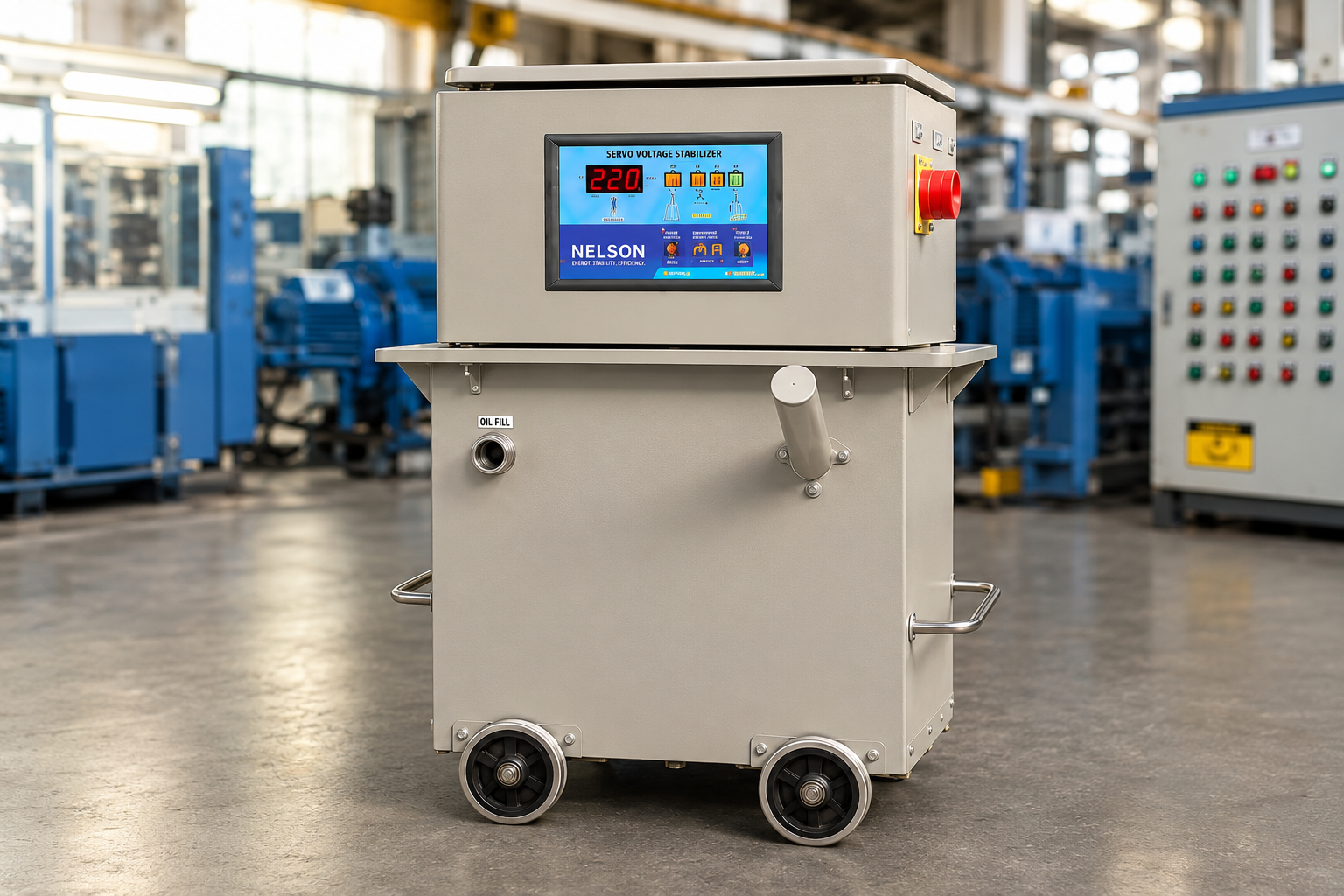
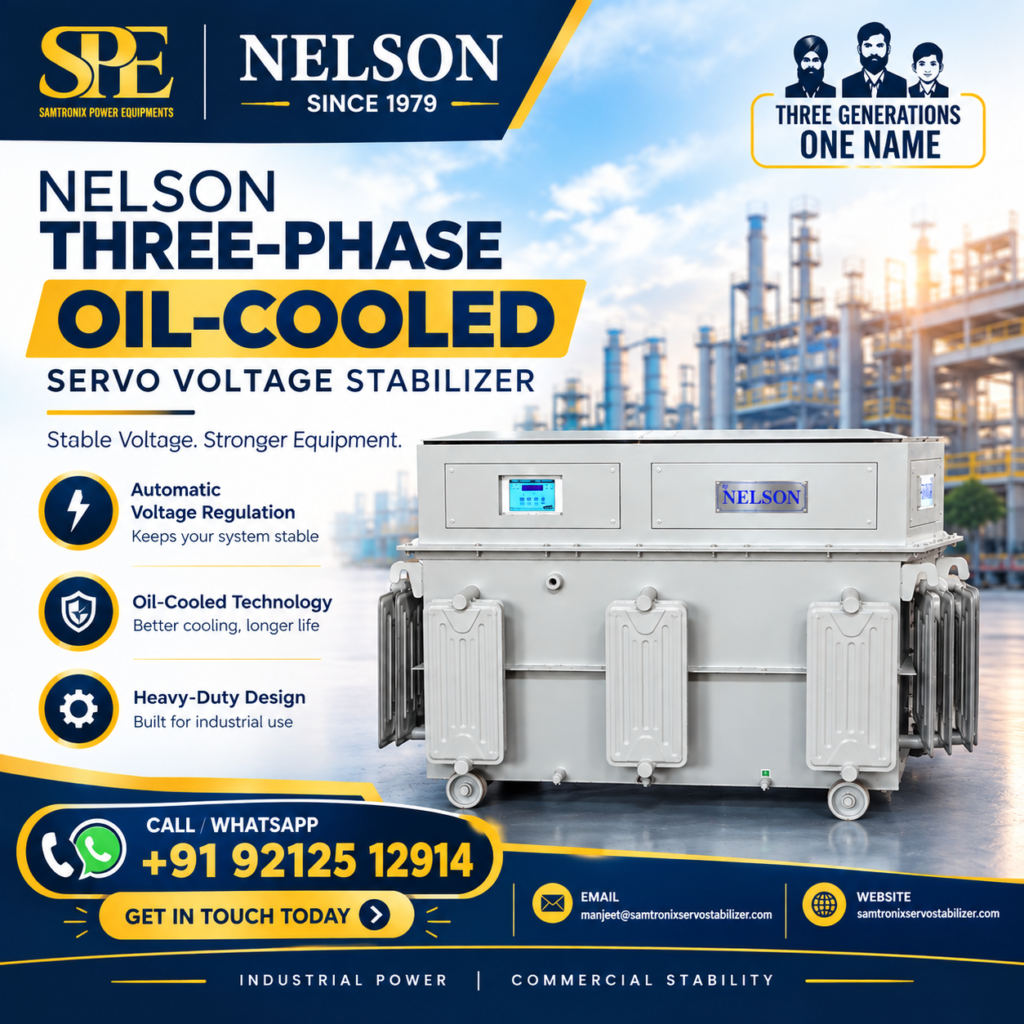
NELSON, associated with Samtronix Power Equipments and carrying the Since 1979 legacy, manufactures voltage regulation equipment intended for industrial and commercial requirements. The stabilizer shown in the image represents a heavy-duty three-phase oil-cooled configuration with a digital control panel, external cooling fins, robust enclosure, and wheeled construction.
What Is a Three Phase Oil Cooled Servo Voltage Stabilizer?
A Three Phase Oil Cooled Servo Voltage Stabilizer is an automatic voltage regulation system designed for three-phase electrical loads. Its primary purpose is to compensate for variations in the incoming voltage and provide a regulated output to connected equipment.
The word “servo” refers to the servo-controlled voltage correction mechanism. Instead of allowing fluctuations to pass directly to the load, the system continuously monitors the supply and makes corrective adjustments. The oil-cooled design uses insulating and heat-transfer oil to help manage heat generated during operation.
This combination makes a Three Phase Oil Cooled Servo Voltage Stabilizer particularly useful where electrical equipment operates for long hours and where voltage consistency is important to production quality and equipment reliability.
Why Voltage Fluctuation Is a Serious Industrial Problem
Voltage fluctuation is not simply a matter of lights becoming brighter or dimmer. Industrial equipment can react significantly to changes in electrical voltage. A machine may continue running while its electrical components experience additional stress, which can eventually contribute to overheating, inconsistent operation, or premature component failure.
For example, consider a manufacturing machine that requires a relatively stable voltage to operate its control electronics and motors. If the incoming supply repeatedly drops or rises, the machine’s internal components may have to operate outside their preferred electrical conditions. The immediate result could be a fault, unexpected shutdown, production interruption, or inconsistent machine performance.
A properly selected Three Phase Oil Cooled Servo Voltage Stabilizer can help address this problem by automatically correcting voltage variations before the regulated supply reaches the connected load.
How a Three Phase Oil Cooled Servo Voltage Stabilizer Works
The operating principle is based on continuous voltage sensing, automatic control, servo correction, and regulated output.
The stabilizer first monitors the incoming three-phase voltage. Its control system determines whether the voltage is below or above the desired level. When a correction is required, the servo mechanism adjusts the voltage accordingly. The correction process is automatic, meaning an operator does not have to manually adjust the voltage whenever the supply changes.
The oil-cooling system helps dissipate heat produced during electrical operation. This becomes particularly relevant in heavy-duty applications where the stabilizer may operate continuously for extended periods.
A simplified operating sequence can be represented as:
Incoming Three-Phase Supply → Voltage Sensing → Control System → Servo Correction → Regulated Output → Connected Equipment
This continuous correction is one of the main reasons industries use a Three Phase Oil Cooled Servo Voltage Stabilizer instead of relying on manual voltage adjustment.
Key Components and Their Functions
A typical Three Phase Oil Cooled Servo Voltage Stabilizer consists of several electrical and mechanical components working together. The exact configuration varies according to the application and required electrical specifications, but the major components generally perform the following functions.
| Component | Primary Function |
|---|---|
| Voltage sensing system | Monitors incoming and output voltage conditions |
| Control circuit | Determines the required correction |
| Servo motor mechanism | Drives the voltage correction mechanism |
| Variable transformer | Helps adjust voltage according to the control signal |
| Buck-boost transformer | Performs voltage correction |
| Oil-filled tank | Provides insulation and assists heat transfer |
| Radiators/cooling fins | Help dissipate heat from the oil and internal assembly |
| Digital control panel | Displays operating parameters and system status |
| Protection system | Helps safeguard the stabilizer and connected equipment |
| Enclosure | Protects internal components from the surrounding environment |
Understanding these components is useful when diagnosing electrical problems because voltage regulation is not performed by one component alone. The sensing, control, correction, cooling, and protection systems must work together.
Why Oil Cooling Is Used

Heat is an important consideration in high-capacity electrical equipment. Electrical components generate heat during operation, and excessive temperature can affect insulation, component life, and overall system performance.
In an oil-cooled stabilizer, specially selected insulating oil surrounds relevant internal components and helps transfer heat away from them. Heat is then dissipated through the external cooling surfaces or radiators.
The external finned structures visible on the stabilizer in the image are part of the thermal management arrangement. They increase the surface area available for heat dissipation.
For applications involving long operating hours or substantial electrical loads, a Three Phase Oil Cooled Servo Voltage Stabilizer can therefore provide a practical approach to voltage regulation and thermal management.
Understanding the Digital Control Panel
The digital panel is an important part of a modern Three Phase Oil Cooled Servo Voltage Stabilizer. It provides the operator with information about the stabilizer’s operating condition.
Depending on the specific model and configuration, a digital control system may display parameters such as input voltage, output voltage, phase-related electrical information, operating status, and fault or protection conditions.
The advantage of digital monitoring is that operators can identify abnormal electrical conditions more easily instead of depending entirely on external measuring instruments.
For maintenance teams, this information can also help identify whether a problem is related to incoming voltage, output regulation, phase conditions, or a protection event.
Three-Phase Voltage Regulation for Industrial Equipment
Three-phase electrical systems are widely used for industrial machinery because they are suitable for motors and other higher-power electrical loads. However, unstable three-phase voltage can create operational problems across the connected system.
A Three Phase Oil Cooled Servo Voltage Stabilizer is designed specifically for this type of electrical environment. It continuously regulates the three-phase supply so connected machinery receives a more stable voltage.
Applications can include manufacturing machinery, industrial automation systems, CNC equipment, processing machinery, electrical panels, compressors, pumps, motors, and other industrial loads, depending on the stabilizer’s designed capacity and specifications.
The correct stabilizer should always be selected according to the actual electrical characteristics of the installation rather than simply choosing a unit based on physical size.
Problems a Servo Stabilizer Can Help Solve
One of the biggest advantages of installing a Three Phase Oil Cooled Servo Voltage Stabilizer is that it addresses voltage instability at the power-input stage.
Consider a production facility where the incoming voltage frequently drops during periods of high demand. Motors may struggle to operate normally, while electronic control systems can generate faults. Production may stop until the voltage returns to an acceptable condition.
In another situation, a high-voltage condition may place additional stress on electrical components. Even when equipment continues working, repeated electrical stress can affect reliability over time.
Voltage regulation provides a controlled electrical environment between the incoming supply and the connected load.
| Common Problem | Possible Effect | Role of Voltage Stabilization |
|---|---|---|
| Low input voltage | Motor performance issues and equipment malfunction | Corrects voltage toward the required level |
| High input voltage | Electrical component stress | Reduces excessive voltage |
| Repeated fluctuations | Unstable machine operation | Provides automatic correction |
| Long operating hours | Thermal and electrical stress | Oil cooling assists heat management |
| Production interruptions | Downtime and process disruption | Supports more consistent power conditions |
| Unstable control voltage | Machine faults or resets | Helps maintain regulated supply |
| Three-phase imbalance/abnormality | Equipment performance problems | Monitoring and protection can identify abnormal conditions, depending on model |
Where a Three Phase Oil Cooled Servo Voltage Stabilizer Can Be Used
The application of a Three Phase Oil Cooled Servo Voltage Stabilizer depends on the electrical requirements of the site and the equipment being protected.
Industrial manufacturing facilities can use voltage stabilizers for machinery where consistent voltage is important for reliable operation. Processing plants may use them for production equipment and electrical systems operating for long periods. Commercial installations can also require voltage regulation when sensitive or power-intensive equipment is connected to the supply.
Typical application areas include:
Manufacturing Units: Production machinery, industrial automation, machine tools, and electrical control systems can benefit from regulated voltage.
CNC and Precision Machinery: Voltage instability can affect electronic controls and machine operation, making stable power particularly valuable.
Motors and Pumps: Three-phase motors can be affected by abnormal voltage conditions. Proper voltage regulation can support reliable operation.
Industrial Processing Plants: Equipment operating continuously can require a stable electrical environment.
Commercial Facilities: Larger commercial installations with significant electrical loads may require three-phase voltage regulation.
How to Select the Right Stabilizer for Your Application
Selecting a Three Phase Oil Cooled Servo Voltage Stabilizer should begin with the electrical characteristics of the site rather than the stabilizer’s appearance.
The first requirement is determining the connected load. The total electrical load should be evaluated along with motor starting currents, expansion requirements, and the type of machinery being operated.
The input voltage range is another critical consideration. A stabilizer should be designed to handle the actual voltage fluctuations experienced at the installation. Measuring the supply at different times of the day can provide more useful information than relying on a single voltage reading.
The required output voltage must also be established. The stabilizer should be configured according to the requirements of the connected equipment.
Phase configuration, frequency, load type, installation environment, cooling requirements, and protection features should also be considered.
| Selection Factor | Why It Matters |
|---|---|
| Connected load | Determines the required electrical capacity |
| Input voltage range | Establishes the correction range required |
| Output voltage | Determines the regulated supply requirement |
| Phase configuration | Ensures compatibility with the electrical system |
| Motor starting current | Prevents undersizing for motor-driven equipment |
| Operating hours | Helps determine cooling and duty requirements |
| Environment | Influences enclosure and installation considerations |
| Future expansion | Allows room for additional electrical loads |
| Protection requirements | Helps safeguard equipment and the stabilizer |
| Monitoring requirements | Determines the usefulness of digital indication and controls |
Maintenance of an Oil-Cooled Servo Stabilizer
Regular maintenance is essential for keeping a Three Phase Oil Cooled Servo Voltage Stabilizer operating reliably. Preventive maintenance is generally more effective than waiting for a failure to occur.
The external cooling surfaces should remain clean and unobstructed because accumulated dust can reduce heat dissipation. Electrical connections should be inspected periodically by qualified personnel to identify loose connections, overheating marks, or other abnormalities.
The condition and level of insulating oil should be checked according to the manufacturer’s maintenance recommendations. The control panel should also be inspected for abnormal indications, alarms, or unusual readings.
The servo mechanism and associated moving components require appropriate inspection and maintenance as specified by the manufacturer.
Maintenance should always be performed by qualified electrical personnel following the equipment’s technical documentation and safety procedures.
Why Correct Installation Matters
Even a properly designed Three Phase Oil Cooled Servo Voltage Stabilizer cannot perform correctly if it is incorrectly installed.
The installation location should provide adequate ventilation and sufficient space around the equipment for inspection and maintenance. The stabilizer should be installed on a suitable foundation capable of supporting its weight.
Proper electrical connections, earthing, cable sizing, protection devices, and phase sequence should be verified during installation. The exact installation requirements depend on the stabilizer model and site conditions.
Before commissioning, the incoming supply and connected load should be checked carefully. This helps prevent problems caused by incorrect wiring or an unsuitable electrical configuration.
NELSON Three Phase Oil Cooled Servo Voltage Stabilizer
The NELSON unit shown in the image has the visual characteristics of a heavy-duty industrial voltage stabilizer, including a robust enclosure, digital monitoring panel, cooling radiators, and a three-phase configuration.
Its design is focused on applications where voltage regulation and continuous industrial operation are important. The NELSON Three Phase Oil Cooled Servo Voltage Stabilizer can be positioned as an industrial power-conditioning solution for businesses that need a more controlled supply for their electrical equipment.
The NELSON Since 1979 branding also communicates a long-standing manufacturing identity, while the “Three Generations, One Name” message reflects the brand’s emphasis on continuity across generations.
FAQs – Three Phase Oil Cooled Servo Voltage Stabilizer
1. Why is oil cooling used in a servo stabilizer?
Oil helps provide electrical insulation and assists in transferring heat away from internal components. This makes oil cooling useful for stabilizers designed for demanding and continuous-duty applications.
2. Can a servo stabilizer protect industrial machinery?
A Three Phase Oil Cooled Servo Voltage Stabilizer helps protect connected equipment from unsuitable voltage conditions by automatically correcting voltage fluctuations. It should be selected according to the machinery’s actual electrical requirements.
3. What does the digital display show?
The digital control panel can provide operating information such as voltage and system status. The exact parameters displayed depend on the particular stabilizer model and controller configuration.
4. How do I choose the correct KVA capacity?
The required capacity should be determined from the connected electrical load, motor starting requirements, operating conditions, input voltage range, and possible future expansion. A qualified electrical professional should verify the final selection.
5. Where can an oil-cooled servo stabilizer be installed?
A Three Phase Oil Cooled Servo Voltage Stabilizer can be used in suitable manufacturing plants, processing facilities, workshops, commercial installations, and other industrial environments where three-phase voltage regulation is required.
6. Does a servo stabilizer require regular maintenance?
Yes. Periodic inspection of electrical connections, cooling surfaces, oil condition, control systems, protection devices, and mechanical components helps maintain reliable operation. Maintenance should follow the manufacturer’s recommendations and be performed by qualified personnel.
Connect with Samtronix on LinkedIn for Industrial Power Expertise.