
Modern homes depend on electrical appliances almost every day. Refrigerators, air conditioners, televisions, washing machines, computers, water pumps, microwave ovens and other equipment all require a reasonably stable voltage supply for proper operation. When the incoming voltage keeps moving above or below the required level, appliances can experience heating, malfunctioning, reduced performance and, in some situations, permanent electrical damage. This is where a Voltage Stabilizer for Home Appliances becomes useful.
A Voltage Stabilizer for Home Appliances is designed to monitor incoming voltage and correct unsuitable voltage before it reaches connected equipment. The main purpose is not simply to increase or decrease voltage whenever required, but to keep the output within a safer operating range for the appliance. Understanding how this process works can help homeowners identify when voltage protection is actually required and how voltage fluctuations affect home appliances.
How Does a Voltage Stabilizer Work?
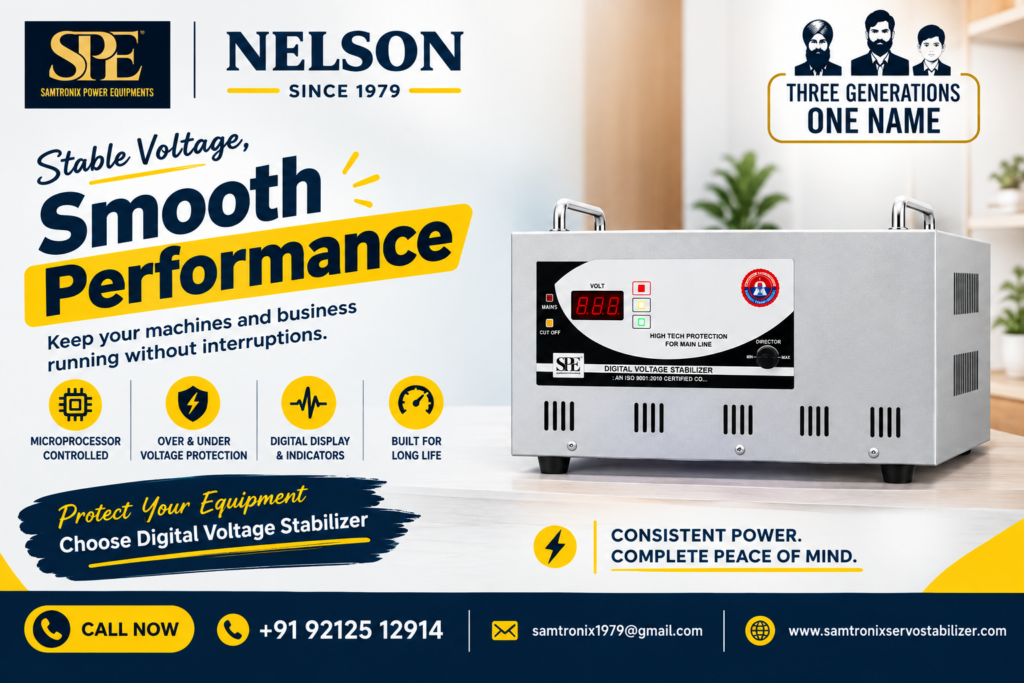
The basic working principle is based on continuously sensing the incoming voltage, identifying whether it is too high or too low, and correcting the voltage before supplying it to the connected appliance. A Voltage Stabilizer for Home Appliances normally contains sensing, control and voltage-correction components that work together.
When the electricity supply enters the stabilizer, the sensing circuit checks the input voltage. If the voltage is lower than the required output level, the stabilizer increases it through its correction mechanism. If the voltage becomes too high, the stabilizer reduces it to a suitable level.
The control circuit decides how much correction is needed. In a servo voltage stabilizer, this process can involve a motor-driven mechanism that adjusts the position of a variable transformer. The movement is controlled according to the voltage detected by the sensing system.
This is why a servo stabilizer is often described as a servo controlled voltage stabilizer. It does not simply provide a fixed correction. Instead, it continuously responds to changes in the incoming supply.
Main Working Process of a Home Voltage Stabilizer
The working of a Voltage Stabilizer for Home Appliances can be understood through a simple sequence. Electricity first enters the stabilizer from the household supply. The sensing section measures the incoming voltage and sends the information to the control circuit.
The control system determines whether the voltage is within the required range. When an abnormal voltage is detected, the correction mechanism starts working. In a servo-based design, the servo motor moves the regulating mechanism to make the necessary correction.
Once the voltage reaches the required level, the corrected output is supplied to the appliance. If the input changes again, the stabilizer responds to the new condition.
| Stage | What happens |
|---|---|
| Input | Electricity enters from the household supply |
| Sensing | Input voltage is continuously monitored |
| Control | The circuit determines the required correction |
| Correction | Voltage is increased or decreased |
| Output | Corrected voltage is supplied to the appliance |
| Response | The stabilizer adjusts again when input voltage changes |
This continuous correction is one of the important reasons a Voltage Stabilizer for Home Appliances can help when the local electrical supply is unstable.
Why Voltage Fluctuates in Homes
Many homeowners notice lights becoming unusually bright or dim, fans changing speed, or appliances behaving differently at different times of the day. These conditions can happen because the incoming voltage is not always perfectly stable.
Voltage Stabilizer for Home Appliances may fluctuate because of changes in electrical load, long distribution lines, overloaded local networks, switching of heavy equipment, loose electrical connections or changes in demand during peak hours. In some areas, fluctuations may be more noticeable during certain periods.
The condition of the internal household wiring can also matter. A stabilizer cannot correct every electrical problem caused by poor wiring, loose terminals or damaged cables. Such issues should be checked separately by a qualified electrician.
Understanding why voltage fluctuates in homes is important because the correct solution depends on the actual electrical condition rather than simply assuming that every problem is caused by the appliance itself.
How Voltage Fluctuations Affect Home Appliances
Electrical appliances are designed to operate within a particular voltage range. Continuous operation outside the recommended range can put additional stress on electrical and electronic components.
When voltage is too low, motors may struggle to start or continue running normally. A compressor in an air conditioner or refrigerator may draw higher current while trying to maintain operation. Excessive heating can occur in some electrical equipment.
When voltage is too high, insulation and electronic components can experience additional electrical stress. Sensitive circuits, power supplies and control boards may become more vulnerable when exposed to unsuitable voltage conditions.
A Voltage Stabilizer for Home Appliances helps by correcting the incoming supply before it reaches the connected equipment.
| Voltage condition | Possible appliance effect |
|---|---|
| Low voltage | Motor struggling, higher current and heating |
| High voltage | Electrical stress and possible component damage |
| Frequent fluctuation | Repeated stress on electrical components |
| Rapid variation | Unstable appliance operation |
| Stable corrected output | More suitable operating supply |
What Happens When Voltage Is Too High?
When voltage becomes higher than the appliance’s intended operating range, electrical components may receive more voltage than they were designed to handle. The result depends on the appliance and the severity and duration of the overvoltage.
Electronic power supplies may become stressed, while motors and other components can experience additional heating. In severe conditions, sensitive components can fail.
A Voltage Stabilizer for Home Appliances can detect an excessive input voltage and reduce it to a more appropriate output level. This correction takes place before the supply reaches the connected equipment.
However, homeowners should not assume that a stabilizer is a replacement for all electrical protection. Proper earthing, suitable circuit protection and good-quality wiring remain important parts of a safe electrical installation.
What Happens When Voltage Is Too Low?
Low voltage is another common concern, particularly for appliances that contain motors or compressors. When the supply voltage falls, a motor may not receive the electrical conditions it requires for efficient operation.
The motor may struggle to start, operate with reduced performance or generate additional heat. Repeated low-voltage operation can become a concern when the appliance is used for long periods.
A Voltage Stabilizer for Home Appliances can raise the output voltage when the input falls below the required level, provided the incoming voltage remains within the stabilizer’s specified operating range.
This is particularly relevant for homes where voltage becomes noticeably lower during peak electricity usage.
How to Protect Appliances From Voltage Fluctuations
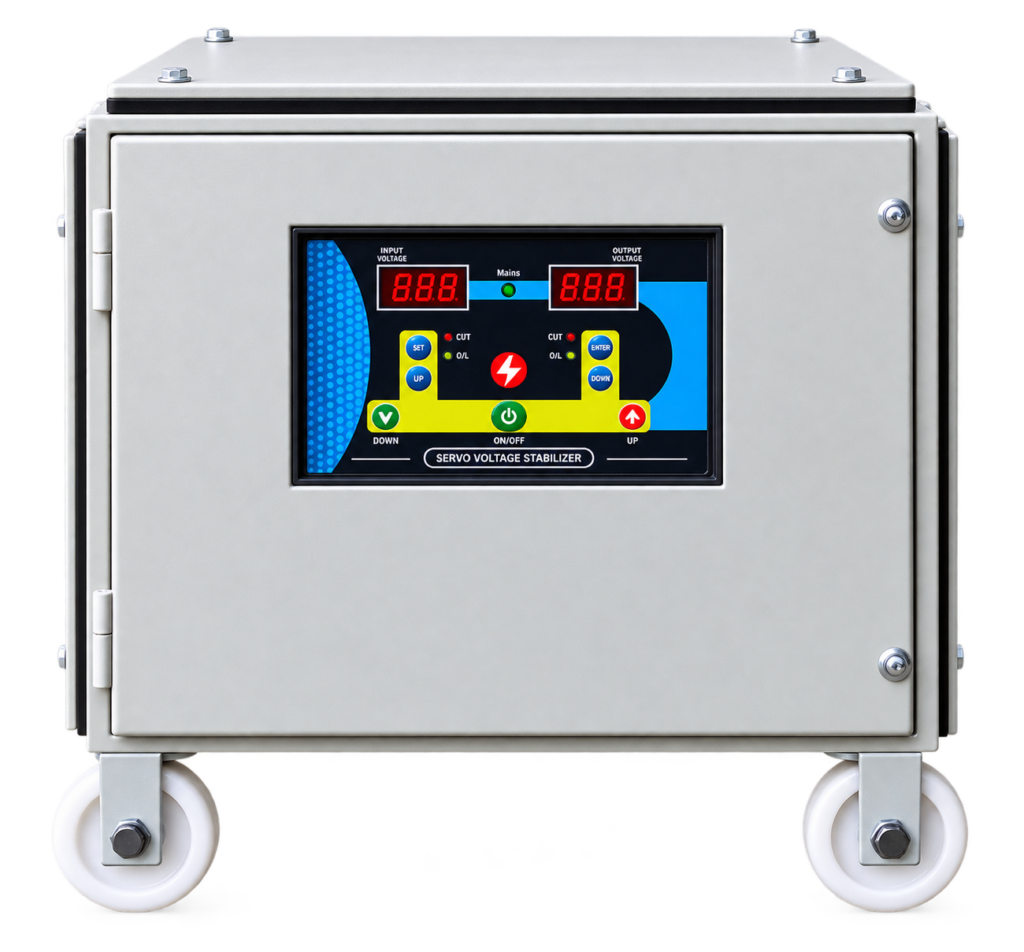
The first step is identifying which appliances are actually experiencing the problem. A refrigerator, air conditioner, washing machine, television and computer may have different electrical requirements.
The stabilizer should therefore be selected according to the connected load, starting current, operating conditions and input voltage range. Simply selecting a stabilizer based on the physical size of an appliance is not a proper method.
A Voltage Stabilizer for Home Appliances should have an appropriate capacity for the connected equipment. For larger residential loads, the total connected load should be calculated before selecting the stabilizer.
Samtronix Power Equipments works with servo-based voltage regulation requirements and can help identify suitable stabilizer configurations based on the application and electrical conditions.
How to Protect Appliances From Low Voltage
Protection from low voltage starts with understanding how low the supply actually becomes. A temporary small variation and a severe voltage drop are not the same condition.
A voltage measurement should be taken during the period when the problem is normally observed. If the voltage falls significantly when several appliances are operating, the stabilizer’s input operating range becomes an important consideration.
A servo voltage stabilizer can correct low incoming voltage through its voltage-regulating mechanism. The output is then maintained closer to the required level for connected appliances.
For households with multiple appliances, the load should be considered together rather than selecting a unit only according to one appliance’s normal running wattage.
How to Protect Appliances From High Voltage
High voltage protection requires the stabilizer to handle the actual maximum input voltage experienced at the property. If the input voltage occasionally rises above normal levels, the stabilizer needs sufficient correction capability.
A properly selected Voltage Stabilizer for Home Appliances senses the increased input and adjusts its regulating mechanism to reduce the output voltage.
This can be particularly useful where appliances operate for many hours each day and repeated voltage variation is present.
Voltage Stabilizer for Household Appliances and Motor Loads
Not every household appliance behaves the same way electrically. Motor-driven equipment such as refrigerators, air conditioners, water pumps and washing machines can have starting-current requirements that need to be considered.
A stabilizer selected only from the appliance’s normal running load may not always be suitable for equipment with significant starting current.
For this reason, the application should be discussed before selecting a Voltage Stabilizer for Home Appliances. The connected load, motor characteristics and expected voltage fluctuation should all be considered.
Servo Voltage Stabilizer for Home Applications
A servo voltage stabilizer uses a motor-controlled correction mechanism to regulate voltage. The servo motor responds to signals from the control circuit and moves the regulating mechanism according to the detected voltage condition.
This design allows continuous correction rather than depending on a simple fixed correction step.
The term servo stabilizer is commonly used for this type of voltage-regulating equipment. A servo controlled voltage stabilizer can be configured for different electrical requirements, including residential and other applications where accurate voltage regulation is needed.
For larger electrical installations, a 3 phase servo stabilizer may be considered where the incoming electrical system and connected load require three-phase regulation.
Choosing the Correct Capacity for Home Appliances
Capacity selection should be based on the actual electrical load rather than simply choosing a commonly searched capacity. For example, homeowners may search for terms such as 5kva servo stabilizer, 5 kva servo stabilizer or even 5kva price servo stabilizer when researching solutions.
However, the correct capacity depends on the equipment connected to the stabilizer and its operating characteristics. A 5 KVA unit may be appropriate for one application but unsuitable for another depending on the total load and starting requirements.
The following factors should be checked before selection.
| Factor | Why it matters |
|---|---|
| Total connected load | Determines required stabilizer capacity |
| Starting current | Important for motor-driven appliances |
| Minimum input voltage | Determines low-voltage correction requirement |
| Maximum input voltage | Determines high-voltage correction capability |
| Phase requirement | Identifies single-phase or three-phase configuration |
| Appliance type | Different loads behave differently |
| Operating duration | Continuous loads may require careful sizing |
Voltage Stabilizer for Home Appliances With Multiple Loads
A household may have several appliances operating at the same time. An air conditioner may start while a refrigerator compressor is already running, while lights, televisions, pumps and other equipment are also connected.
The combined load can therefore be different from the load of each individual appliance.
Before installing a Voltage Stabilizer for Home Appliances, the connected electrical load should be assessed properly. In some situations, separate stabilizers may be considered for particular equipment, while in other applications a suitably designed central arrangement may be used.
The right configuration depends on the electrical distribution of the property.
When a Servo Stabilizer Needs Extra Attention
Servo stabilizers contain mechanical and electrical components, so installation quality matters. Incorrect wiring, unsuitable earthing, excessive loading or operation beyond the specified input range can create problems even when the stabilizer itself is properly manufactured.
The installation location should also provide suitable ventilation and protection from excessive moisture, dust and other environmental conditions.
A stabilizer should not be continuously overloaded. If the connected load increases after installation, the original stabilizer capacity should be reviewed.
Common Signs That Appliances May Be Experiencing Voltage Problems
Some voltage problems are easy to notice. Lights may dim when a heavy appliance starts. Fans can change speed unexpectedly. Air conditioners may have difficulty starting. Refrigerators may make unusual starting attempts. Electronic equipment may restart or switch off unexpectedly.
These symptoms do not automatically prove that voltage fluctuation is the cause. Wiring, loose connections, appliance faults and other electrical problems can produce similar symptoms.
Measuring the supply voltage at different times is a better approach than assuming the cause.
Servo Stabilizer Manufacturers and Application Requirements
When researching servo stabilizer manufacturers, homeowners and businesses should look at whether the manufacturer can understand the actual application rather than only supplying a standard unit.
Samtronix Power Equipments provides servo voltage stabilizer solutions for different capacity requirements and electrical applications. The company also works with requirements involving single-phase and 3 phase servo stabilizer systems.
The selection process should consider the voltage range, load type, installation conditions and expected operating environment.
Searches such as servo stabilizer manufacturers in delhi, servo stabilizer price and stabilizer manufacturer are commonly used when people are researching voltage-regulation equipment. The technical requirement, however, remains more important than the search phrase used to find the equipment.
How Voltage Fluctuation Damages Appliances
Voltage fluctuation damage does not always happen immediately. Repeated electrical stress over time can affect components, especially when equipment frequently operates outside its recommended voltage range.
Motors can experience heating during low-voltage conditions. Electronic circuits can be affected by excessive voltage. Power supplies can also experience additional stress during repeated variations.
This is why a Voltage Stabilizer for Home Appliances can be useful in locations where voltage instability is a regular issue rather than an occasional event.
Voltage Stabilizer for Home Appliances and Sensitive Electronics
Televisions, computers, networking equipment, home automation systems and other electronic devices may contain sensitive electronic circuits. Sudden voltage changes can affect their power supply sections and operating stability.
For sensitive equipment, the stabilizer should be selected according to the manufacturer’s electrical requirements. It is also important to understand that a stabilizer and a UPS serve different electrical functions. A stabilizer regulates voltage, while a UPS is designed around power continuity and backup.
Using the correct equipment for the actual problem avoids unnecessary electrical modifications.
Practical Electrical Checks Before Installing a Stabilizer
Before installing a Voltage Stabilizer for Home Appliances, voltage should ideally be checked at different times of the day. Morning, afternoon and evening readings can reveal whether the supply changes significantly with electrical demand.
The electrician should also check wiring condition, earthing, connections and the distribution arrangement.
| Check | Purpose |
|---|---|
| Input voltage measurement | Identifies actual fluctuation |
| Maximum voltage reading | Helps assess high-voltage condition |
| Minimum voltage reading | Helps assess low-voltage condition |
| Connected load | Helps determine required capacity |
| Earthing | Supports electrical safety |
| Wiring condition | Identifies separate electrical faults |
These checks make the selection of a Voltage Stabilizer for Home Appliances more practical and reduce the possibility of selecting a unit without understanding the actual electrical condition.
Why Correct Stabilizer Selection Matters
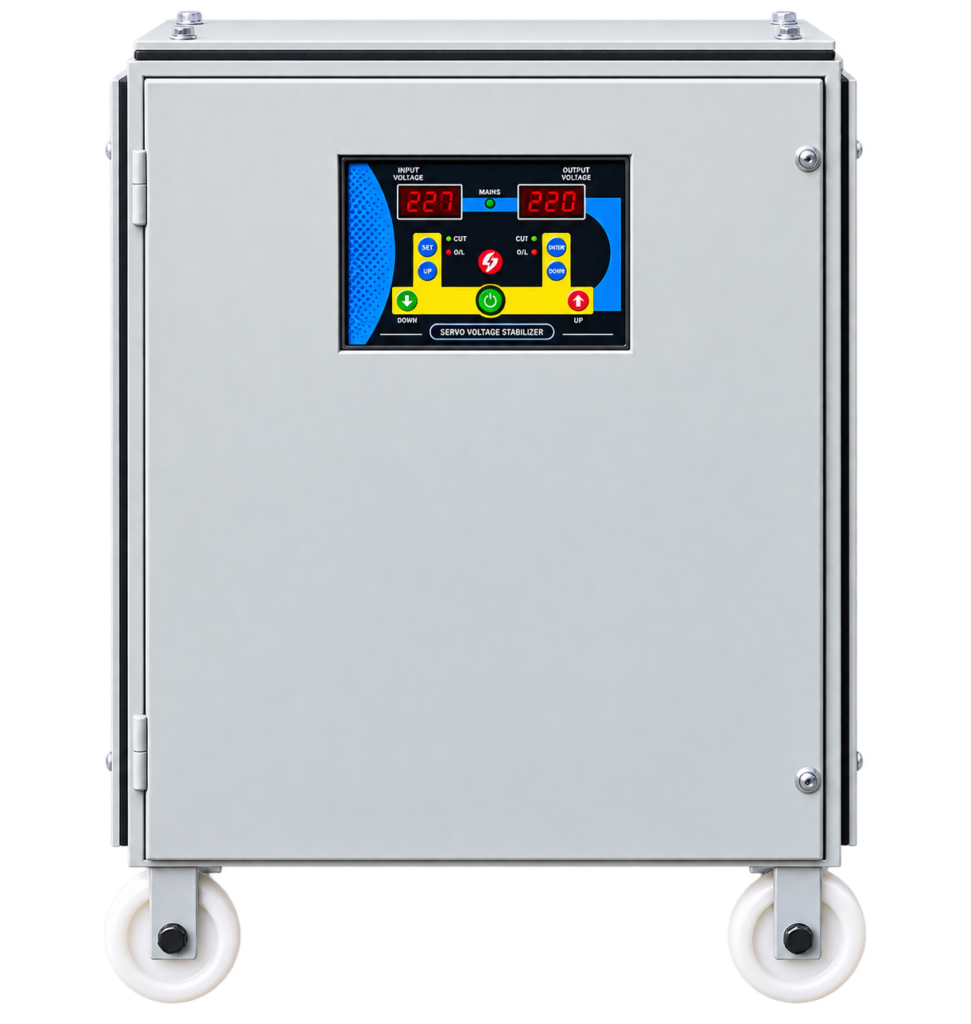
A stabilizer should not be selected only because the product name contains “home” or because a particular KVA capacity is commonly searched online. The connected equipment and voltage conditions should be considered first.
For example, a household containing only electronic appliances may have different requirements from a home that also operates air conditioners, pumps and other motor-driven equipment.
The same principle applies when someone searches for a 5 kva servo stabilizer. The capacity should be confirmed against the actual load instead of assuming that 5 KVA is suitable simply because it is a popular search term.
Samtronix Power Equipments can support requirements involving servo voltage stabilizer systems and application-specific voltage regulation.
FAQs | Voltage Stabilizer for Home Appliances
1. Why does my AC struggle to start during low voltage?
Low voltage can make the compressor struggle to start. A properly sized servo voltage stabilizer can help maintain a more suitable supply.
2. Why do my lights become bright and dim repeatedly?
Frequent brightness changes can indicate voltage fluctuation. Measuring the supply can help identify whether a Voltage Stabilizer for Home Appliances is required.
3. Can a stabilizer stop my refrigerator from restarting repeatedly?
If unstable voltage is causing the issue, a suitable stabilizer can help by maintaining a more consistent output voltage to the refrigerator.
4. My water pump becomes weak during certain hours. Why?
The supply voltage may be dropping when electrical demand increases. A correctly selected servo stabilizer can help compensate for low input voltage.
5. What should I check before buying a home stabilizer?
Check the minimum and maximum input voltage, total connected load, starting current and phase requirement before selecting the stabilizer.
6. Can Samtronix Power Equipments provide a stabilizer for multiple appliances?
Yes. Samtronix Power Equipments can help assess the connected load and voltage conditions to determine a suitable servo voltage stabilizer configuration.
7. Why does my electronic equipment restart during voltage fluctuations?
Sudden voltage changes can affect electronic power supplies and cause equipment to restart. A suitable Voltage Stabilizer for Home Appliances can help maintain a more consistent supply.
Connect with Samtronix on LinkedIn for Industrial Power Expertise.