
Modern industrial operations depend heavily on a stable and controlled electrical supply. Manufacturing machines, automation systems, control panels, production equipment, motors, and other electrical loads can be affected when the incoming voltage continuously moves outside the required operating range. A controlled voltage supply helps industries maintain consistent equipment operation and reduce interruptions caused by voltage fluctuations.
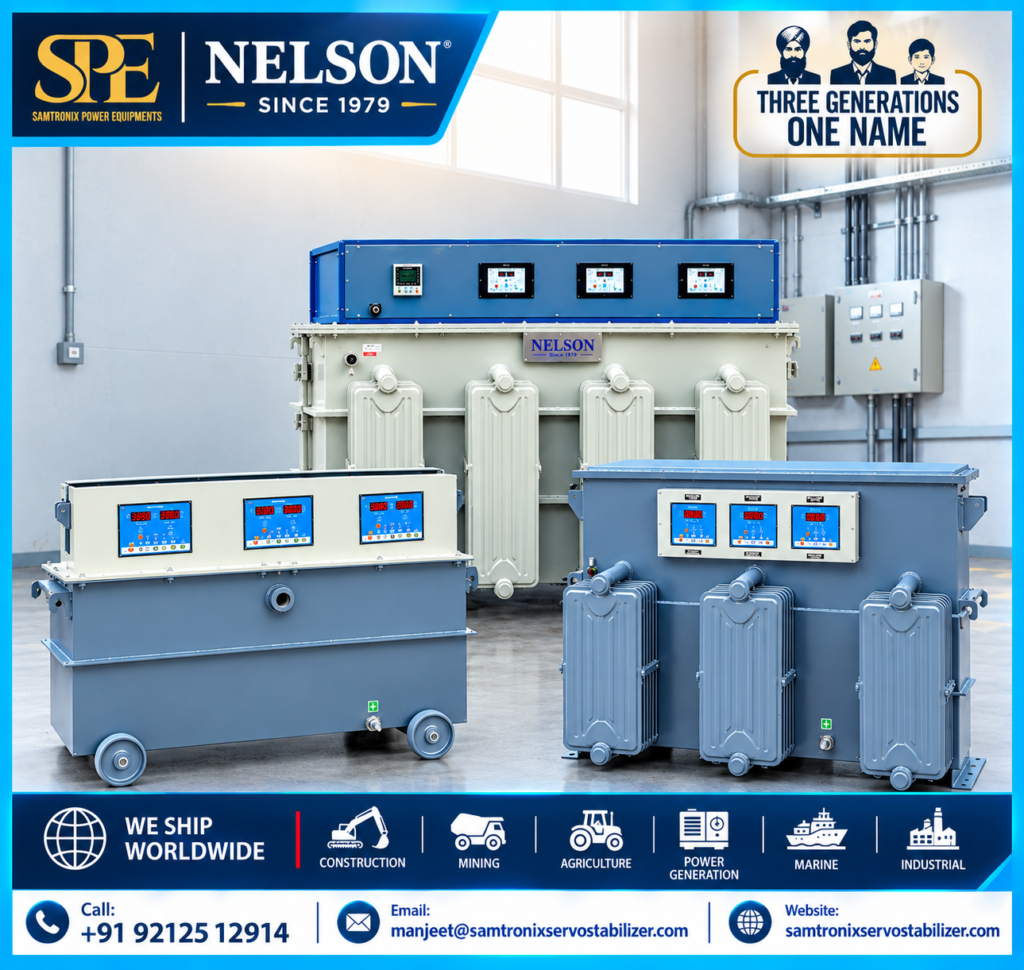
The image represents a range of heavy-duty oil-cooled voltage stabilizing equipment designed for industrial environments. The equipment features robust enclosures, digital monitoring panels, cooling arrangements, and industrial-style construction. Such systems are suitable for applications where electrical loads require controlled and regulated voltage for dependable operation. An Industrial Oil Cooled Servo Stabilizer is particularly relevant for installations where continuous operation, thermal management, and automatic voltage correction are important considerations.
What Is an Industrial Oil Cooled Servo Stabilizer?
An Industrial insulated transformer Oil Cooled Servo Stabilizer is an automatic voltage regulation system designed to maintain the output voltage within a controlled range even when the incoming supply voltage fluctuates. It uses a servo-controlled voltage correction mechanism to sense changes in the input and make corresponding adjustments to the output.
The oil-cooled design uses insulating and heat-transfer oil around the relevant electrical components. During continuous operation, electrical equipment produces heat. Oil can help transfer this heat away from internal components and distribute it through the cooling system. This makes oil-cooled construction useful for heavy-duty installations where equipment may operate for extended periods.
The equipment shown in the image demonstrates the type of industrial construction associated with high-capacity voltage stabilization systems. The units have large metal enclosures, multiple digital displays, cooling components, and control sections intended for industrial electrical environments.
An Industrial Oil Cooled Servo Stabilizer can therefore become an important part of an electrical power-management arrangement where voltage consistency is required for connected equipment.
Understanding the Equipment Shown in the Image
The image shows multiple industrial stabilizer units positioned in a professional industrial environment. The central unit is a large oil-cooled assembly with multiple cooling radiators and a blue control enclosure positioned on the top. Additional stabilizer units are visible in the foreground, each with digital monitoring displays and oil-cooling arrangements.
The digital panels provide an interface for observing electrical operating parameters. Depending on the actual configuration, such panels may be used to display parameters such as input voltage, output voltage, current, or other operating information.
The physical design also demonstrates why an Industrial Oil Cooled Servo Stabilizer needs appropriate installation space. Large-capacity electrical equipment requires sufficient clearance for ventilation, inspection, electrical connections, and maintenance activities.
Key Features Visible in the Image
| Feature | Purpose in Industrial Operation |
|---|---|
| Oil-cooled construction | Helps manage heat generated during operation |
| Digital display panels | Allows operators to monitor operating parameters |
| Heavy-duty enclosure | Provides a structured housing for electrical components |
| Cooling radiators | Assist with heat dissipation |
| Automatic voltage control | Helps maintain controlled output voltage |
| Industrial control section | Provides access to monitoring and control functions |
| Multiple cooling elements | Supports thermal management |
| Robust floor-mounted construction | Suitable for dedicated industrial installation areas |
How an Industrial Oil Cooled Servo Stabilizer Works
The operating principle of an Industrial Oil Cooled Servo Stabilizer begins with monitoring the incoming electrical supply. The stabilizer continuously senses the input voltage and determines whether the voltage is above or below the desired output level.
When a voltage variation is detected, the control system sends a signal to the servo mechanism. The servo motor operates the voltage correction arrangement to compensate for the detected variation. The objective is to provide a regulated output to the connected electrical load.
The correction process happens automatically, which means operators do not need to manually adjust the voltage every time the incoming supply changes. This is particularly useful in industrial facilities where electrical loads may remain operational for long periods.
The oil-cooling arrangement performs another important function. Electrical components generate heat during operation, particularly when the equipment handles substantial loads. The oil helps transfer heat away from the active components, while the radiators assist in releasing that heat into the surrounding environment.
This combination of automatic voltage correction and thermal management makes an Industrial Oil Cooled Servo Stabilizer suitable for demanding industrial electrical applications.
Why Voltage Stability Matters in Industrial Facilities
Industrial insulated transformer are often designed to operate within defined electrical parameters. Voltage variations can influence motors, control circuits, electronic systems, automation equipment, instrumentation, and other connected loads.
When the supply voltage is inconsistent, equipment may not operate under its intended electrical conditions. Depending on the equipment and severity of the variation, this can contribute to operational interruptions, unwanted trips, inconsistent machine behavior, or stress on electrical components.
An Industrial Oil Cooled Servo Stabilizer is designed to address the voltage-regulation part of this challenge by continuously correcting fluctuations in the incoming supply.
The exact stabilizer configuration should always be selected according to the connected load, input-voltage range, phase configuration, required output voltage, environmental conditions, and installation requirements.
Oil Cooling and Thermal Management
Thermal management is a major consideration for industrial electrical equipment. During operation, transformers, servo mechanisms, control components, and other electrical parts can generate heat. If heat is not properly managed, operating conditions can become more demanding for internal components.
In an oil-cooled stabilizer, insulating oil provides and insulated transformer both electrical insulation and a pathway for transferring heat. Heated oil circulates or moves through the tank and transfers heat toward the cooling surfaces. Radiators increase the surface area available for heat dissipation.
The large radiator sections visible on the stabilizers in the image are an important part of this design. Their presence highlights the focus on thermal management in equipment intended for industrial applications.
For an Industrial Oil Cooled Servo Stabilizer, proper oil condition, radiator cleanliness, installation clearance, and routine inspection are important considerations for maintaining reliable operation.
Digital Monitoring for Industrial Operation
The digital displays shown on the equipment provide a convenient way to monitor electrical conditions. In an industrial environment, visual access to operating parameters can make it easier for operators and maintenance personnel to identify changes in the electrical system.
Depending on the model and control system, digital monitoring may provide information about input and output voltage, current, operating status, or other electrical parameters.
This information can be useful when troubleshooting an electrical issue or checking whether the stabilizer is operating within the expected range.
A modern Industrial Oil Cooled Servo Stabilizer can combine automatic voltage correction with digital monitoring so that voltage regulation and operational information are available through the same industrial control arrangement.
Industrial Applications
The image presents the stabilizer equipment alongside application icons representing construction, mining, agriculture, power generation, marine operations, and industrial environments. These sectors can contain electrical systems that require stable power for their equipment and control infrastructure.
Application Areas
| Industry | Typical Electrical Requirements |
|---|---|
| Manufacturing | Stable power for production machinery and control systems |
| Construction | Voltage regulation for electrical equipment at demanding sites |
| Mining | Controlled electrical supply for heavy-duty machinery and systems |
| Agriculture | Power stability for pumps, processing systems, and automation |
| Power Generation | Voltage control for selected electrical systems |
| Marine | Regulated electrical supply for suitable onboard applications |
| Industrial Plants | Voltage regulation for machines, automation, and electrical loads |
In manufacturing environments, an Industrial Oil Cooled Servo Stabilizer can be integrated into the electrical distribution arrangement supplying production equipment.
In mining and heavy industrial applications, electrical loads can be substantial and operating conditions can be demanding. Properly specified stabilization equipment can help maintain the voltage supplied to connected systems.
Agricultural processing facilities may also operate motors, pumps, control equipment, and other electrical loads that benefit from a controlled power supply.
Three-Phase Industrial Voltage Stabilization
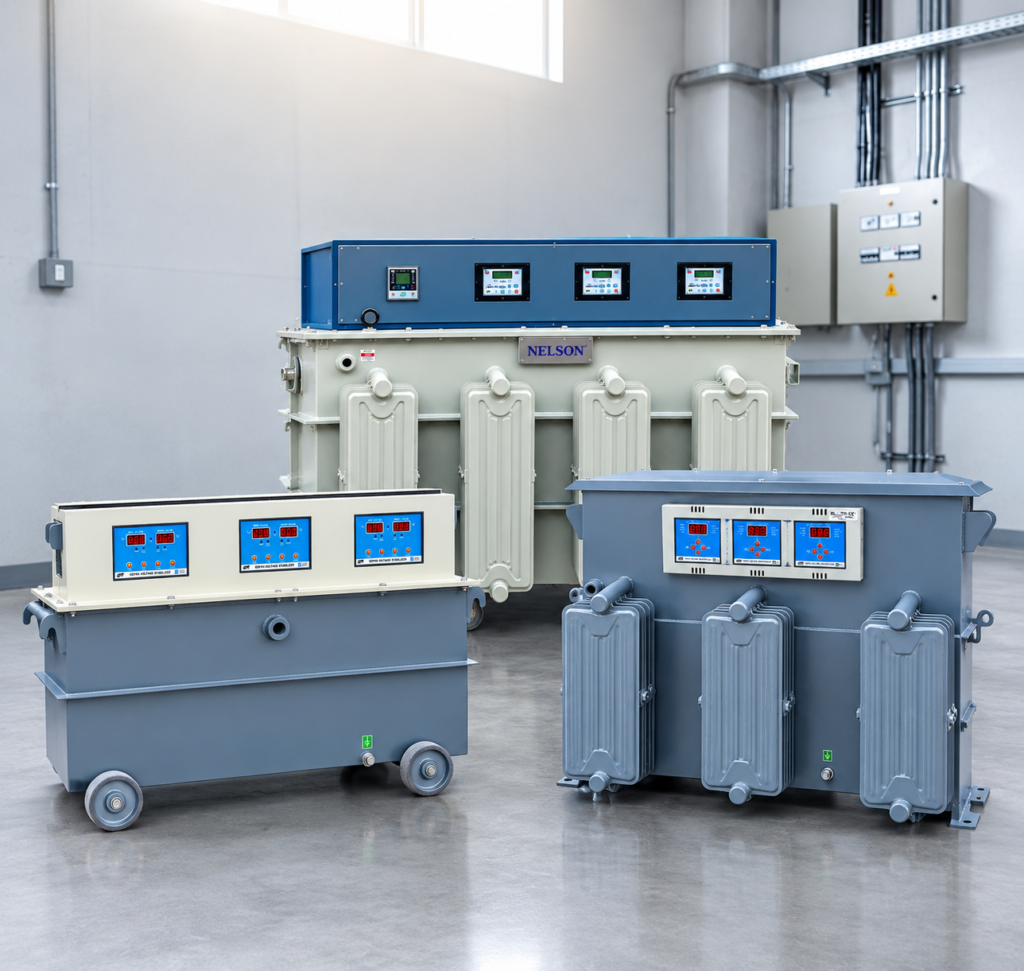
The equipment shown in the image is representative of industrial stabilizer systems that can be configured for three-phase electrical applications. Three-phase systems are widely used in industrial facilities because they can supply large electrical loads efficiently.
A three-phase Industrial Oil Cooled Servo Stabilizer monitors and corrects the electrical supply according to its designed control configuration. Proper phase balance and suitable electrical protection remain important during installation.
Three-phase stabilization is particularly relevant for facilities operating motors and industrial machinery because many machines depend on a properly maintained three-phase supply.

The exact electrical arrangement should be determined by a qualified electrical professional based on the site’s load characteristics and electrical distribution design.
Important Selection Parameters
Choosing an Industrial Oil Cooled Servo Stabilizer requires more than simply looking at the physical size of the equipment. Electrical and operating conditions should be evaluated before selecting a suitable configuration.
| Parameter | Why It Matters |
|---|---|
| Connected load | Determines the required electrical capacity |
| Input voltage range | Defines the correction range required |
| Output voltage | Determines the regulated supply requirement |
| Phase configuration | Establishes whether single-phase or three-phase equipment is required |
| Frequency | Must match the electrical system |
| Load type | Motors, electronics, heating loads, and automation may behave differently |
| Installation environment | Influences enclosure and cooling requirements |
| Operating duration | Helps determine thermal-management requirements |
| Starting current | Important for motor-driven equipment |
| Protection requirements | Helps safeguard the stabilizer and connected load |
Correct sizing is especially important for an Industrial Oil Cooled Servo Stabilizer because industrial loads may have high starting currents and changing operating conditions.
Importance of Correct Installation
Installation plays an important role in the performance of industrial voltage stabilization equipment. A suitable location should provide enough space around the stabilizer for inspection, maintenance, electrical connections, and heat dissipation.
The floor should be capable of supporting the equipment’s weight. Electrical connections should be completed according to applicable electrical standards and the manufacturer’s installation instructions.
The cooling radiators should not be blocked by walls, stored materials, or other equipment. Adequate clearance allows heat to move away from the stabilizer more effectively.
For an Industrial Oil Cooled Servo Stabilizer, grounding is also an essential part of the installation. The stabilizer should be properly connected to the site’s earthing system according to applicable electrical requirements.
Maintenance of Oil Cooled Stabilizer Systems
Regular maintenance helps identify developing issues before they affect industrial operation. Maintenance schedules should be based on the manufacturer’s recommendations and the actual operating environment.
Technicians can inspect the enclosure, electrical connections, control panels, cooling radiators, oil condition, wiring, and protective devices. Unusual noise, overheating, oil leakage, abnormal readings, or repeated voltage-related alarms should be investigated.
The digital monitoring system can also assist maintenance teams by providing information about operating conditions.
Basic Maintenance Checklist
| Maintenance Area | What to Check |
|---|---|
| Oil system | Leakage, level, condition, and contamination |
| Radiators | Dust, blockage, physical damage |
| Electrical terminals | Tightness and signs of heating |
| Control panel | Display operation and abnormal indications |
| Wiring | Damage, loose connections, or insulation issues |
| Earthing | Proper connection and continuity |
| Enclosure | Corrosion, damage, and cleanliness |
| Cooling system | Proper heat dissipation |
| Servo mechanism | Smooth operation and abnormal sounds |
A planned maintenance program for an Industrial Oil Cooled Servo Stabilizer can help maintain consistent operating conditions and identify mechanical or electrical problems early.
Servo Stabilizer for Heavy Industrial Loads
Industrial electrical insulated transformer loads are not always constant. Production machines can start and stop, motors can switch operating conditions, and different sections of a plant can become active at different times.
These changes can influence the electrical characteristics of a facility. A properly selected Industrial Oil Cooled Servo Stabilizer can continuously respond to voltage variations within its specified correction range.
The stabilizer should be selected after understanding both the normal running load and the starting characteristics of connected machinery. This is particularly important where motors, compressors, pumps, CNC equipment, welding systems, or other equipment with significant starting requirements are involved.
Samtronix Power Equipments and NELSON Since 1979
The image carries the NELSON Since 1979 identity along with Samtronix Power Equipments branding. The visual also highlights the message “Three Generations One Name,” representing the brand’s long-standing identity across generations.
Samtronix Power Equipments presents industrial voltage stabilization equipment for applications requiring controlled electrical supply. The displayed equipment includes oil-cooled stabilizer designs with digital monitoring arrangements and industrial enclosures.
For facilities evaluating an Industrial Oil Cooled Servo Stabilizer, understanding the actual electrical requirement remains essential. The required input range, output voltage, phase configuration, load capacity, environment, and operating conditions should be discussed before the equipment configuration is finalized.
Industrial Power Systems and Operational Continuity
Voltage regulation is one part of a broader industrial power-management strategy. A stabilizer does not replace proper electrical protection, grounding, distribution design, maintenance, or appropriate equipment selection. Instead, it forms part of the overall electrical infrastructure.
When an Industrial Oil Cooled Servo Stabilizer is correctly selected and integrated, it can provide automatic voltage correction for connected loads within its specified operating range.
This is especially useful in facilities where production equipment depends on a consistent electrical supply and where manual voltage adjustment would not be practical.
Questions to Ask Before Installing a Stabilizer
Before selecting an Industrial Oil Cooled Servo Stabilizer, facility managers should collect information about the electrical system. The incoming voltage range should be measured, the connected load should be calculated, and the starting current of major motors should be considered.
The facility should also determine whether the application requires single-phase or three-phase stabilization, the desired output voltage, frequency, installation location, environmental conditions, and available electrical protection.
This information allows the stabilizer configuration to be matched more accurately with the actual application rather than selecting equipment only according to the nominal connected load.
FAQs – Industrial Oil Cooled Servo Stabilizer
1. Why is oil used in an industrial servo stabilizer?
Oil provides electrical insulation and helps transfer heat away from internal electrical components. It works together with radiators or other cooling surfaces to support thermal management.
2. Can an Industrial Oil Cooled Servo Stabilizer be used for three-phase loads?
Yes, suitable three-phase configurations are available for industrial electrical systems. The required configuration should be selected according to the site’s voltage, load, and phase requirements.
3. What information is required to select the correct stabilizer?
Important information includes connected load, input-voltage range, required output voltage, phase configuration, frequency, motor starting current, load type, and installation environment.
4. Does the stabilizer automatically correct voltage fluctuations?
Yes. A servo-controlled stabilizer continuously senses voltage conditions and automatically operates its correction mechanism within its specified operating range.
5. What maintenance does an oil-cooled stabilizer require?
Maintenance can include checking oil condition and leakage, cooling radiators, electrical connections, control panels, wiring, earthing, and overall operating performance according to the manufacturer’s maintenance schedule.
6. Where can an Industrial Oil Cooled Servo Stabilizer be used?
An Industrial Oil Cooled Servo Stabilizer can be designed for suitable applications across manufacturing, construction, mining, agriculture, power-related facilities, marine environments, and other industrial installations where controlled voltage is required.
Connect with Samtronix on LinkedIn for Industrial Power Expertise.