
Electrical equipment does not always need to operate at one fixed voltage. During testing, commissioning, maintenance, laboratory work, production processes, and electrical experiments, the required voltage may need to be increased or reduced gradually. Sudden voltage changes can make testing difficult and may create unnecessary stress on connected equipment. This is where a Single Phase Variac becomes a practical solution for controlled AC voltage adjustment.
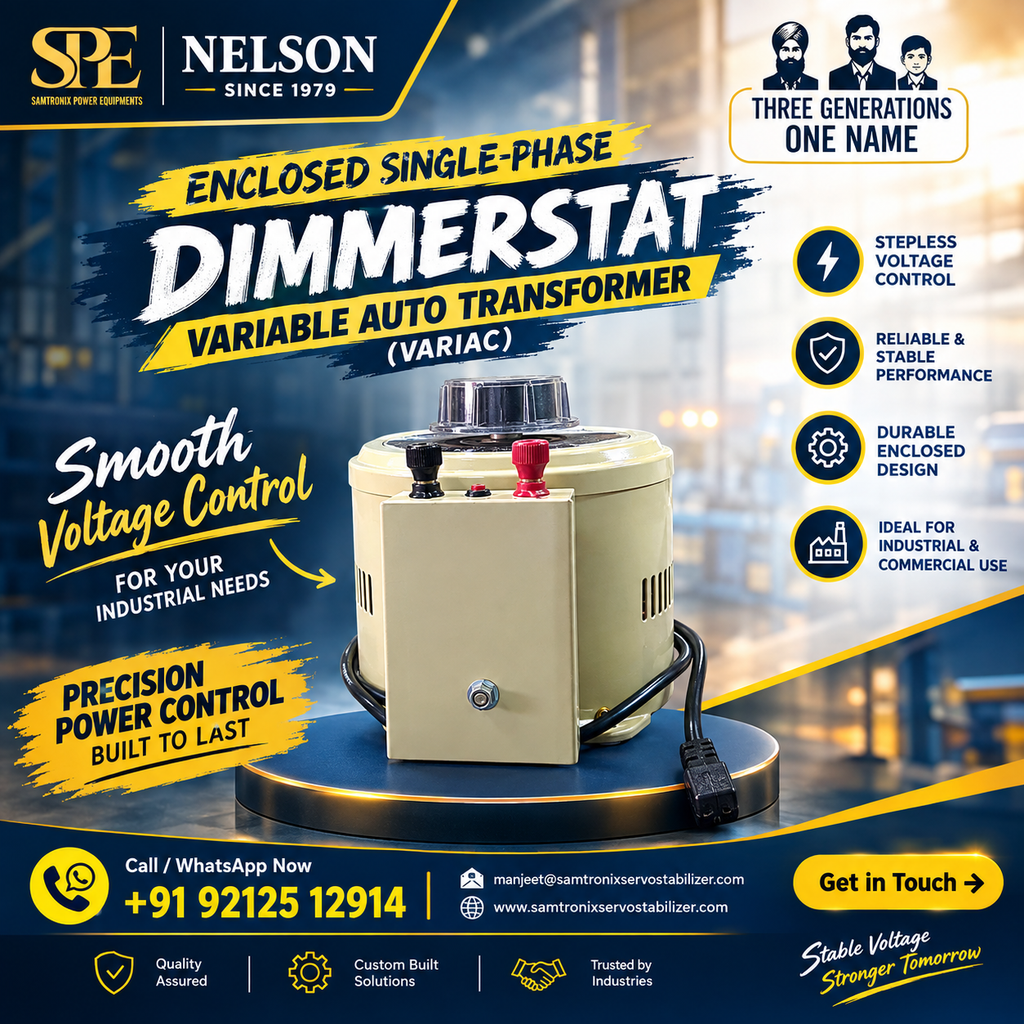
A Single Phase Variac is a variable autotransformer designed to provide smooth and adjustable AC output voltage. Instead of depending on only a few fixed voltage steps, the output can be adjusted continuously through a control knob. This gives the operator much better control when a particular voltage level is required for a machine, test setup, electrical component, heating application, or other AC load.
For industries and technical workplaces, controlled voltage is not only about convenience. It can make testing more systematic, help technicians identify electrical problems, and allow equipment to be operated at a required voltage level during specific procedures. A properly designed Single Phase Variac can therefore become an important part of an electrical testing and control setup.
Samtronix Power Equipments manufactures electrical power-control solutions with a focus on practical industrial requirements. Its enclosed variable transformer design provides a compact arrangement where the operating components are protected inside a suitable enclosure while the operator can adjust the output through the control mechanism.
What Is a Single Phase Variac?
A Single Phase Variac is a variable AC transformer based on an autotransformer arrangement. It uses a winding and a movable contact mechanism to obtain the required output voltage from different points of the winding.
When the operator turns the control knob, the contact position changes. This changes the effective number of turns used for the output and consequently changes the output voltage. The result is a smooth voltage adjustment rather than a simple fixed-voltage selection.
This operating principle makes a Single Phase Variac useful where electrical equipment needs controlled AC voltage during testing, adjustment, development, maintenance, or production.
The enclosed design shown in the product image is especially useful where the variable transformer needs a protected external housing. The enclosure also gives the product a neat appearance and makes it easier to integrate into a working environment.
How Does a Single Phase Variac Work?
The working principle of a Single Phase Variac is relatively straightforward, but its practical usefulness is significant.
The AC supply is connected to the transformer winding. A movable brush or contact travels over the winding as the control knob is rotated. The selected contact point determines the voltage available at the output.
For example, if a technician is testing equipment and needs to gradually increase the AC voltage, the operator can begin from a low output and rotate the control gradually. The connected equipment can then be observed as voltage is increased.
This type of controlled adjustment can be useful for identifying the point at which a device starts operating, checking its response to voltage changes, or carrying out controlled electrical testing.
| Component | Function |
|---|---|
| AC Input | Supplies single-phase electrical power |
| Transformer Winding | Provides the variable voltage path |
| Moving Contact/Brush | Selects the required winding point |
| Control Knob | Allows manual voltage adjustment |
| Enclosure | Protects internal components |
| Output Terminals | Deliver controlled AC voltage |
| Ventilation Openings | Help manage heat generated during operation |
The actual voltage range, current capacity, cooling arrangement, and construction should always be selected according to the intended application.
Why Smooth Voltage Adjustment Matters
In many electrical applications, simply switching between available voltage levels is not enough. A technician may need to observe equipment behavior at several intermediate voltage levels.
A Single Phase Variac allows this gradual adjustment. This can be useful when testing motors, electrical assemblies, heating systems, lamps, control circuits, power supplies, and other single-phase equipment.
Suppose a machine does not start properly at its normal supply condition. Instead of immediately assuming that the machine itself is faulty, a controlled voltage test can help the technician observe how it behaves as the voltage changes.
Similarly, during product development, an engineer may need to test how an electrical circuit responds to supply fluctuations. A variable AC source can make such testing easier to manage.
The important point is that voltage adjustment should be carried out within the equipment’s specified electrical limits and with appropriate protection.
Important Applications of a Single Phase Variac
A Single Phase Variac can be used across a wide range of technical and industrial activities.
Electrical Testing: Testing is one of the most useful applications. Engineers and technicians can adjust the AC voltage gradually and observe the response of the connected equipment.
This can help when checking starting behavior, operating thresholds, voltage sensitivity, and response under controlled conditions.
Laboratory Applications: Electrical laboratories often require an adjustable AC source for experiments and demonstrations. A Single Phase Variac can provide controlled voltage adjustment for suitable laboratory equipment.
It can also be integrated into testing benches where different voltage levels are required regularly.
Equipment Commissioning: During commissioning, technicians may want to verify equipment operation before running it continuously at its intended operating condition.
A controlled voltage source allows the operator to increase voltage gradually while monitoring current, temperature, sound, vibration, and equipment response.
Maintenance and Troubleshooting: Electrical faults are not always visible. Sometimes equipment behaves differently when supply voltage changes.
A Single Phase Variac can help technicians perform controlled diagnostic tests. It can be used as part of a properly protected troubleshooting setup to understand whether abnormal behavior is related to voltage conditions.
Heating Applications: Certain heating equipment requires controlled AC voltage during testing or process adjustment. A suitable variable transformer can provide gradual voltage control where the load characteristics and transformer rating permit its use.
Product Development: Manufacturers developing electrical products may need to test equipment under different supply conditions.
A Single Phase Variac can be incorporated into a development or testing station for controlled voltage experimentation.
Demonstration and Training: Technical training environments can also benefit from controlled AC voltage sources. Students and technicians can observe how electrical equipment responds when voltage is adjusted gradually.
Common Industrial Problems and How Controlled Voltage Helps
A variable voltage source is most valuable when it solves an actual operational problem.
| Practical Problem | How Controlled Voltage Can Help |
|---|---|
| Equipment does not start as expected | Allows controlled voltage testing |
| Need to observe starting behavior | Voltage can be increased gradually |
| Testing at different AC levels | Provides adjustable output |
| Troubleshooting voltage-sensitive equipment | Helps isolate voltage-related behavior |
| Laboratory requires different AC levels | One adjustable source can support multiple tests |
| Sudden voltage application is undesirable during testing | Allows gradual energization |
| Repeated manual voltage changes are required | Control knob provides convenient adjustment |
| Equipment development requires supply variation | Enables controlled test conditions |
The Single Phase Variac does not automatically correct an unstable incoming supply in the same way as an automatic voltage stabilizer. Its primary role is controlled manual adjustment of AC output. Understanding this difference is important when selecting equipment for an electrical system.
Enclosed Single Phase Variac for Practical Working Environments
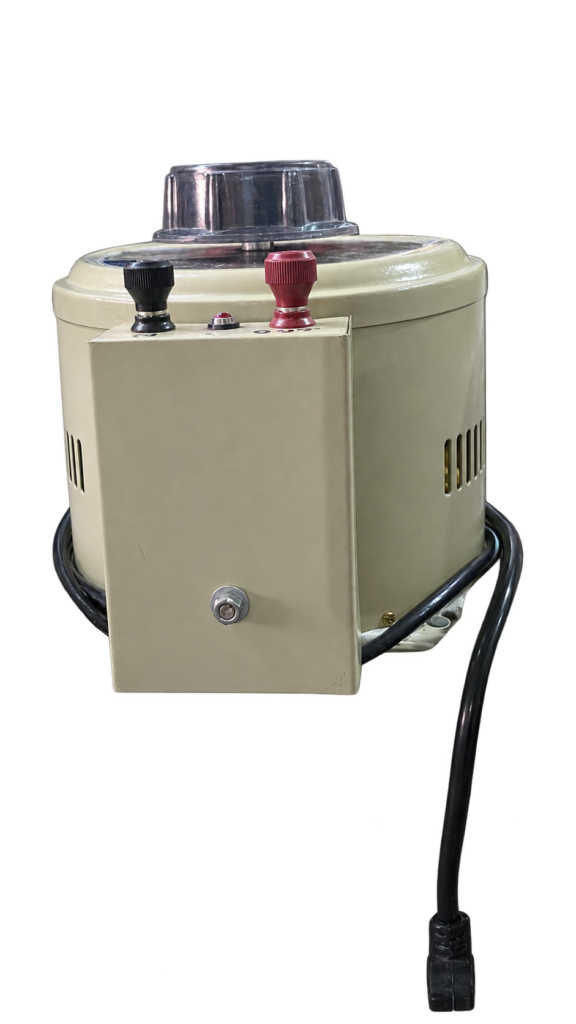
An enclosed Single Phase Variac is designed with its operating components housed inside a protective casing. The image shown features a compact enclosure with a top-mounted adjustment mechanism, terminals, ventilation openings, and a power cable arrangement.
The enclosure can make the unit more convenient for practical use because the internal assembly is not exposed in the same way as an open construction.
For workshops, service areas, laboratories, testing stations, and industrial environments, an enclosed arrangement can also provide a cleaner installation.
The design should still be installed and operated according to appropriate electrical safety practices. An enclosure should not be treated as a replacement for proper earthing, circuit protection, insulation, or safe operating procedures.
Selecting the Right Single Phase Variac
Selecting a Single Phase Variac should begin with the actual electrical requirement rather than only the physical size of the unit.
The first consideration is the input voltage. The required output voltage range should then be established according to the application. Current requirement is equally important because the connected load must remain within the transformer’s rated capability.
The type of load should also be considered. Resistive loads, inductive loads, motors, heating equipment, laboratory equipment, and electronic systems can behave differently when voltage is changed.
The expected operating duration is another important point. A unit intended for occasional testing may have different requirements from one used continuously in an industrial process.
| Selection Parameter | What to Check |
|---|---|
| Phase | Confirm that the application requires single-phase supply |
| Input Voltage | Match the available AC supply |
| Output Range | Define the minimum and maximum required voltage |
| Current Rating | Calculate the expected continuous load current |
| Load Type | Identify resistive, inductive, motor, heating, or other load |
| Duty Cycle | Check whether operation is intermittent or continuous |
| Cooling | Consider heat dissipation for the working environment |
| Enclosure | Select suitable protection for the installation |
| Control | Manual knob or another required control arrangement |
| Protection | Provide suitable electrical protection externally and internally where specified |
A common mistake is selecting a unit only according to the voltage range while ignoring current. A voltage requirement may look suitable on paper, but the load current can determine whether the selected Single Phase Variac is actually suitable for the application.
Single Phase Variac in Testing and Troubleshooting
Troubleshooting becomes easier when the test conditions can be controlled.
Imagine an electrical machine that trips whenever it is switched on. A technician may want to investigate its behavior without repeatedly applying the full operating voltage immediately. With an appropriately rated Single Phase Variac, the technician can establish a controlled test procedure and monitor the equipment as voltage changes.
Measurements such as output voltage, load current, temperature, and abnormal noise can be recorded during the process.
This type of approach can provide useful information for identifying electrical behavior. However, a variable transformer should not be used to bypass protective devices or operate equipment outside its specified limits.
For professional troubleshooting, the test setup should include suitable fuses, circuit breakers, meters, earthing, insulation practices, and other protection required for the application.
Maintenance Practices for a Single Phase Variac
Regular inspection can help maintain reliable operation.
The enclosure should be kept clean and ventilation openings should not become blocked. Dust accumulation around ventilation areas can restrict airflow and increase operating temperature.
The control mechanism should operate smoothly. If the knob becomes unusually stiff, noisy, or inconsistent, the unit should be inspected rather than forced.
Electrical terminals and cables should also be checked periodically for signs of looseness, heating, physical damage, or deterioration.
The internal brush and winding assembly are important working parts of a Single Phase Variac. Excessive wear, sparking, unusual noise, or unstable output should be treated as signs that inspection may be required.
| Maintenance Check | Recommended Attention |
|---|---|
| Enclosure | Check physical condition |
| Ventilation | Keep openings clear |
| Cable | Inspect for cuts or damage |
| Terminals | Check for looseness and heating |
| Control Knob | Ensure smooth movement |
| Output | Verify expected voltage behavior |
| Internal Contact | Inspect during qualified servicing |
| Earthing | Verify continuity according to installation requirements |
Maintenance intervals depend on usage, environment, load, and operating conditions.
Safety Considerations While Using a Single Phase Variac
Safety is especially important because a Single Phase Variac controls AC mains voltage and its output is not automatically isolated from the input supply.
Operators should understand the electrical arrangement before connecting equipment. Appropriate protective devices should be used, and the unit should be properly earthed where required by the installation.
The connected load should remain within the rated voltage and current limits.
The control knob should be adjusted carefully rather than rotated rapidly without observing the output. A suitable voltmeter can be used to monitor the output voltage where the application requires accurate adjustment.
Another important point is that a Single Phase Variac should not be assumed to provide isolation simply because it is called a transformer. An autotransformer uses a common winding arrangement, so isolation requirements must be considered separately when designing the complete test system.
Samtronix Power Equipments: Practical Variable Voltage Solutions
Samtronix Power Equipments focuses on electrical power-control and voltage-management equipment for practical industrial and commercial requirements.
Its enclosed Single Phase Variac design is intended for applications where controlled AC voltage adjustment is required in a compact and accessible arrangement.
The product can be considered for suitable testing, laboratory, service, electrical development, and industrial applications where manual voltage adjustment is part of the operating requirement.
For a proper selection, the required input voltage, output voltage range, current, load type, operating duration, installation environment, and enclosure requirements should be clearly defined before manufacturing or supply.
This helps ensure that the selected Single Phase Variac is matched to the actual electrical application instead of being selected only from a general voltage requirement.
Technical Parameters to Discuss Before Selection
Before ordering or specifying a Single Phase Variac, it is useful to prepare a clear technical requirement.
| Requirement | Information to Provide |
|---|---|
| Application | Testing, laboratory, industrial, heating, development, etc. |
| Input Supply | Available single-phase AC voltage |
| Required Output | Minimum and maximum voltage |
| Load Current | Normal and maximum expected current |
| Load Type | Resistive, inductive, motor, electronic, etc. |
| Operating Mode | Intermittent or continuous |
| Installation | Bench, panel, machine, or enclosure |
| Cooling | Air-cooled or application-specific requirement |
| Control | Manual adjustment or required control arrangement |
| Protection | Required safety and circuit protection |
Providing these details to Samtronix Power Equipments can make the selection and customization process much more precise.
Why Controlled AC Voltage Is Useful in Modern Workplaces
Electrical equipment is becoming more sensitive, while testing requirements are becoming more detailed. Engineers often need to reproduce different operating conditions instead of simply switching equipment ON or OFF.
A Single Phase Variac provides a straightforward method of creating controlled AC voltage conditions.
Its value is particularly visible in service workshops and testing environments where technicians need to repeat the same type of voltage adjustment many times.
Instead of changing wiring repeatedly or using several fixed voltage sources, the operator can adjust the control knob according to the required test condition.
For this reason, a properly selected Single Phase Variac can become a useful component of an electrical test bench, service station, laboratory setup, or industrial control arrangement.
FAQs – Single Phase Variac
1. Why does my Single Phase Variac show unstable output at a particular knob position?
Check the load current, brush/contact condition, terminals, and measurement instrument. A worn contact or overloaded unit can cause irregular output and should be inspected by a qualified technician.
2. Can a Single Phase Variac be used continuously?
It can be designed for continuous operation, but the exact duty depends on its current rating, cooling arrangement, load, ambient conditions, and construction. Confirm the required duty before selecting the unit.
3. Why does the Variac become unusually hot during testing?
Excessive load current, prolonged operation, poor ventilation, or an unsuitable rating can increase heating. Stop the test if temperatures become abnormal and check the complete setup.
4. Can I connect an electronic device directly to a Single Phase Variac?
Only when the device and the test arrangement are suitable for variable AC input. Check the equipment specifications and remember that a Variac does not inherently provide electrical isolation.
5. What should I do if the output voltage does not reach the expected level?
Check the input voltage, rated output range, load condition, connections, and meter accuracy. If the issue remains, the internal contact or winding may require qualified inspection.
6. Why is current rating important when selecting a Single Phase Variac?
Voltage alone does not define the required capacity. The connected load draws current, and exceeding the rated current can cause overheating and damage to the transformer.
7. Can Samtronix Power Equipments provide a Single Phase Variac for a specific application?
Yes, application-specific requirements can be discussed with Samtronix Power Equipments. Provide the input voltage, required output range, current, load type, duty cycle, and installation details for proper specification.
Connect with Samtronix on LinkedIn for Industrial Power Expertise.