
A stable electrical supply is important for equipment that depends on controlled voltage for accurate and consistent operation. Voltage can fluctuate because of changing loads, long distribution lines, starting currents, or variations in the electrical supply. In such situations, having a device that allows controlled manual adjustment of voltage can be useful for testing, production, laboratory work, electrical servicing and other applications. A Single Phase Enclosed Manual Variac is designed around this requirement, providing a practical way to adjust output voltage manually through a rotary control.
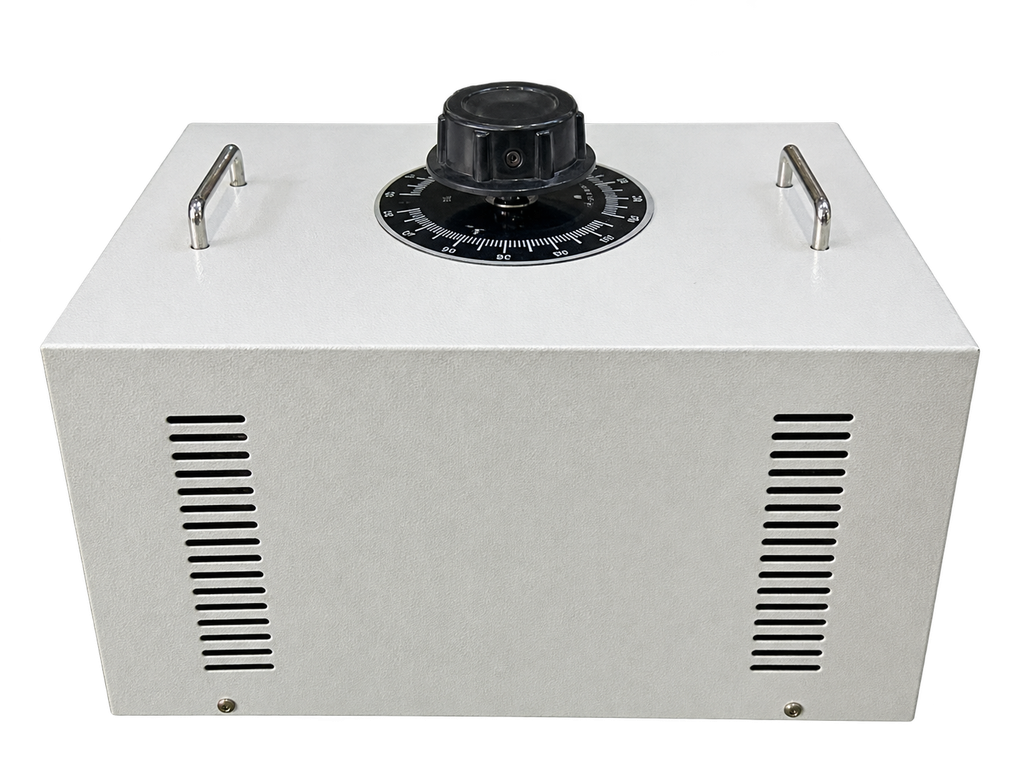
A Single Phase Enclosed Manual Variac combines a variable autotransformer with a protective enclosure. The enclosure provides a more organised and safer form factor for installation and operation, while the manual control allows the operator to increase or decrease the output voltage according to the application requirement. The large dial and rotary knob visible on the equipment make adjustment simple and easy to understand, even for operators who are working with the equipment for the first time.
For industrial users, voltage control is not only about increasing or reducing voltage. It is also about achieving a controlled electrical condition during testing and operation. A Single Phase Enclosed Manual Variac can therefore be used wherever gradual voltage adjustment is needed instead of a fixed output voltage. Samtronix Power Equipments manufactures voltage control equipment with a focus on practical industrial use, dependable construction and application-oriented electrical solutions.
What Is a Single Phase Enclosed Manual Variac?
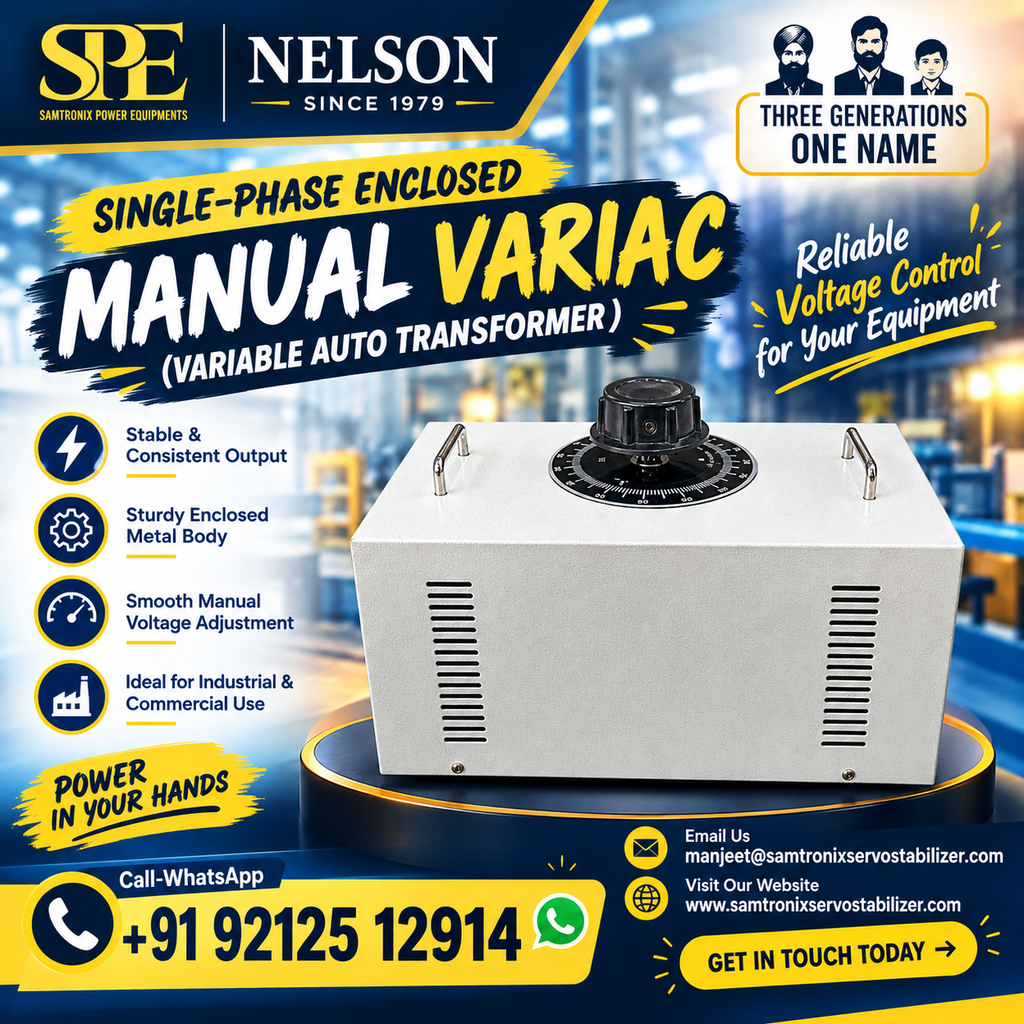
A Single Phase Enclosed Manual Variac is a single-phase variable autotransformer enclosed inside a metal housing. Unlike a conventional fixed transformer, its output voltage can be adjusted manually using a rotary knob. The knob is connected to the variable winding mechanism, allowing the operator to select the required voltage within the designed operating range.
The word “Variac” is commonly used for a variable autotransformer, while “manual” indicates that the voltage adjustment is performed by the operator rather than automatically by a servo control system. The enclosed construction gives the equipment a compact appearance and helps protect the internal electrical components from accidental contact, dust and general industrial handling.
The main advantage of a Single Phase Enclosed Manual Variac is controlled voltage adjustment. An operator can make gradual changes instead of switching directly between predetermined voltage levels. This can be useful when equipment needs to be tested at different voltage conditions or when a specific output level is required for an electrical process.
How Does a Single Phase Enclosed Manual Variac Work?
The working principle is based on a variable autotransformer winding. The input is connected to the winding and a movable contact changes the effective number of turns used for the output. When the operator rotates the control knob, the contact moves along the winding, changing the output voltage.
The calibrated dial helps the operator understand the approximate adjustment position. The actual output should still be verified using a suitable electrical measuring instrument whenever accurate voltage is required. This is especially important in industrial applications because the displayed dial position and actual output voltage can be affected by operating conditions and equipment configuration.
A Single Phase Enclosed Manual Variac does not automatically correct fluctuating mains voltage in the same way an automatic servo stabilizer does. Its primary function is manual variable-voltage control. This difference is important when selecting equipment for a particular electrical application.
Main Construction of the Enclosed Variac
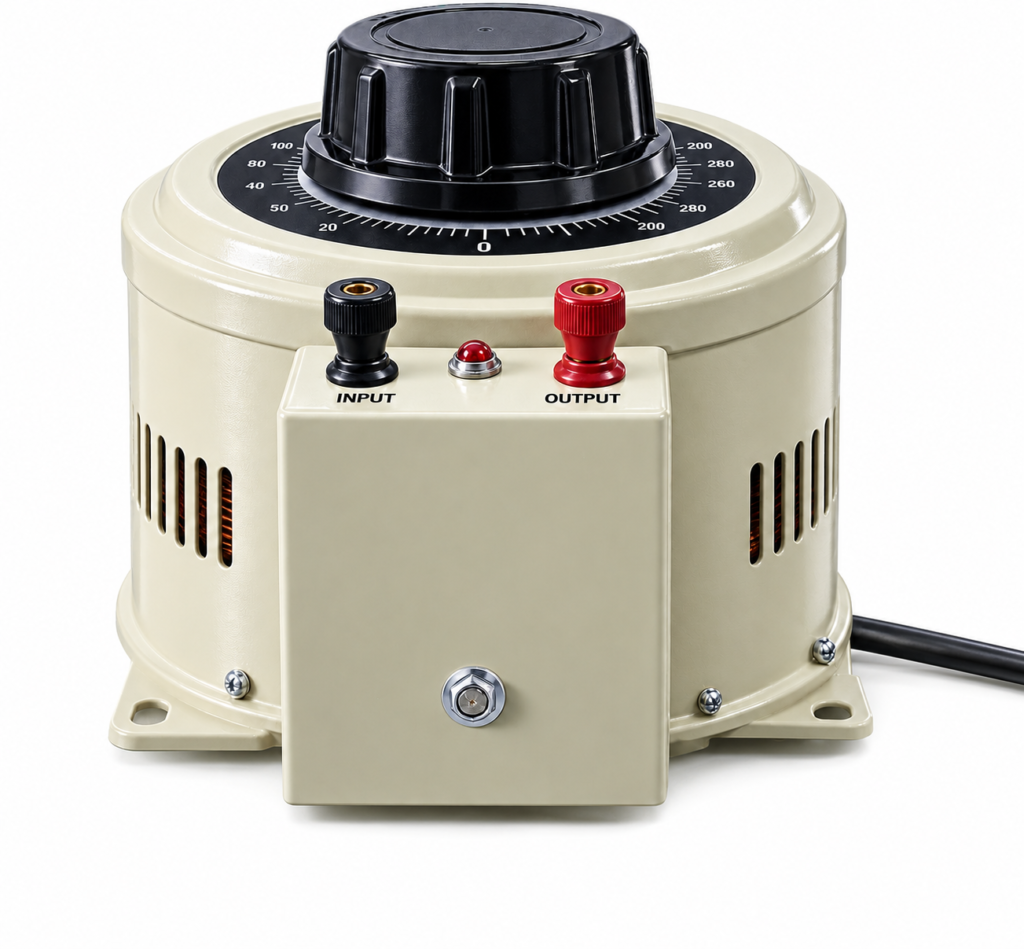
The enclosure normally contains the variable transformer assembly, mechanical adjustment mechanism, terminals and associated electrical components. Ventilation slots can be provided in the housing to assist with heat dissipation during operation.
The front or top-mounted control provides direct access to the adjustment mechanism. In the shown design, the large rotary knob and circular graduated scale provide a clear method of manual voltage adjustment. The metal enclosure also gives the equipment a professional industrial appearance suitable for workshops, laboratories and electrical panels.
| Component | Main Purpose |
|---|---|
| Variable winding | Provides adjustable output voltage |
| Rotary knob | Allows manual voltage adjustment |
| Calibrated dial | Indicates adjustment position |
| Metal enclosure | Provides physical protection |
| Ventilation slots | Assist heat dissipation |
| Electrical terminals | Provide input and output connections |
Why Enclosure Matters in Industrial Voltage Control
An exposed variable transformer may not be suitable for every working environment. Industrial areas can contain dust, tools, moving equipment and frequent operator activity. An enclosed design helps keep the electrical assembly protected within a dedicated housing.
The enclosure also makes installation more organised. A Single Phase Enclosed Manual Variac can be incorporated into a workbench, testing setup, electrical control arrangement or dedicated equipment station, depending on its electrical specification and installation requirements.
However, an enclosure should not be considered a replacement for proper electrical safety practices. Correct earthing, suitable protection, proper cable sizing, ventilation and installation by qualified personnel remain important.
Single Phase Enclosed Manual Variac for Testing Applications
One of the useful applications of a Single Phase Enclosed Manual Variac is controlled electrical testing. Some equipment needs to be operated at different voltage levels during development, servicing or quality checks. A manually adjustable voltage source can make this process more convenient.
For example, an engineer may need to gradually increase voltage while observing how a connected load responds. Instead of repeatedly changing fixed voltage supplies, the operator can rotate the Variac control and monitor the output.
This approach can be helpful for electrical laboratories, service workshops, educational setups, manufacturing inspection areas and equipment testing stations. The exact suitability depends on the required voltage range, current capacity, duty cycle and connected load.
Role of Variac Technology in Servo Stabilizer Systems
Variable autotransformer technology is also relevant to servo voltage stabilizer construction. A servo stabilizer continuously monitors the input and uses a motor-driven mechanism to adjust the variable transformer position when automatic voltage correction is required.
This is where terms such as dimmer type servo stabilizer and variac/dimmer type servo stabilizer manufacturer are commonly used in the industry. The variable transformer or dimmer mechanism acts as an important part of the voltage adjustment system.
A Single Phase Enclosed Manual Variac, however, is manually operated. A servo stabilizer uses a control system and motorised mechanism to perform voltage correction automatically. Understanding this difference prevents confusion when selecting a product for an application.
Linear and Dimmer Technology in Servo Stabilizer
The phrase linear and dimmer technology in servo stabilizer generally relates to the voltage correction mechanism used in servo-controlled systems. A dimmer or variable transformer arrangement provides a continuously adjustable voltage path, while the servo mechanism controls its position according to the correction requirement.
In larger servo stabilizer systems, the dimmer assembly is connected with a motor and control mechanism. When the input voltage changes, the control circuit identifies the deviation and commands the motor to move the variable transformer mechanism.
This is different from manually operating a Single Phase Enclosed Manual Variac. In the manual version, the operator decides the required adjustment. In an automatic servo system, the control circuit performs this task according to the stabilizer’s operating parameters.
Understanding the Dimmer Motor Used in Servo Stabilizers
A dimmer motor is used in servo stabilizer systems to move the variable transformer contact mechanism. The motor does not directly stabilise the voltage by itself. Instead, it provides the mechanical movement required to change the variable transformer position.
Search terms such as dimmer motor for 150 kva servo stabilizer, dimmer motor for servo stabilizer motor for servo stabilizer and servo stabilizer dimmer motor in hyd are often used by people looking for components or technical information related to servo stabilizer assemblies. The required motor and mechanical arrangement depend on the stabilizer design, capacity and control system.
For example, a large industrial stabilizer requires an appropriately designed motor and dimmer assembly capable of handling its intended operating conditions. A Single Phase Enclosed Manual Variac does not normally require this type of automatic motorised correction mechanism because its adjustment is performed manually.
Servo Stabilizer Dimmer Stades and Mechanical Movement
The term servo stabilizer dimmer stades may appear in searches related to dimmer stages or mechanical positions in servo stabilizer systems. In practical terms, the variable contact position determines the voltage transformation ratio.
A gradual movement of the contact produces a gradual change in output voltage. The mechanical design must therefore provide smooth movement and reliable contact with the winding. Poor mechanical alignment, excessive wear or improper maintenance can affect voltage adjustment.
For a Single Phase Enclosed Manual Variac, smooth manual movement is similarly important. The knob should operate properly without excessive force or irregular movement. If the control becomes stiff or unstable, the equipment should be inspected instead of being forced into position.
Single Phase Enclosed Manual Variac in Workshops
Electrical workshops often require adjustable voltage during troubleshooting and servicing. Different electrical devices may respond differently when their supply voltage changes. A Single Phase Enclosed Manual Variac allows technicians to make controlled adjustments while monitoring the connected equipment.
It can be particularly useful when a technician needs to identify whether a device starts correctly at a particular voltage level or when a controlled increase in voltage is required during testing.
The operator should always know the connected load requirements before energising the equipment. The Variac should not be overloaded simply because the output voltage can be adjusted. Current capacity and thermal limitations are equally important.
Applications of Single Phase Enclosed Manual Variac
A Single Phase Enclosed Manual Variac can be used in several controlled-voltage applications. Laboratory testing is one area where manual adjustment is often useful because engineers may need different voltage conditions during experiments and equipment evaluation.
Electrical servicing is another application. Technicians can use adjustable voltage during certain troubleshooting procedures where the connected equipment and testing method allow it. Manufacturing environments may also use variable voltage equipment for inspection or controlled testing of electrical products.
The equipment can also be useful for educational and training applications where understanding voltage variation and transformer operation is required. Its visible control mechanism makes the relationship between knob movement and output voltage easier to demonstrate.
| Application Area | Typical Purpose |
|---|---|
| Electrical laboratory | Controlled voltage testing |
| Service workshop | Equipment troubleshooting |
| Manufacturing | Electrical product testing |
| Research setup | Variable supply experiments |
| Training environment | Transformer demonstrations |
Selecting the Correct Manual Variac
Choosing a Single Phase Enclosed Manual Variac should begin with the electrical requirements rather than only the physical size of the equipment. Input voltage, required output voltage range, current capacity, connected load and operating duration all need to be considered.
The type of load is also important. Resistive loads, inductive loads and electronic equipment can behave differently when supplied through a variable transformer. A suitable design should therefore be selected according to the actual application.
| Selection Factor | Why It Matters |
|---|---|
| Input voltage | Determines compatible supply |
| Output range | Defines adjustment capability |
| Current capacity | Prevents unsuitable loading |
| Load type | Influences operating behaviour |
| Duty cycle | Determines thermal requirements |
| Installation | Affects enclosure and ventilation needs |
Samtronix Power Equipments can help users identify the appropriate configuration according to their application requirements. Providing complete electrical details before selection can make the process more accurate and avoid unnecessary changes later.
Maintenance of a Single Phase Enclosed Manual Variac
Regular inspection helps maintain reliable operation. The enclosure should be kept clean and ventilation openings should not become blocked. Dust accumulation around electrical equipment can interfere with heat dissipation and general maintenance.
The rotary mechanism should also be checked for unusual stiffness, noise or inconsistent movement. Electrical terminals should be inspected periodically by qualified personnel to identify loose connections or signs of heating.
If the output voltage does not respond normally to knob movement, continued operation should be avoided until the equipment has been inspected. Attempting to repair an internal variable transformer while it is energised can create a serious electrical hazard.
Common Operating Problems and Practical Solutions
One common problem is unexpected output voltage. This can happen because the operator is reading the dial incorrectly, the measuring instrument is unsuitable, or the equipment is being operated outside its intended conditions. Checking the actual output using an appropriate meter is therefore more reliable than depending only on the dial.
Another issue can be excessive heating. Heating may occur when the connected load draws current near or above the equipment’s intended capacity or when ventilation is restricted. Checking load requirements and ensuring proper airflow can help identify the cause.
Mechanical stiffness is another problem that should not be ignored. The control mechanism should move smoothly. If it becomes difficult to turn, forcing the knob may damage the internal mechanism.
Safety Considerations for Manual Voltage Adjustment
A Single Phase Enclosed Manual Variac should be installed and operated according to its electrical specifications. The operator should understand that changing the output voltage can directly affect the connected equipment.
The enclosure should remain properly closed during normal operation, and suitable electrical protection should be provided. Earthing should be correctly connected where required. Any maintenance inside the enclosure should be carried out only after the supply has been isolated and the equipment has been verified as de-energised.
It is also important not to assume that lower voltage automatically means lower risk. Electrical energy can remain hazardous, and connected capacitors or other components may retain energy after disconnection.
Samtronix Power Equipments and Voltage Control Solutions
Samtronix Power Equipments provides electrical voltage-control solutions designed around practical industrial requirements. Its product range and engineering approach include servo voltage stabilizers, variable voltage equipment and transformer-related solutions.
For users searching for a variac/dimmer type servo stabilizer manufacturer, it is important to explain the actual application clearly. Requirements can be different for a manually controlled Variac, an automatic servo stabilizer or a specialised dimmer assembly.
The Single Phase Enclosed Manual Variac shown in this application is focused on manual voltage adjustment in a compact enclosed construction. Its straightforward operating concept makes it useful where the operator needs direct control over the output voltage.
FAQs – Single Phase Enclosed Manual Variac
1. Can a Single Phase Enclosed Manual Variac automatically maintain constant output voltage?
No. A manual Variac requires the operator to adjust the voltage. Automatic correction requires a suitable servo stabilizer control system.
2. Why does my Variac become hot during operation?
Heating can result from excessive loading, long operating periods, restricted ventilation or operation outside the specified electrical conditions. The load and ventilation should be checked before continued use.
3. Why does the output voltage not match the dial reading?
The dial may indicate the adjustment position rather than a precise measured output. Always verify the actual voltage with a properly rated measuring instrument.
4. Can a Manual Variac be used with an inductive load?
It may be suitable for certain inductive loads when correctly specified, but the load’s current, starting characteristics and operating requirements must be considered before use.
5. What is the purpose of a dimmer motor in a servo stabilizer?
The dimmer motor moves the variable transformer mechanism so that the servo control system can adjust the output voltage automatically.
6. Can a Single Phase Enclosed Manual Variac replace a servo stabilizer?
Not in applications requiring automatic voltage correction. A manual Variac provides operator-controlled adjustment, while a servo stabilizer is designed for automatic correction.
7. What information should I provide before selecting a Variac?
The input voltage, required output range, load current or capacity, load type, operating duration and intended application are useful details for selecting a suitable configuration.
Connect with Samtronix on LinkedIn for Industrial Power Expertise.