
A production line can stop in seconds, but the reason behind the stoppage may have started much earlier. A machine may suddenly trip, a motor may heat up, a control panel may show an error, or a sensitive electronic system may behave unpredictably. In many industrial environments, one of the factors behind such problems is unstable voltage.
This is where an Industrial Servo Stabilizer Manufacturer in Delhi becomes relevant for factories, workshops, commercial facilities, processing units, hospitals, laboratories, and other installations where electrical equipment depends on a controlled power supply.
A servo voltage stabilizer continuously monitors voltage and automatically corrects variations before supplying power to connected equipment. The basic system uses voltage sensing, a control circuit, a servo motor, a variable transformer and a buck-boost transformer to make the required correction.
For industries operating around Delhi and Industrial Servo Stabilizer Manufacturer in Delhi and the wider NCR region, choosing the right stabilizer is not simply about selecting a KVA number. The input voltage range, connected load, phase configuration, cooling arrangement, correction requirement, installation environment and type of machinery all influence the appropriate design.
Understanding Industrial Voltage Fluctuations

Industrial electrical loads are rarely constant throughout the day. Large motors may start and stop, production machinery may operate simultaneously, and the electrical demand of an industrial area can change significantly.
These conditions can result in variations in the incoming supply. If equipment receives voltage outside its intended operating range for extended periods, its performance can be affected. Motors, automation systems, CNC equipment, control panels, compressors, pumps and other electrical loads may respond differently depending on the severity and duration of the variation.
An Industrial Servo Stabilizer Manufacturer in Delhi generally designs stabilizing systems around the actual electrical conditions of the installation rather than treating every application as identical.
The first step is therefore understanding the electrical problem.
| Industrial condition | Possible operational concern |
|---|---|
| Low incoming voltage | Motors may draw increased current and equipment may lose performance |
| High incoming voltage | Electrical components can experience additional stress |
| Frequent voltage variation | Machines may trip or operate inconsistently |
| Phase imbalance | Three-phase equipment can experience uneven electrical conditions |
| Large motor starting loads | Temporary voltage drops may occur |
| Sensitive control systems | Errors and unexpected shutdowns may occur |
These issues do not necessarily mean that every facility requires the same type of stabilizer. Proper assessment of the electrical installation is important before selecting the equipment.
What Is a Servo Voltage Stabilizer?
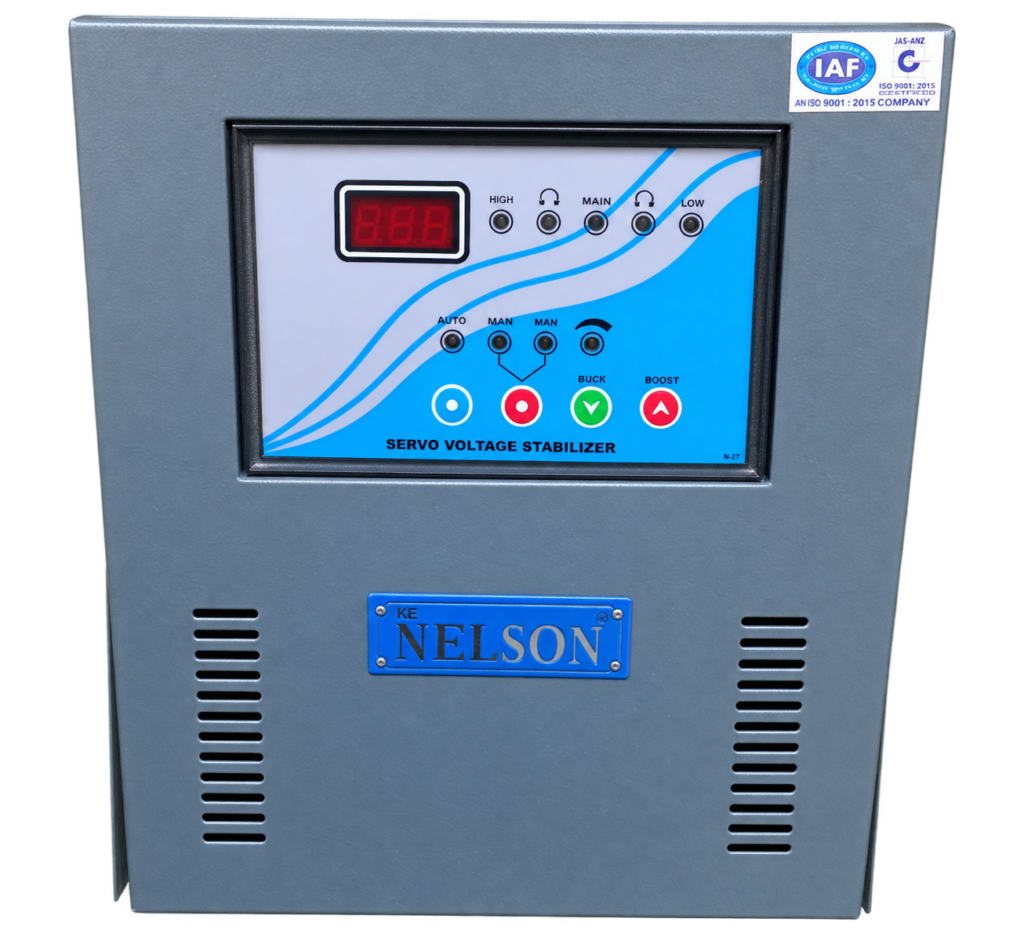
A servo voltage stabilizer is an automatic voltage regulation system designed to maintain a controlled output despite changes in the incoming supply.
Unlike a manually adjusted voltage transformer, the system automatically detects the difference between the incoming or output voltage and the desired reference voltage. The control circuit then directs a servo motor to move the variable transformer mechanism in the required direction.
The corrected voltage passes through the buck-boost transformer, which adds or subtracts the required correction from the supply. This closed-loop process continues automatically.
This is why a Industrial Servo Stabilizer Manufacturer in Delhi is commonly used for industrial applications where maintaining an appropriate voltage level is important for machinery operation.
How a Servo Controlled Voltage Stabilizer Works
The working principle can be understood through four basic stages.
First, the sensing circuit monitors the electrical voltage. It detects whether the supply is above or below the desired reference.
Second, the control circuit processes this information and determines the correction required.
Third, the servo motor moves the variable transformer mechanism according to the correction signal.
Finally, the buck-boost transformer adds or subtracts voltage so that the output moves toward the required level. The system continuously repeats this process.
This makes the servo controlled voltage stabilizer an automatic system rather than a device that requires an operator to manually adjust the voltage whenever the supply changes.
Why Industries Use Servo Stabilizers
Industrial machinery often represents a significant operational investment. A problem with the electrical supply can therefore become an operational problem when it affects machine availability, process consistency or production continuity.
A properly selected Industrial Servo Stabilizer Manufacturer in Delhi can help maintain the voltage supplied to connected equipment within the specified operating range.
Industries may use stabilizers for machinery such as:
| S. No. | Application / Equipment |
|---|---|
| 1 | CNC Machines |
| 2 | Injection Moulding Machines |
| 3 | Packaging Equipment |
| 4 | Textile Machinery |
| 5 | Pumps And Compressors |
| 6 | Production Lines |
| 7 | Automation Systems |
| 8 | Industrial Control Panels |
| 9 | Testing Equipment |
| 10 | Laboratory Equipment |
| 11 | Medical And Diagnostic Equipment |
The suitability of a stabilizer depends on the equipment and electrical conditions at the site. A stabilizer should be selected according to actual load requirements rather than simply choosing the largest available capacity.
Choosing the Correct KVA Capacity
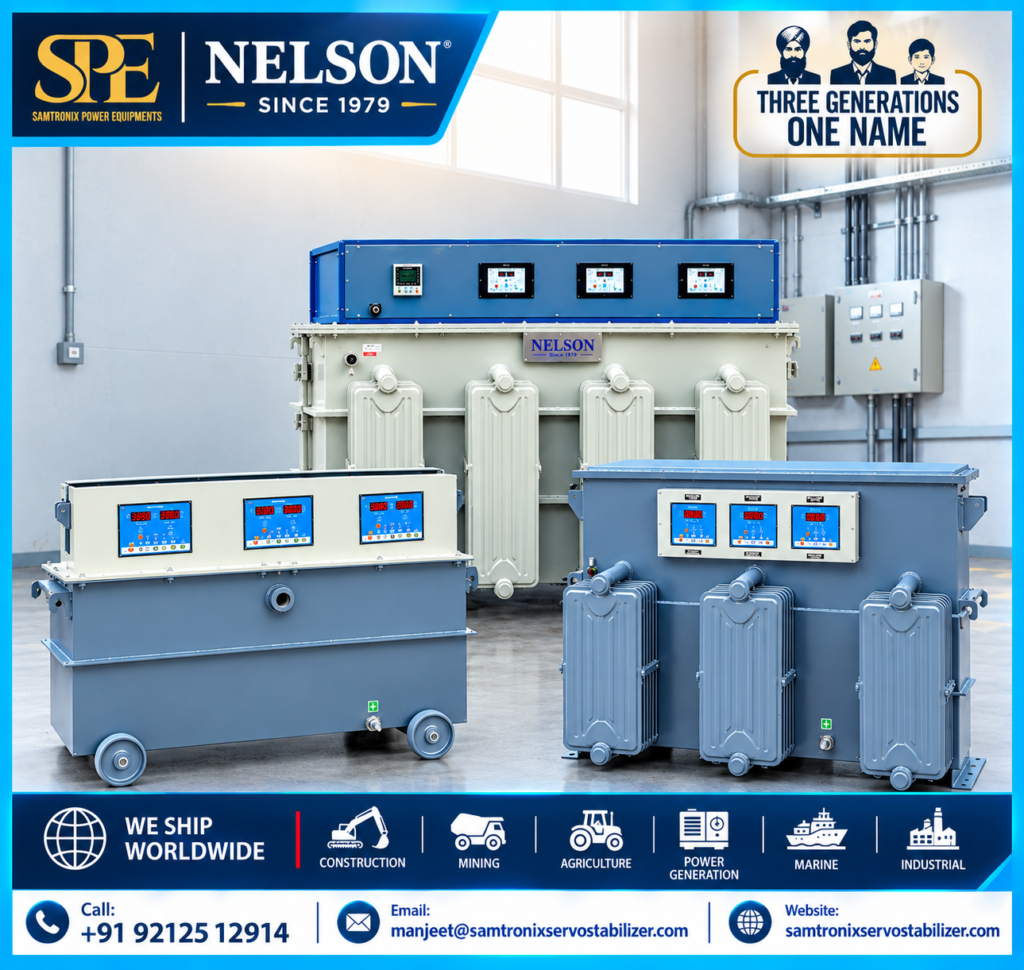
KVA is one of the most important specifications when selecting an industrial stabilizer.
A small installation may require a relatively low-capacity unit, while a manufacturing facility with several machines operating simultaneously may require a considerably larger system.
For example, a 5 kva servo stabilizer may be suitable for a particular smaller load, but that does not mean a 5 KVA unit is appropriate for every small industrial application. Motors, compressors and other inductive loads can have starting characteristics that need to be considered during sizing.
The connected load, maximum simultaneous load, starting current, operating voltage, phase configuration and future expansion should be evaluated before finalizing the capacity.
Searches for servo stabilizer 5kva price or Industrial Servo Stabilizer Manufacturer in Delhi often focus on the capacity alone. However, the technical specification of the unit is equally important because two stabilizers with the same KVA rating may be designed for different electrical conditions.
Common Industrial Servo Stabilizer Capacities
There is no single capacity suitable for every installation. The appropriate rating depends on the electrical load.
| Capacity example | Typical consideration |
|---|---|
| 5 KVA | Smaller electrical loads and selected equipment |
| 10 KVA | Small industrial or commercial applications |
| 15–25 KVA | Multiple equipment or medium-sized loads |
| 30–50 KVA | Larger machinery and industrial sections |
| 100 KVA | Larger connected industrial loads |
| 200 KVA and above | Centralized or heavy industrial applications |
These are capacity examples rather than universal application rules. A technical load assessment should be carried out before choosing the equipment.
3 Phase Servo Stabilizer for Industrial Applications
A 3 phase servo stabilizer is commonly used where machinery operates on a three-phase electrical supply.
Three-phase industrial systems can experience voltage differences between individual phases. This makes phase-wise monitoring and correction particularly relevant for certain industrial installations.
In a three-phase servo stabilizer, the control arrangement can monitor the three phases and make corrections according to the design of the system. Some systems use independent phase control to address phase-specific variations.
This type of equipment can be used with industrial machinery such as CNC systems, production equipment, pumps, compressors, processing machinery and other three-phase loads.
The correct configuration depends on whether the site has balanced or unbalanced loads, the incoming voltage range and the requirements of the connected machinery.
Air-Cooled and Oil-Cooled Industrial Stabilizers
Industrial Servo Stabilizer Manufacturer in Delhi can be designed with different cooling arrangements.
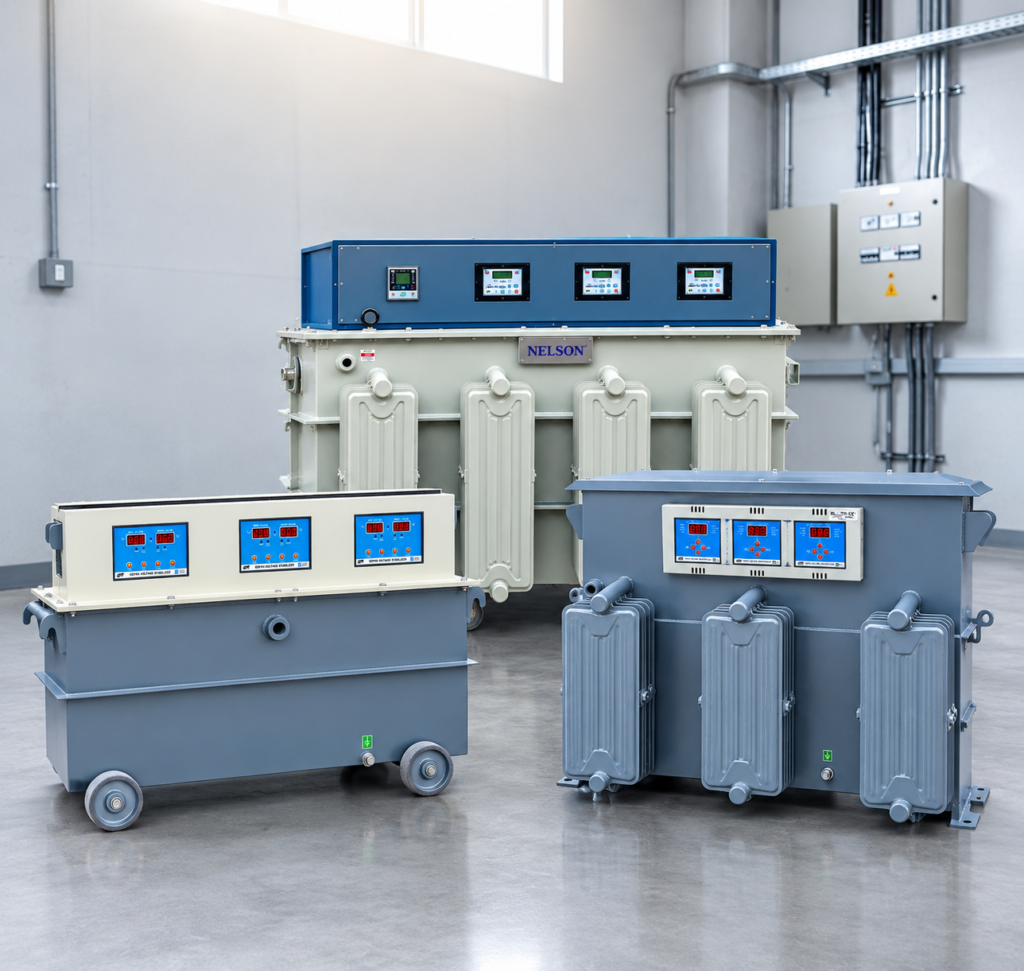
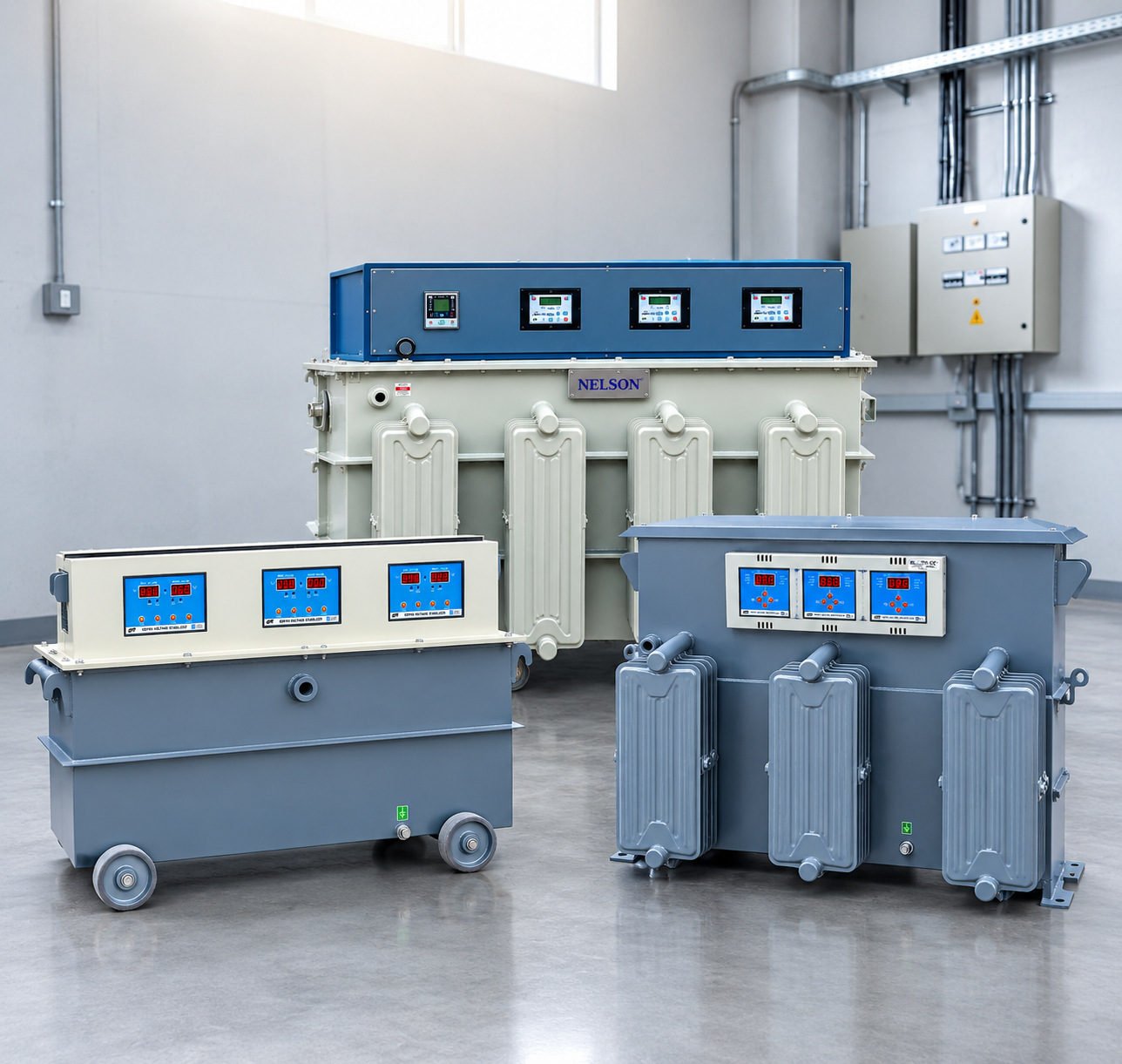
Air-cooled systems dissipate heat through air circulation and are used across many industrial and commercial applications. Oil-cooled systems use insulating oil as part of the thermal management arrangement and are commonly considered for larger or heavy-duty installations.
The choice depends on capacity, duty cycle, installation conditions, available space and the electrical design.
An Industrial Servo Stabilizer Manufacturer in Delhi may therefore need information about the installation environment before recommending an air-cooled or oil-cooled configuration.
| Factor | Air-cooled | Oil-cooled |
|---|---|---|
| Cooling method | Air circulation | Insulating oil |
| Typical consideration | Indoor and selected industrial installations | Larger/heavy-duty applications |
| Maintenance requirement | Depends on design and environment | Requires attention to oil and associated components |
| Selection basis | Capacity and installation conditions | Capacity, duty cycle and installation conditions |
The final selection should be based on engineering requirements rather than simply choosing one cooling method because it appears more suitable.
What Makes a Good Industrial Stabilizer Design?

When evaluating Industrial Servo Stabilizer Manufacturer in Delhi, buyers should look beyond the outer cabinet.
Important technical areas include the quality of the variable transformer, servo motor, control system, transformer construction, protection system, wiring, terminals, enclosure and monitoring arrangement.
The control circuit is particularly important because it is responsible for detecting voltage changes and directing the correction mechanism.
A properly engineered system should also consider protection against conditions such as overload, excessive voltage and other abnormal operating situations according to the design specification.
Servo Stabilizer Manufacturers in Delhi and Site Requirements
Delhi and NCR contain a wide range of industrial and commercial installations, so electrical requirements can vary considerably from one facility to another.
An Industrial Servo Stabilizer Manufacturer in Delhi may encounter applications involving machinery with different load patterns, input ranges and operating environments.
These questions help determine the configuration rather than relying only on the nameplate KVA.
Servo Voltage Stabilizer Manufacturer Selection Considerations
When looking at servo stabilizer manufacturers in delhi, businesses can evaluate manufacturers based on technical and service-related factors.
| Area to evaluate | Why it matters |
|---|---|
| Manufacturing capability | Helps determine whether the design can match the application |
| Technical specifications | Defines actual operating capability |
| Input range | Determines the voltage variation the unit is designed to handle |
| Output regulation | Indicates the expected stability of the supplied voltage |
| Capacity | Must match the connected electrical load |
| Phase configuration | Should correspond with the site’s electrical system |
| Cooling method | Should suit capacity and operating conditions |
| Protection features | Helps address specified abnormal conditions |
| Installation support | Important for correct commissioning |
| Service support | Useful for maintenance and troubleshooting |
This approach is more useful than selecting a unit only from a generic servo stabilizer price list.
Why Input Voltage Range Matters
Two factories may have identical machinery but completely different voltage conditions.
One site might experience relatively small variations, while another may regularly experience wider fluctuations. Therefore, the required input range should be established through measurements or reliable site information.
An Industrial Servo Stabilizer Manufacturer in Delhi can use this information to determine the appropriate correction range.
For industrial buyers, it is useful to monitor voltage at different times of the day rather than taking only one reading. Morning, afternoon, evening and high-load operating periods can provide a clearer picture of the site’s electrical conditions.
Servo Voltage Stabilizers and Sensitive Machinery
Modern industrial machinery often contains electronic controls, sensors, drives and programmable systems. These components can be sensitive to electrical conditions.
A Industrial Servo Stabilizer Manufacturer in Delhi does not replace every form of power-quality equipment. For example, voltage stabilization and protection from transient disturbances are separate considerations.
The purpose of the stabilizer is primarily voltage regulation. Additional equipment may be required depending on the nature of the electrical problem and the machinery involved.
Understanding this distinction helps industries avoid expecting one device to solve every power-quality issue.
Maintenance of an Industrial Servo Stabilizer
Like other electromechanical equipment, a servo stabilizer requires appropriate maintenance.
The exact maintenance schedule depends on the design, operating environment and usage. General inspection areas can include electrical connections, control components, ventilation, moving mechanisms, transformer condition and signs of abnormal heating.
For systems using a motor-driven variable transformer, the mechanical movement and associated components should also be inspected as recommended by the manufacturer.
Keeping maintenance records can help identify recurring voltage conditions or developing equipment issues before they become operational problems.
Applications Across Industrial Sectors
Servo voltage stabilizers are used across different industries because voltage regulation can be relevant wherever electrical machinery requires a controlled supply.
Typical application areas include manufacturing plants, engineering workshops, textile units, printing facilities, packaging plants, pharmaceutical production, laboratories, hospitals, commercial buildings and other installations with sensitive or high-value electrical equipment.
The actual stabilizer configuration will differ according to the machinery and electrical infrastructure.
A 5 kva servo stabilizer, for instance, may serve a completely different purpose from a large centralized industrial stabilizer. Capacity should therefore always be considered alongside the load characteristics.
Understanding Servo Stabilizer Price Searches
People frequently search terms such as servo stabilizer price and Industrial Servo Stabilizer Manufacturer in Delhi and servo stabilizer 5kva price when beginning their research.
However, a meaningful technical evaluation cannot be based only on a price figure because stabilizers can differ in capacity, input range, output regulation, transformer construction, control system, cooling method, enclosure and protection features.
For an industrial installation, the specification should be established first. Once the required configuration is known, different technical proposals can be evaluated on the same basis.
This makes the purchasing process more practical and helps prevent the selection of a unit that does not match the site’s electrical requirements.
Role of an Industrial Servo Stabilizer Manufacturer in Delhi
A Industrial Servo Stabilizer Manufacturer in Delhi Manufacturer is not simply responsible for placing components inside a cabinet. Industrial applications often require the stabilizer to be configured around the electrical conditions of the installation.
An Industrial Servo Stabilizer Manufacturer in Delhi may work with information about the incoming supply, connected machinery, load pattern, capacity requirement, cooling arrangement and installation environment.
This is particularly important for customized industrial systems where standard specifications may not completely describe the site’s requirements.
A technical approach can also help identify whether a single-phase servo voltage stabilizer, 3 phase servo stabilizer, air-cooled system or oil-cooled system is appropriate for the application.
Practical Selection Checklist
Before approaching servo stabilizer manufacturers, an industrial buyer can prepare a few basic details.
| Information | What to provide |
|---|---|
| Supply | Single phase or three phase |
| Input voltage | Minimum and maximum observed voltage |
| Required output | Equipment’s required operating voltage |
| Connected load | Total connected KVA or electrical load |
| Running load | Maximum simultaneous operating load |
| Motors | Motor ratings and starting requirements |
| Installation | Indoor or outdoor |
| Cooling | Site and environmental conditions |
| Operating hours | Intermittent or continuous operation |
| Future expansion | Expected additional machinery |
Providing these details allows the manufacturer to understand the application more accurately.
FAQs | Industrial Servo Stabilizer Manufacturer in Delhi
1. What does an Industrial Servo Stabilizer Manufacturer in Delhi do?
An Industrial Servo Stabilizer Manufacturer in Delhi designs and manufactures automatic voltage regulation systems according to the electrical requirements of industrial applications.
2. What is a servo voltage stabilizer?
A servo voltage stabilizer automatically corrects variations in incoming AC voltage using a control circuit, servo motor, variable transformer and buck-boost transformer.
3. Is a 5 KVA servo stabilizer suitable for every small machine?
No. The required capacity depends on the machine’s actual electrical load, starting characteristics and operating conditions.
4. When is a 3 phase servo stabilizer required?
A 3 phase servo stabilizer is generally considered for equipment and installations operating on a three-phase supply.
5. What information is needed to select a stabilizer?
Input voltage range, output requirement, connected load, phase configuration, motor loads and installation conditions are important starting points.
6. What is the difference between a servo stabilizer and a servo controlled voltage stabilizer?
In common industrial usage, both terms can describe voltage stabilizers that use a servo-controlled mechanism for automatic voltage correction.
7. How often should an industrial servo stabilizer be maintained?
The maintenance interval depends on the stabilizer design, operating conditions and manufacturer’s recommendations. Regular inspection is important for continuously operating industrial systems.
Connect with Samtronix on LinkedIn for Industrial Power Expertise.