
Imagine a CNC machine running smoothly, a production line working continuously, and sensitive electrical equipment receiving a controlled power supply. Then, without warning, the incoming voltage rises or drops. The machine may stop, production can be interrupted, and repeated electrical stress can affect equipment performance.
This is where a properly selected servo voltage stabilizer becomes important.
New Delhi has a large mix of manufacturing units, offices, hospitals, laboratories, workshops, printing units, automation facilities, commercial buildings, and other electrical installations. Many of these applications depend on equipment that requires a controlled and stable voltage supply.
For such environments, finding experienced Servo Stabilizer Manufacturers is not simply about purchasing a cabinet and connecting it to the electrical system. The stabilizer needs to be selected according to the connected load, input voltage conditions, phase requirement, installation environment, and operating pattern.
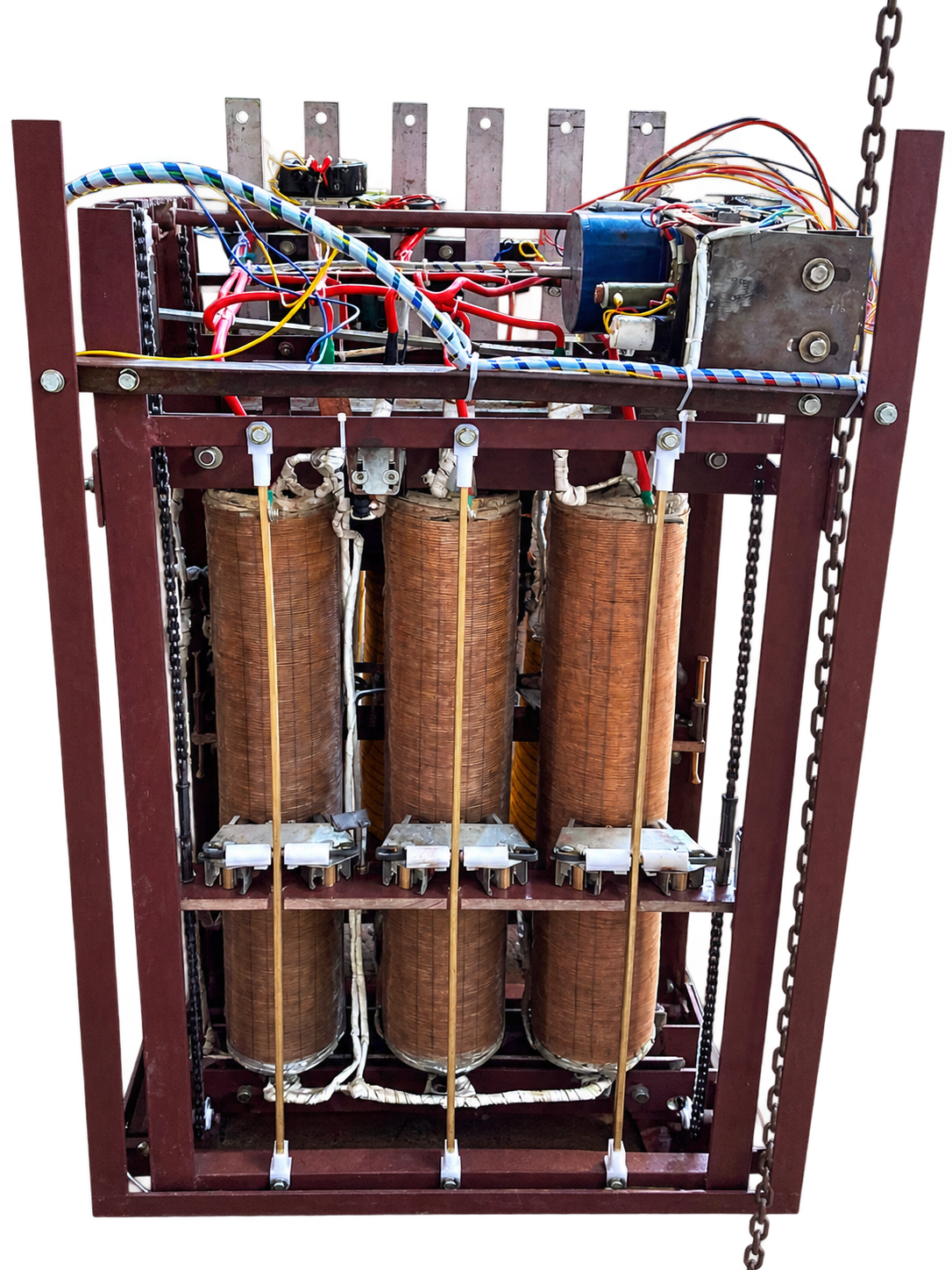

Why Voltage Stability Matters In New Delhi
Electrical equipment may not always receive exactly the same incoming voltage throughout the day. Changes in electrical loads, distribution conditions, and the starting of large motors can contribute to voltage variation.
The effect can become more noticeable in facilities where several machines operate at the same time.
A servo voltage stabilizer continuously monitors the incoming supply and uses an automatic correction mechanism to regulate the output. Servo-based systems generally use a motorized variac and buck-boost transformer arrangement, allowing the correction mechanism to adjust the voltage according to the incoming condition.
Manufacturers serving industrial applications commonly provide air-cooled and oil-cooled designs along with single-phase and three-phase configurations.
For a business in New Delhi, the important question is not simply whether a stabilizer is available. The important question is whether the unit is engineered for the actual electrical requirement.
What Do Servo Stabilizer Manufacturers Actually Provide?
Professional Servo Stabilizer Manufacturers generally work around the complete voltage-regulation requirement rather than simply supplying a finished cabinet.
The manufacturing process can involve transformer selection, winding design, control-system selection, sensing circuits, motorized mechanisms, protection features, enclosure design, cooling arrangements, wiring, and testing.
A good manufacturer should first understand the application. A small commercial load and a heavy industrial machine do not necessarily require the same configuration.
Similarly, an indoor installation and an outdoor industrial installation may have completely different environmental requirements.
This is why technical discussions before manufacturing or supplying a unit are useful. The manufacturer may need information such as connected load, starting current, input voltage range, output voltage requirement, phase configuration, frequency, installation location, and whether the load contains motors, CNC equipment, compressors, pumps, medical equipment, or automation systems.
Servo Voltage Stabilizer For Industrial And Commercial Applications

A servo voltage stabilizer is commonly used where controlled voltage is important for electrical equipment.
Applications can include manufacturing machinery, CNC systems, packaging equipment, printing machinery, medical equipment, laboratories, office infrastructure, automation panels, refrigeration systems, and other sensitive electrical loads.
The exact configuration depends on the electrical system.
A single-phase installation may require a single-phase stabilizer, while industrial machinery connected to a three-phase supply may require a 3 phase servo stabilizer.
Capacity also needs to be selected correctly. A stabilizer should not be selected only from the nameplate of one machine when several loads are connected to the same supply.
Connected load, maximum demand, starting current, future expansion, and actual operating conditions should be considered.
5 KVA Servo Stabilizer: Where Does It Fit?
A 5 kva servo stabilizer can be suitable for smaller electrical loads when the connected equipment falls within the required capacity and electrical specifications.
It may be considered for selected commercial equipment, small machines, office installations, laboratories, or other applications where the load calculation supports a 5 kVA unit.
A common mistake is selecting a stabilizer only because the equipment is described as a 5 kVA load. Electrical engineers or experienced Servo Stabilizer Manufacturers may also examine the type of load.
Motors and compressors, for example, can have higher starting requirements than their normal running consumption.
Before selecting a servo stabilizer 5kva, it is useful to check the actual load, starting characteristics, input voltage variation, phase requirement, and desired output.
Basic Information To Share With A Manufacturer
| Requirement | Why It Matters |
|---|---|
| Connected load | Helps determine suitable capacity |
| Input voltage range | Helps define the required correction range |
| Output voltage | Determines regulated output requirement |
| Single or three phase | Determines stabilizer configuration |
| Load type | Helps account for motors and sensitive equipment |
| Installation location | Influences enclosure and cooling |
| Operating hours | Helps determine continuous-duty requirements |
| Future expansion | Helps avoid immediate capacity limitations |
Understanding A Servo Controlled Voltage Stabilizer

A servo controlled voltage stabilizer uses a feedback-based control arrangement.
The sensing circuit monitors the incoming voltage and the control mechanism operates the servo motor to adjust the variable transformer position. The correction transformer then helps bring the output toward the required voltage.
The process happens automatically while the connected load is operating. This is useful where voltage conditions change and manual adjustment would not be practical.
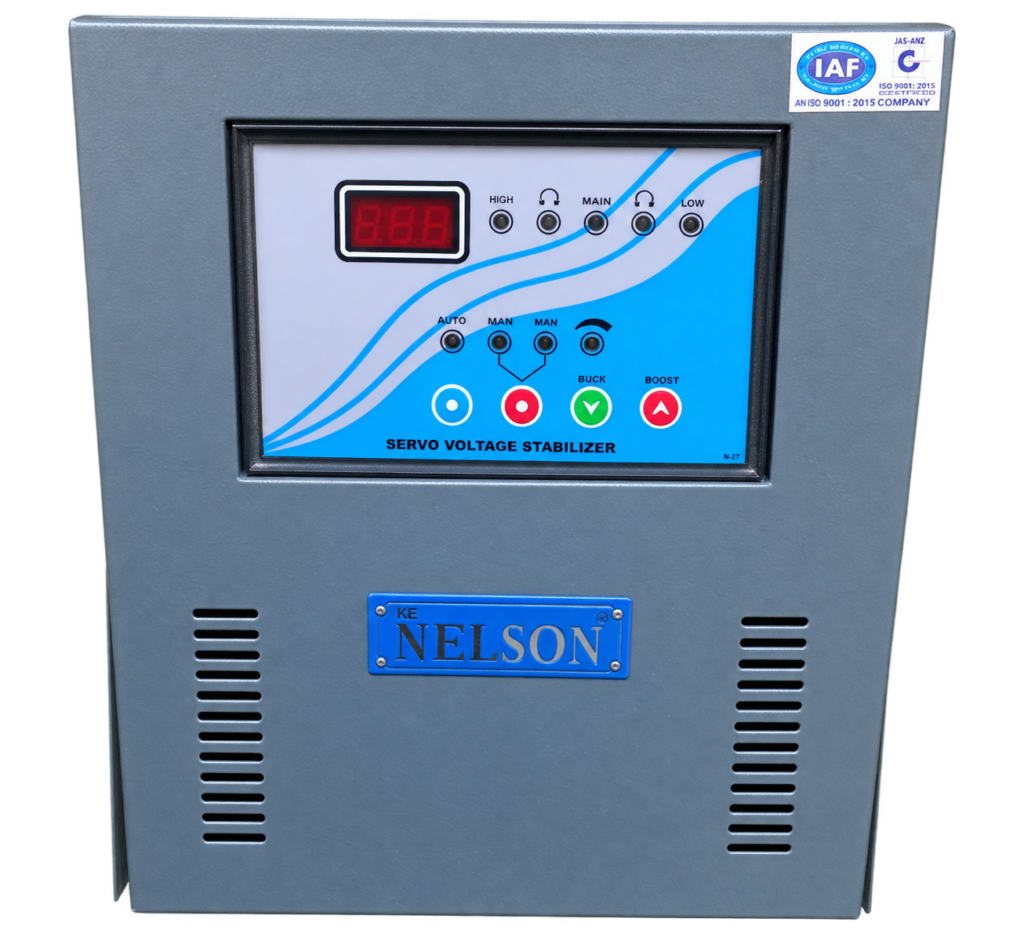
The control system is one of the important parts of the equipment. Depending on the design, stabilizers may include digital displays, high- and low-voltage protection, overload protection, time delay, short-circuit protection, bypass arrangements, and other monitoring features.
The exact protection package should always be confirmed from the technical specification rather than assuming every stabilizer has identical features.
3 Phase Servo Stabilizer For Industrial Loads
Industrial electrical systems often use three-phase power for machinery and larger loads.
A 3 phase servo stabilizer is designed for such systems and regulates the three-phase supply according to its specific configuration.
Three-phase stabilization can be particularly relevant for machinery such as CNC equipment, pumps, compressors, motors, HVAC systems, injection molding equipment, and industrial automation.
A manufacturer may need to evaluate whether the load is balanced or unbalanced and whether individual phase correction is required.
The input voltage range should also be measured instead of being guessed.
For a New Delhi industrial facility, a site assessment can therefore be more useful than selecting a standard model from a catalogue. Actual electrical conditions help determine the appropriate stabilizer design.
Air Cooled And Oil Cooled Designs | Servo Stabilizer Manufacturers
Cooling is another important factor when selecting a stabilizer.
Air-cooled units are commonly used where the installation environment and capacity are suitable for air-based heat dissipation.
Oil-cooled designs use insulating oil for heat transfer and insulation and are commonly associated with larger or heavy-duty industrial installations. Manufacturers serving Delhi and NCR provide both air-cooled and oil-cooled servo stabilizers for different applications.
The selection should depend on capacity, operating conditions, installation location, ambient temperature, duty cycle, and manufacturer recommendations.
How Servo Stabilizer Manufacturers In Delhi Handle Custom Requirements

Not every electrical installation has the same voltage problem.
One facility may experience frequent low voltage, while another may experience a wider fluctuation range. Some installations may have large motors that create temporary voltage disturbances when they start.
Experienced servo stabilizer manufacturers in delhi can therefore use application information to configure the stabilizer around the customer’s electrical system.
Custom requirements may include different input ranges, output voltage settings, indoor or outdoor enclosures, special control panels, different cooling arrangements, additional protection, bypass systems, or specific mounting requirements.
Manufacturers operating in Delhi and NCR list capacities ranging from smaller units to large industrial systems, including single-phase, three-phase, air-cooled, and oil-cooled configurations.
Choosing Servo Stabilizer Manufacturers For A New Delhi Installation
When evaluating Servo Stabilizer Manufacturers, technical capability should be considered alongside manufacturing and after-sales support.
The manufacturer should be able to explain how the stabilizer is designed for the stated input range and load.
The technical documentation should clearly mention capacity, phase, input range, output voltage, frequency, accuracy, protection features, cooling arrangement, and installation requirements.
It is also useful to ask how the unit is tested before dispatch.
Testing may include checking voltage regulation, control operation, protection functions, insulation, wiring, and overall electrical performance depending on the product design.
A manufacturer that understands the application can also help avoid a common problem: selecting a capacity that looks sufficient on paper but does not work properly with the actual load characteristics.
Servo Voltage Stabilizer Manufacturer And After-Sales Support

A stabilizer contains electrical, control, and moving components, so installation and maintenance should not be ignored.
The servo motor, sensing system, control circuit, transformer section, terminals, cooling system, and protection components all have roles in reliable operation.
This makes after-sales support relevant when choosing a servo voltage stabilizer manufacturer.
Installation guidance, commissioning, troubleshooting, maintenance support, and availability of replacement components can become important over the operating life of the equipment.
For industrial installations, it can also be useful to maintain records of input voltage, output voltage, recurring faults, overload events, and maintenance work.
Such records can help technicians identify repeated electrical issues before they become major operational problems.
Common Applications In New Delhi
Voltage stabilization can be required across many sectors.
| Application | Why Voltage Regulation May Matter |
|---|---|
| CNC machinery | Supports controlled supply conditions for sensitive control and drive systems |
| Hospitals | Helps maintain suitable supply conditions for electrical equipment |
| Laboratories | Supports sensitive instruments and testing equipment |
| Printing units | Helps electronic and motor-driven systems operate consistently |
| Packaging machinery | Supports automation and motor loads |
| Offices | Can support computers and sensitive electronic equipment |
| Manufacturing plants | Useful for production machinery operating for extended periods |
| Workshops | Can support machines exposed to changing supply conditions |
The exact stabilizer specification still needs to be determined from the electrical load rather than the application name alone.
What Information Should Be Checked Before Ordering?
Before contacting Servo Stabilizer Manufacturers, collecting a few technical details can make the selection process much easier.
First, check the incoming voltage using a suitable meter over different operating periods if possible. A single voltage reading may not show the complete variation.
Next, identify the connected load and determine whether the equipment operates continuously or intermittently.
The phase requirement should also be confirmed.
Check whether the load contains motors, compressors, welding equipment, CNC drives, UPS systems, or other equipment with special starting or electrical characteristics.
The installation location matters too.
Indoor electrical rooms, workshops, rooftops, outdoor areas, and dusty industrial environments may require different enclosure and cooling considerations.
Why Correct Capacity Selection Matters
Selecting a stabilizer with an unsuitable capacity can create operational problems.
An undersized unit may be overloaded when connected equipment reaches its operating demand or when motors start.
An unnecessarily large unit may also create installation and electrical-planning considerations that should be evaluated by the responsible engineer.
For this reason, Servo Stabilizer Manufacturers normally need more information than just the kVA written on one machine.
A proper load assessment should consider connected load, maximum demand, starting current, power factor, phase balance, input voltage range, and possible future load additions.
Servo Stabilizer Price Searches And Technical Selection
People researching voltage stabilizers online may use phrases such as servo stabilizer 5kva price, servo stabilizer price, or servo stabilizer 5kva.
However, a useful technical selection should not be based on a search phrase alone.
The specification of a stabilizer can change according to capacity, input range, phase, cooling arrangement, enclosure, control system, protection requirements, and customization.
For this reason, buyers should first establish the electrical requirement and then request a technical specification from the manufacturer.
This keeps the selection process focused on the actual electrical requirement instead of choosing equipment only from a generic product name.
Finding Servo Stabilizer Manufacturers Suppliers In New Delhi
New Delhi and the surrounding NCR region have manufacturers, suppliers, and service providers working with industrial voltage stabilization.
Several manufacturers serving the region list products for applications ranging from smaller commercial loads to large industrial systems.
When searching for servo stabilizer manufacturers in delhi, use specific technical terms according to the requirement.
For example, a buyer may search for a servo voltage stabilizer manufacturer for an industrial project, a 3 phase servo stabilizer for a factory, or a 5 kVA stabilizer for a smaller electrical installation.
The supplier should be able to provide a clear technical datasheet and explain installation requirements.
For larger systems, site inspection and load analysis can be particularly useful.
Installation And Maintenance Practices
Correct installation is just as important as selecting the stabilizer.
The unit should be installed in a suitable location with adequate ventilation or cooling clearance according to its design.
Electrical connections should be completed by qualified personnel and properly sized according to the system requirements.
The stabilizer should also be protected from unnecessary moisture, excessive dust, physical obstruction, and conditions outside the manufacturer’s specified operating environment.
Routine maintenance can include checking terminals, control wiring, ventilation, moving components, electrical connections, and protection functions.
Oil-cooled units require additional attention to the condition and level of insulating oil according to the manufacturer’s maintenance instructions.
Practical Checklist For Buyers
Before finalizing a stabilizer requirement, keep the following information ready:
| Checkpoint | Information To Collect |
|---|---|
| Load | Total connected and maximum operating load |
| Phase | Single phase or three phase |
| Input | Minimum and maximum observed voltage |
| Output | Required regulated voltage |
| Load type | Motor, CNC, electronics, heating, mixed load, etc. |
| Location | Indoor, outdoor, electrical room, workshop |
| Cooling | Air cooled or oil cooled requirement |
| Protection | Required electrical protection features |
| Installation | Space, ventilation, cable entry and foundation |
| Service | Installation, commissioning and maintenance support |
This information allows Servo Stabilizer Manufacturers to understand the application before recommending a configuration.
FAQs – Servo Stabilizer Manufacturers
1. What is a 5 kva servo stabilizer used for?
A 5 kva servo stabilizer is intended for electrical loads that fall within its rated capacity. The connected load and starting characteristics should be checked before selection.
2. When is a 3 phase servo stabilizer required?
It is generally used when the electrical installation has a three-phase supply and the connected equipment requires regulated three-phase power.
3. How do I select the right stabilizer capacity?
Start with the actual connected load, maximum demand, starting current, input voltage range, phase requirement, and future expansion. A qualified engineer or manufacturer can then help determine the suitable capacity.
4. What should I ask a servo voltage stabilizer manufacturer?
Ask for the technical datasheet, input range, output specification, accuracy, protection features, cooling method, installation requirements, testing procedure, warranty terms, and service support.
5. Can servo stabilizers be used for industrial machinery?
Yes. Servo stabilizers are used in many industrial applications, including machinery, automation systems, CNC equipment, pumps, compressors, and production equipment, provided the stabilizer is correctly designed for the load.
6. Are all servo stabilizers suitable for the same voltage conditions?
No. Stabilizers can have different input ranges, capacities, phase configurations, cooling methods, control systems, and protection features. The actual electrical conditions should be checked before selecting the unit.
Connect with Samtronix on LinkedIn for Industrial Power Expertise.