
A three phase dry type transformer is an important electrical solution for industries and commercial facilities where stable, safe and dependable power distribution is required. Unlike oil-filled transformers, this type of transformer does not depend on liquid insulation for cooling and electrical isolation. Its dry construction makes it suitable for many indoor and controlled industrial environments where cleanliness, safety and easier maintenance are important.
Samtronix Power Equipments provides transformer and power equipment solutions designed around practical industrial requirements. A properly selected three phase dry type transformer can support electrical systems where voltage transformation, dependable distribution and operational safety are important. The transformer should be selected according to the actual electrical load, input and output voltage, installation conditions and application requirements.
The demand for a three phase dry type transformer is increasing in industrial electrical systems because modern machines, automation equipment and commercial installations require consistent power. Voltage problems can affect sensitive equipment, create unexpected shutdowns and reduce operational efficiency. A correctly designed transformer helps create a more controlled electrical supply for connected equipment.
What Is a Three Phase Dry Type Transformer?
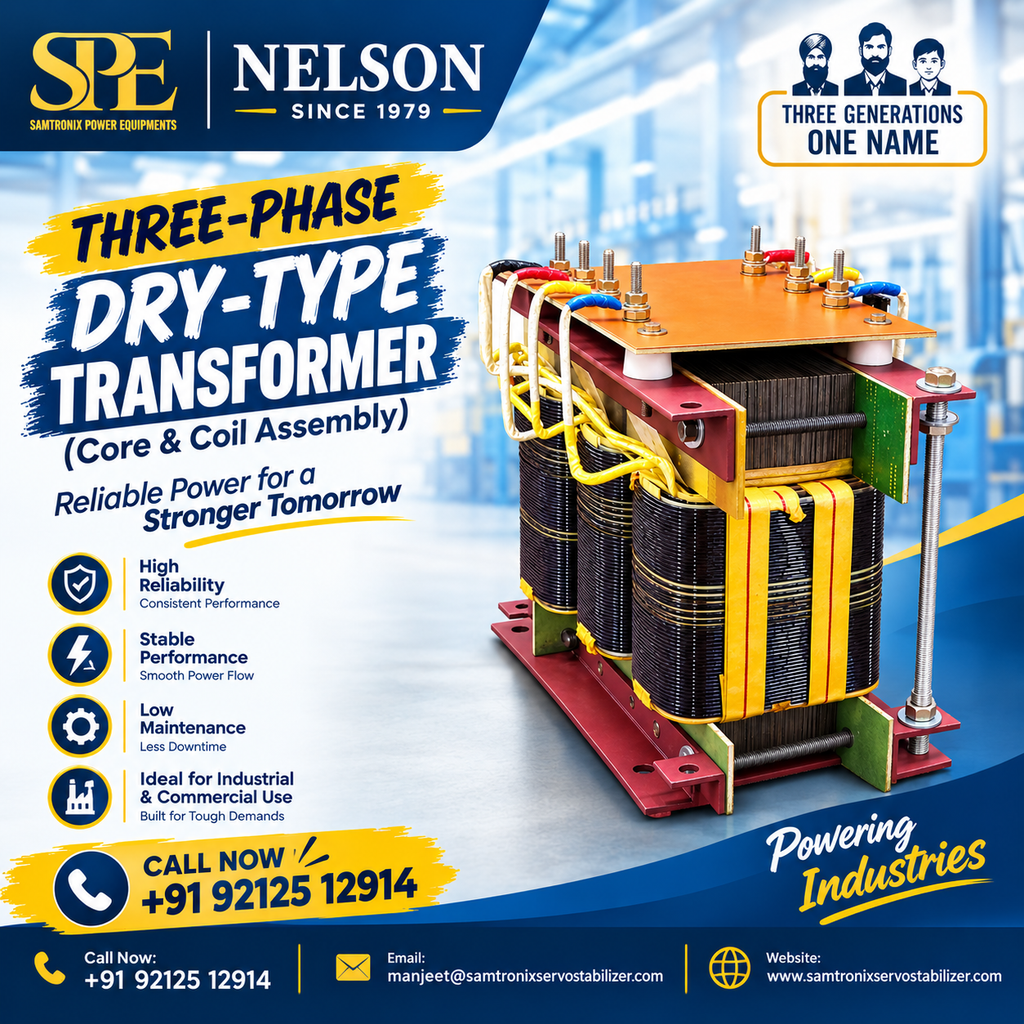
A three phase dry type transformer is an electrical transformer designed to transfer electrical energy between circuits while changing voltage levels. It operates with three-phase electrical power and uses air or solid insulation systems rather than conventional liquid insulation.
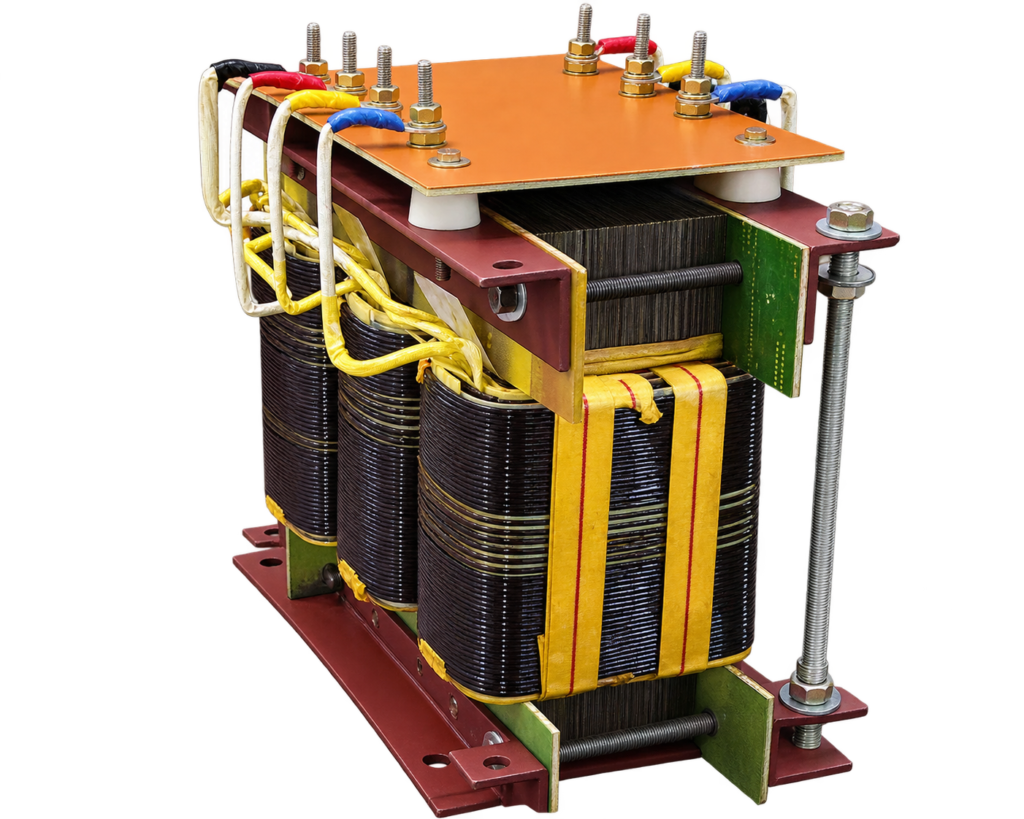
The core and coil assembly shown in the product design contains the magnetic core, windings, insulation materials and mechanical clamping arrangement. The windings are carefully arranged to provide the required electrical transformation while maintaining suitable insulation between electrical sections.
A three phase dry type transformer can be designed for different industrial voltage requirements. Depending on the application, it may be used as a distribution transformer, power transformer, isolation transformer or part of a larger electrical power system.
The dry construction is especially useful when an installation needs a transformer without oil. It can make installation and maintenance more convenient in suitable environments, although proper ventilation and electrical safety arrangements are still necessary.
How Does a Three Phase Dry Type Transformer Work?
The working principle of a three phase dry type transformer is based on electromagnetic induction. Electrical energy enters the primary winding and produces a changing magnetic field in the transformer core. This changing magnetic field induces voltage in the secondary winding.
The relationship between primary and secondary windings determines whether the transformer increases or decreases voltage. In practical industrial systems, the required transformation ratio is selected according to the incoming electrical supply and the voltage required by connected equipment.
The core provides a magnetic path for the changing magnetic flux. The windings carry electrical current, while insulation separates conductive parts and helps maintain safe electrical operation.
A three phase dry type transformer must also handle heat generated during operation. Since it does not use transformer oil for cooling, heat is transferred through the transformer structure and surrounding air. Proper ventilation around the transformer is therefore very important.
Sometimes installation teams focus mainly on transformer capacity and forget about ventilation space. This can create operating problems later. The installation environment, airflow and operating load should always be considered together.
Three Phase Dry Type Transformer Construction
The construction of a three phase dry type transformer normally includes a magnetic core, primary and secondary windings, insulation system, terminals, clamping structure and supporting frame. Each part has a specific role in achieving reliable electrical performance.
The transformer core is made from magnetic material designed to provide an efficient path for magnetic flux. The windings are manufactured according to the required voltage, current and capacity. Insulation materials are used between windings and other conductive components.
The visible core and coil assembly can look simple from outside, but the internal design is critical. Incorrect winding arrangements, unsuitable insulation or poor mechanical support can affect transformer performance.
For industrial installations, mechanical strength is also important because transformers can experience electromagnetic forces during certain operating conditions. A properly engineered three phase dry type transformer therefore needs both electrical and mechanical reliability.
3 Phase Dry Type Transformer for Industrial Applications
A 3 Phase Dry Type Transformer can be used in manufacturing facilities, commercial buildings, control systems, production plants, workshops and other electrical installations where three-phase power transformation is required.
Industrial equipment often operates continuously for long hours. A transformer used in such an environment needs to be appropriately sized for the actual load. Oversizing and undersizing both need proper engineering consideration because the transformer should match the electrical system rather than being selected only by its nameplate capacity.
An industrial dry type transformer can be integrated into a plant electrical distribution system to supply suitable voltage to machines and other electrical equipment.
Samtronix Power Equipments focuses on power equipment solutions for industrial and commercial requirements, where dependable electrical performance is an important part of daily operations.
Three Phase Dry Type Distribution Transformer
A three phase dry type distribution transformer is designed for electrical distribution applications where voltage needs to be transformed before power reaches different loads.
Distribution systems can include manufacturing units, commercial facilities, institutional buildings and industrial electrical networks. The transformer receives power at one voltage level and supplies it at another suitable level.
For example, an 11KV 433V Dry Type Transformer may be considered for systems where medium-voltage input needs to be transformed to a lower voltage suitable for downstream distribution, subject to the actual electrical system design and applicable standards.
A three phase dry type distribution transformer should not be selected only from the voltage numbers. Load demand, fault levels, installation conditions, ambient temperature, harmonics and future electrical requirements can also affect the selection.
Three Phase Air Cooled Transformer
A three phase air cooled transformer uses air as the cooling medium. Heat generated during transformer operation is transferred through the transformer structure into the surrounding air.
This makes a three phase air cooled transformer suitable for installations where an oil-free transformer design is preferred. However, air cooling does not mean ventilation can be ignored.
The transformer room should provide suitable airflow and sufficient clearance. If hot air becomes trapped around the transformer, operating temperature may increase. This is one of the practical installation issues that is sometimes missed during planning.
The actual cooling arrangement depends on the transformer design and application. Natural air cooling and forced-air cooling can be used depending on the required capacity and engineering design.
Cast Resin Dry Type Transformer
A cast resin dry type transformer uses cast resin insulation around the windings. The resin encapsulation provides electrical insulation and mechanical protection to the winding structure.
Cast resin construction can be useful in environments where protection against moisture, dust and other environmental conditions is required. However, the suitability depends on the installation environment and transformer design.
A Cast Resin Dry Type Transformer can be considered for industrial and commercial applications where a robust dry transformer arrangement is needed. Proper installation, ventilation and electrical protection remain important regardless of the insulation technology used.
Three Phase Dry Type Power Transformer
A three phase dry type power transformer is used when electrical power needs to be transformed within a larger power distribution system. Its capacity and voltage configuration depend on the intended application.
For example, requirements can range from smaller commercial installations to larger industrial electrical systems. A Dry Type Transformer 100 KVA may be suitable for a particular smaller load application, while a Dry Type Transformer 500 KVA may be considered where the connected electrical demand is substantially higher.
These capacity examples should not be treated as automatic recommendations. Actual transformer sizing needs to be based on load calculations and system requirements.
The main objective is to provide the required electrical transformation without creating unnecessary operating stress. A correctly engineered three phase dry type transformer can become an important part of a dependable power infrastructure.
Common Transformer Requirements
| Requirement | Typical consideration |
|---|---|
| Three-phase power | Suitable for three-phase electrical distribution |
| Dry construction | No conventional liquid insulation system |
| Air cooling | Requires suitable ventilation and heat dissipation |
| Industrial installation | Designed according to connected load and environment |
| Distribution application | Used for suitable voltage transformation |
| Commercial application | Can support selected building and facility loads |
| Medium-voltage system | Requires appropriate insulation and electrical design |
| Core and coil assembly | Core, windings, insulation and mechanical support |
| Indoor installation | Requires suitable room clearance and ventilation |
| Continuous operation | Requires correct loading and thermal management |
Three Phase Dry Type Transformer Capacity Selection
Capacity selection is one of the most important parts of transformer planning. A three phase dry type transformer should be selected after understanding the connected load, demand load, starting current and expected future requirements.
Motors deserve particular attention because starting current can be considerably higher than normal operating current. If this is ignored during transformer selection, the electrical system may experience unwanted voltage drops during motor starting.
Similarly, equipment with power electronics can introduce harmonics. The transformer design may need to account for such loads depending on the application.
A proper electrical assessment is therefore more useful than simply selecting a transformer based on the current connected load. Industrial requirements can change, and the transformer should be considered as part of the complete power distribution system.
Three Phase Dry Type Transformer Maintenance
Dry transformers generally avoid several maintenance requirements associated with liquid-filled transformer systems, but they are not completely maintenance-free.
Dust accumulation should be controlled because dust can affect insulation surfaces and airflow. Connections should be inspected periodically, especially in industrial environments where vibration or thermal cycling may affect mechanical connections.
The transformer should also be checked for abnormal noise, unusual heating, visible damage or signs of insulation deterioration.
Ventilation openings should remain clear. A blocked ventilation path can reduce heat dissipation and increase operating temperature.
Regular inspection is often easier than dealing with an unexpected electrical failure. Small issues should be identified before they become larger operational problems.
Isolation Transformer and Its Purpose
An isolation transformer is designed to electrically separate one circuit from another while transferring electrical power through electromagnetic induction.
The main isolation transformer purpose is to provide galvanic isolation between the input and output circuits. This can help separate connected equipment from certain electrical disturbances or provide an additional layer of electrical separation when properly designed into a system.
So, what is isolation transformer technology in practical terms? It is a transformer arrangement where the primary and secondary circuits are electrically separated rather than directly connected.
The isolation transformer working principle is based on electromagnetic induction. Electrical energy is transferred magnetically between the primary and secondary windings.
An isolation transformer application may include sensitive electrical equipment, control systems, testing equipment and certain industrial electrical installations. The isolation transformer use depends strongly on the protection and electrical architecture required by the application.
Isolation Transformer in UPS Systems
An isolation transformer in UPS installations can be used where electrical separation between circuits is required. The exact arrangement depends on the UPS design, input and output voltage, grounding arrangement and connected equipment.
The purpose is not simply to add another transformer. The transformer must be selected as part of the complete UPS and electrical protection system.
When discussing an isolation transformer in UPS, engineers should consider voltage, capacity, load characteristics, grounding and fault protection together.
An isolation transformer diagram can help explain the basic arrangement, showing the primary winding separated electrically from the secondary winding while magnetic coupling transfers energy between them.
The concept of galvanic isolation in transformers is especially relevant where electrical separation is required between two parts of a power system.
Searches such as isolation transformer price are common when planning equipment, but pricing alone does not determine whether a transformer is suitable. Transformer capacity, voltage, insulation, application and engineering requirements must be considered before selection.
Why Transformer Installation Planning Matters
A three phase dry type transformer can perform effectively only when it is installed correctly. Adequate clearance, ventilation, electrical protection and proper cable connections are important parts of installation planning.
The transformer should be positioned where inspection and maintenance can be performed safely. It should not be surrounded by unnecessary materials that restrict airflow.
The electrical connections should be properly tightened and protected. Earthing arrangements should also be designed according to the electrical installation requirements.
Environmental conditions matter as well. High dust, humidity, chemical exposure and excessive temperature can affect transformer operation depending on the design.
This is why selecting the transformer and planning its installation should be treated as one engineering process.
Samtronix Power Equipments for Industrial Power Requirements
Samtronix Power Equipments provides power equipment solutions for industrial and commercial requirements. The focus is on dependable electrical equipment designed around practical application needs.
A three phase dry type transformer is not just a voltage conversion device. It forms an important part of the electrical infrastructure that supplies machines, equipment and distribution systems.
For businesses where electrical continuity matters, the right transformer design can support smoother operation and better power management. Samtronix Power Equipments can assist with transformer requirements based on the intended electrical application.
The right product should always be selected after understanding the voltage, load, capacity, installation environment and operational requirements. This avoids many common selection mistakes and helps create a more reliable electrical system.
Three Phase Dry Type Transformer Technical Overview
| Parameter | Description |
|---|---|
| Transformer type | Three-phase dry type |
| Cooling medium | Air |
| Main assembly | Core and coil |
| Application | Industrial and commercial power systems |
| Possible function | Voltage transformation and distribution |
| Insulation approach | Dry insulation system |
| Installation | Subject to application and environmental requirements |
| Capacity | Selected according to connected and demand load |
| Maintenance | Inspection, cleaning, connection checks and thermal monitoring |
| Special configuration | May be designed for distribution or isolation requirements |
FAQs – Three Phase Dry Type Transformer
1. What is the main purpose of a three phase dry type transformer?
It transfers electrical energy while changing the voltage level for industrial, commercial, or distribution systems.
2. Does a three phase dry type transformer require ventilation?
Yes. Proper airflow helps remove heat and maintain safe operating temperatures.
3. Can a dry type transformer be used for industrial machinery?
Yes. It can supply industrial machinery when its voltage and capacity match the equipment requirements.
4. What happens if a transformer is incorrectly sized?
It can cause overheating, voltage drops, overloading, and reduced performance.
5. What is the difference between a dry transformer and an isolation transformer?
A dry transformer describes its construction, while an isolation transformer provides electrical separation between circuits.
6. Why is galvanic isolation important?
It electrically separates circuits while allowing power to transfer magnetically, improving electrical isolation.
7. Can a three phase dry type transformer work with 11KV?
Yes. It can be designed for applications such as 11KV to 433V, depending on system requirements.
Connect with Samtronix on LinkedIn for Industrial Power Expertise.