
Industrial electrical equipment does not always receive the stable voltage it needs to operate properly. In factories, manufacturing units, CNC workshops and heavy production environments, voltage can move up and down several times during the working day. Even a moderate variation can affect motors, control panels, CNC machines, automation systems and other sensitive equipment.
A Three Phase Oil Cooled Automatic Servo Voltage Stabilizer is designed for such demanding electrical conditions. It continuously monitors the incoming voltage and automatically corrects the output so connected equipment receives a more controlled voltage supply. This makes it useful where heavy loads, long operating hours and changing electrical conditions are part of normal operation.
Samtronix Power Equipments manufactures industrial voltage stabilizer systems for applications where reliable voltage regulation is important. Its systems are designed around the actual load, input voltage range, required output and installation conditions rather than treating every industrial application in the same way.
What Is a Three Phase Oil Cooled Automatic Servo Voltage Stabilizer?
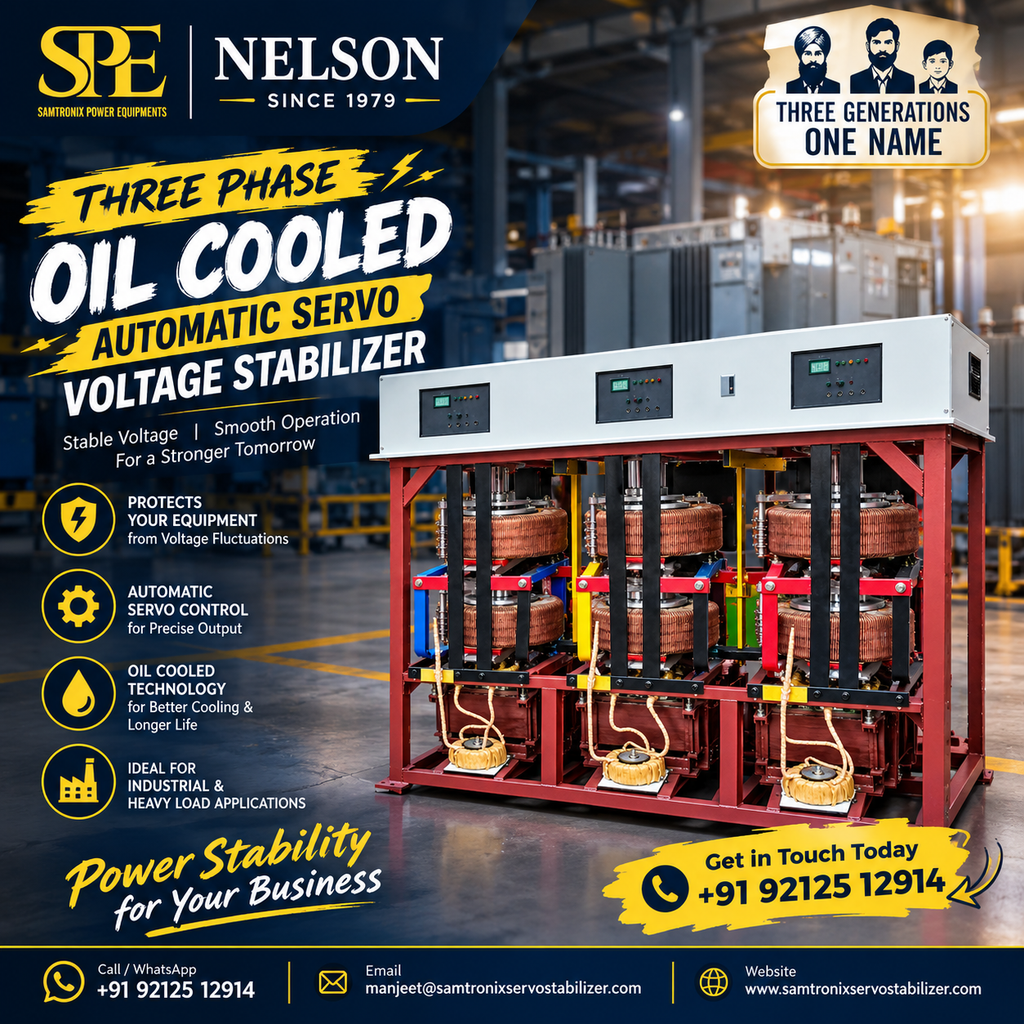
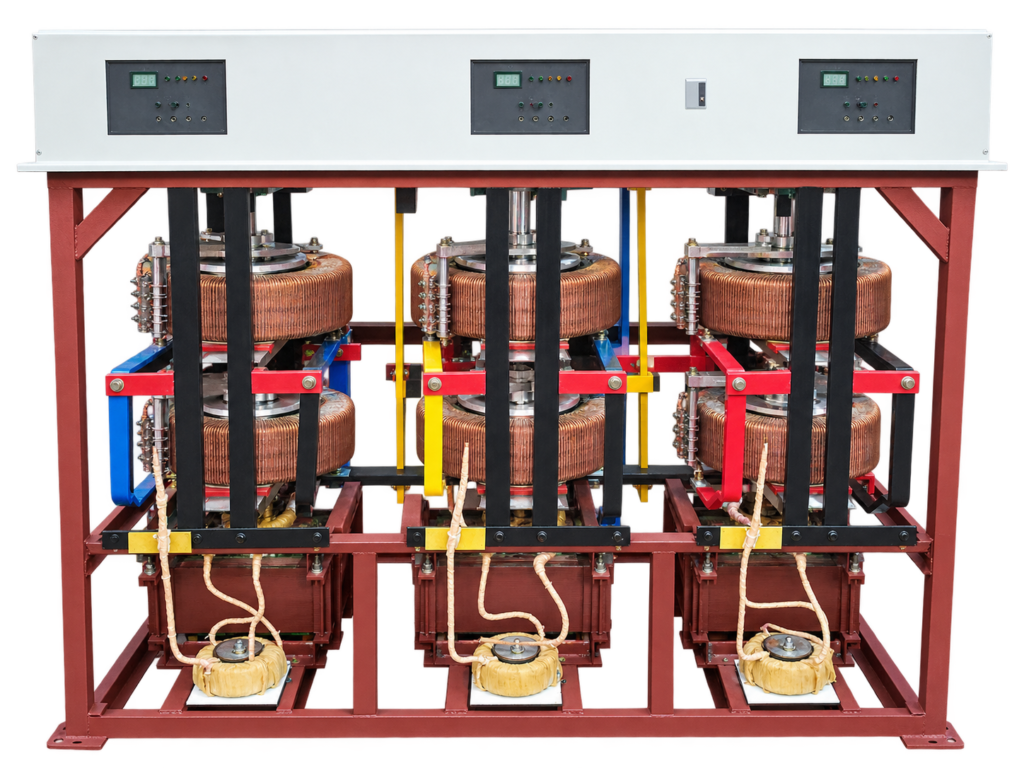
A Three Phase Oil Cooled Automatic Servo Voltage Stabilizer is an automatic voltage regulation system designed for three-phase electrical loads. It uses servo-controlled voltage correction to compensate for fluctuations in the incoming supply.
The word “automatic” is important because the operator does not need to manually adjust the voltage whenever the input changes. The control system continuously senses the voltage condition and operates the servo mechanism to bring the output closer to the required level.
The oil-cooled construction is particularly useful for industrial applications where the stabilizer works with substantial electrical loads for long periods. Oil helps transfer heat away from the internal components, supporting thermal management during continuous operation.
A typical Three Phase Oil Cooled Automatic Servo Voltage Stabilizer can therefore be considered an important part of an industrial power system rather than simply an additional electrical cabinet.
Why Voltage Stability Matters in Industrial Applications
Industrial machines are often designed to operate within a defined voltage range. If the incoming voltage becomes too low, motors may draw higher current to maintain their operation. If voltage becomes excessively high, electrical components can experience additional stress.
For example, assume a machine is designed around a 415 V three-phase supply. If the actual supply repeatedly moves significantly below or above the desired operating range, the machine may not perform consistently. The exact acceptable range depends on the machine manufacturer and electrical design.
This is where a Three Phase Oil Cooled Automatic Servo Voltage Stabilizer becomes useful. It continuously responds to changing input conditions instead of relying on a fixed manual setting.
For factories operating 8, 12 or even 24 hours a day, maintaining controlled voltage can also support more consistent machine operation.
How a Servo Controlled Voltage Stabilizer Works
A servo controlled voltage stabilizer uses a voltage sensing and correction system. The controller detects the incoming voltage and determines whether correction is required. A servo motor then operates the variable transformer mechanism to adjust the voltage.
The basic process can be understood through four stages.
| Stage | What Happens |
|---|---|
| Input sensing | Incoming three-phase voltage is continuously monitored |
| Voltage detection | The control system identifies variation from the required level |
| Servo correction | The servo mechanism adjusts the variable transformer |
| Controlled output | Corrected voltage is supplied to the connected load |
Because this process occurs automatically, the operator does not have to keep checking and adjusting the voltage manually.
A properly selected Three Phase Oil Cooled Automatic Servo Voltage Stabilizer can therefore provide continuous correction during changing electrical conditions.
Why Oil Cooling Is Useful for Heavy Loads
Heat management becomes increasingly important as electrical capacity increases. Industrial stabilizers may remain energized for long working periods, and internal components generate heat during operation.
An oil cooled stabilizer for industrial loads uses insulating and heat-transfer oil around relevant internal components. The oil helps carry heat away from the active electrical components and supports stable thermal conditions.
For heavy loads, this can be especially useful where the stabilizer operates continuously. However, cooling design, oil quality, ventilation around the equipment and maintenance all remain important.
The application should be evaluated according to actual connected load rather than selecting a stabilizer only from the machine nameplate capacity.
Selecting the Correct Capacity
Capacity is one of the first technical details that should be checked before installing a Three Phase Oil Cooled Automatic Servo Voltage Stabilizer.
A stabilizer may be available in capacities such as 5 kVA, 10 kVA, 25 kVA, 50 kVA, 100 kVA, 200 kVA, 300 kVA and higher industrial ratings. The required rating depends on the connected load, starting current, power factor, expansion requirement and operating conditions.
For example, a 5 KVA application and a 100 KVA industrial load should not be treated using the same selection approach.
| Application | Important Capacity Consideration |
|---|---|
| Small control equipment | Connected VA/kVA and sensitivity |
| CNC machine | Running load plus starting characteristics |
| Motor-driven machinery | Starting current and motor characteristics |
| Production line | Combined running load and future expansion |
| Heavy industrial machinery | Continuous load, starting demand and thermal conditions |
Customers searching online for 5 kva servo stabilizer, 5 kva servo stabilizer price or 5kva price servo stabilizer should first confirm the actual electrical requirement. Capacity alone does not determine whether a stabilizer is suitable.
For larger industrial systems, the selection process should include the complete electrical load profile.
Three Phase Servo Stabilizer for CNC Machines
CNC machines require controlled electrical conditions because their operation involves motors, drives, controllers, sensors and electronic systems.
A Three Phase Oil Cooled Automatic Servo Voltage Stabilizer for CNC machine applications can help regulate voltage reaching the equipment when the incoming supply fluctuates. A Three Phase Oil Cooled Automatic Servo Voltage Stabilizer can be particularly suitable for larger CNC installations where the connected load is substantial.
A servo voltage stabilizer for CNC machines should be selected after checking the CNC machine’s rated voltage, phase configuration, kVA requirement, input voltage range and starting characteristics.
For example, if a CNC machine has a rated capacity of 30 kVA, simply choosing a 30 kVA stabilizer without checking operating conditions may not be the right approach. Actual engineering requirements should be considered before final selection.
Voltage Stabilizer for Factory Applications
A factory can contain several types of electrical equipment operating simultaneously. Motors, compressors, CNC machines, welding equipment, pumps, production lines and control systems can create a complex electrical load.
A Three Phase Oil Cooled Automatic Servo Voltage Stabilizer for factory applications therefore needs to be selected according to the complete load profile.
In a manufacturing unit, voltage variation can also occur because of changes in local electrical demand. Large motors starting or stopping can influence the electrical system, depending on the installation.
A properly engineered industrial three phase voltage stabilizer can help maintain a more controlled supply for connected machinery.
Industrial Voltage Stabilizer Three Phase Systems
An industrial voltage stabilizer three phase system is generally designed for environments where electrical loads are larger and operating hours are longer than typical commercial applications.
The stabilizer should be selected according to input voltage variation, output requirement, load capacity and installation conditions.
For example, a factory receiving approximately 360 V during low-voltage periods and around 440 V during higher-voltage periods has a very different requirement from a site where the input remains close to 400–415 V.
The actual correction range should therefore be determined from measured site conditions.
| Parameter | Example to Check |
|---|---|
| Nominal supply | 400 V / 415 V |
| Phase | Three phase |
| Frequency | Commonly 50 Hz in India |
| Connected load | Measured in kVA |
| Input variation | Actual minimum and maximum |
| Output requirement | Based on equipment specification |
| Load type | Motors, CNC, electronics, heaters etc. |
These values provide a better starting point for selecting a Three Phase Oil Cooled Automatic Servo Voltage Stabilizer.
Servo Stabilizer for Manufacturing Industry
Manufacturing facilities often depend on continuous machine operation. Unexpected voltage variation can interrupt production, create machine alarms or affect sensitive electronic systems.
A servo stabilizer for manufacturing industry applications is therefore normally selected with attention to both electrical and operational requirements.
Heavy loads require special consideration because motors and other inductive equipment can have higher starting requirements. If the stabilizer is selected only on the basis of average running load, the system may not perform as expected during starting conditions.
This is why Samtronix Power Equipments focuses on application-based stabilizer selection for industrial users.
Voltage Stabilizer for Heavy Machinery
Heavy machinery can include large motors, compressors, pumps, industrial presses and production equipment. Such loads can operate for several hours continuously and may have significant starting current.
A Three Phase Oil Cooled Automatic Servo Voltage Stabilizer for heavy machinery should therefore be engineered around the actual load characteristics.
For example, a 75 kVA running load does not automatically mean that a 75 kVA stabilizer will be appropriate. The motor starting condition, power factor and future load addition can influence the required capacity.
A Three Phase Oil Cooled Automatic Servo Voltage Stabilizer can be configured for demanding applications where continuous voltage correction and thermal management are required.
What Information Should Be Given to the Manufacturer?
Before requesting a stabilizer, customers should collect some basic technical information. This avoids unnecessary back-and-forth and allows the manufacturer to understand the application correctly.
| Required Information | Why It Matters |
|---|---|
| Total connected load | Helps determine capacity |
| Input voltage range | Determines correction requirement |
| Output voltage | Defines the required stabilized supply |
| Phase configuration | Confirms three-phase requirement |
| Load type | Identifies motors, CNC, electronics etc. |
| Starting load | Important for motor-driven equipment |
| Operating hours | Helps assess continuous-duty requirements |
| Installation location | Helps determine enclosure and cooling requirements |
Providing these details can make the selection of a servo voltage stabilizer much more accurate.
Installation Considerations | Three Phase Oil Cooled Automatic Servo Voltage Stabilizer
Even a correctly designed stabilizer requires suitable installation conditions. The equipment should have sufficient space around it for maintenance and heat dissipation according to its design.
Industrial installations should also consider cable sizing, earthing, protection devices, ventilation, accessibility and environmental conditions.
For oil-cooled systems, the installation area should allow proper inspection and maintenance of the oil-filled components. The stabilizer should not be placed where unnecessary heat, water exposure, dust accumulation or restricted airflow could create avoidable problems.
A Three Phase Oil Cooled Automatic Servo Voltage Stabilizer should also be connected by qualified electrical personnel according to the system design and applicable electrical safety requirements.
Maintenance of an Oil Cooled Stabilizer
Regular inspection helps identify problems before they become major interruptions. Oil level and condition, electrical connections, control components, servo mechanism and cooling arrangements should be checked according to the equipment maintenance schedule.
Loose electrical connections can create heating. Dust accumulation can affect control components. Mechanical wear in moving parts can also affect voltage correction performance.
Maintenance intervals depend on operating conditions, load, environment and equipment design. A stabilizer installed inside a relatively clean production area may have different maintenance requirements from equipment installed in a dusty industrial environment.
Common Application Areas
A Three Phase Oil Cooled Automatic Servo Voltage Stabilizer can be used across several industrial environments where controlled voltage is required.
| Industrial Area | Typical Equipment |
|---|---|
| CNC workshop | CNC machines, drives and control systems |
| Manufacturing unit | Production machinery and motors |
| Factory | Motors, pumps and automation |
| Metal processing | Heavy machinery and production equipment |
| Packaging industry | Automated production equipment |
| Engineering workshop | Machine tools and compressors |
| Industrial processing | Motors, control panels and production systems |
The exact stabilizer configuration should always be based on the electrical characteristics of the application.
Samtronix Power Equipments for Industrial Voltage Regulation
Samtronix Power Equipments develops servo stabilizer systems for industrial requirements, including applications involving heavy loads and manufacturing machinery.
As Three Phase Oil Cooled Automatic Servo Voltage Stabilizer Manufacturer, Samtronix Power Equipments works with different capacity requirements and electrical conditions. Customers looking for servo stabilizer manufacturers in Delhi can discuss their input voltage, load capacity and application requirements before finalizing the equipment.
The company also works with customers searching for servo stabilizer manufacturers, industrial voltage stabilizer systems and a servo voltage stabilizer manufacturer for factory applications.
Instead of selecting equipment only by a keyword such as servo stabilizer price, customers should provide actual technical information. This allows the required system to be designed around the application.
Understanding Servo Stabilizer Capacity
The term kVA represents apparent power and is commonly used when specifying stabilizer capacity. It should not be confused directly with kW because the relationship depends on power factor.
For example, at a power factor of 0.8, a 100 kVA load corresponds approximately to 80 kW of real power.
The basic relationship is:
| Parameter | Example |
|---|---|
| Apparent power | 100 kVA |
| Power factor | 0.8 |
| Approximate real power | 80 kW |
This simple calculation helps explain why the stabilizer capacity should be selected using actual electrical data rather than only the motor’s kW rating.
When a Servo Stabilizer Requires More Attention
If machines regularly show low-voltage alarms, control panel trips, motor heating, unexpected shutdowns or inconsistent machine behaviour, the incoming electrical supply should be measured.
Do not automatically assume that the stabilizer is the cause. The problem could also involve undersized cables, loose connections, poor earthing, overloaded transformers, phase imbalance or issues within the machine itself.
For this reason, voltage measurements should ideally be recorded at different times, including periods of high and low factory activity.
A Three Phase Oil Cooled Automatic Servo Voltage Stabilizer should be selected after understanding the actual electrical problem rather than simply purchasing a higher-capacity unit.
FAQs | Three Phase Oil Cooled Automatic Servo Voltage Stabilizer
1. What should I check if my factory voltage keeps changing during production?
Measure the minimum and maximum input voltage during both low-load and peak-load periods. These readings help determine the required correction range.
2. Why does my CNC machine trip even when the factory supply looks normal?
Short voltage dips or phase-wise fluctuations may not be visible on a basic meter. Record voltage at the CNC input during machine starting and peak production.
3. Can I connect several machines to one servo stabilizer?
Yes, if the combined load, starting current, phase distribution and stabilizer capacity are properly calculated. The actual simultaneous load should be checked before installation.
4. What happens if my stabilizer is frequently reaching its correction limit?
It may indicate that the incoming voltage variation is outside the stabilizer’s designed correction range. The actual input range should be measured and reviewed.
5. Why does voltage become unstable when a large motor starts?
A large motor can draw substantially higher current during starting, which may cause a temporary voltage drop. The starting characteristics should be considered when sizing the stabilizer.
6.Can the Three Phase Oil Cooled Automatic Servo Voltage Stabilizer work continuously?
Yes, the Oil Cooled Automatic Servo Voltage Stabilizer can work continuously when it is correctly designed and rated for the connected load and intended operating conditions.
7. Can Samtronix design a stabilizer for a factory?
Yes. Samtronix Power Equipments can discuss application-specific requirements for a voltage stabilizer for factory installations, including heavy machinery and manufacturing loads.
Connect with Samtronix on LinkedIn for Industrial Power Expertise.