
Industrial electrical equipment requires a stable and reliable power supply to operate correctly. In manufacturing plants, CNC workshops, packaging units, production lines, and commercial facilities, voltage fluctuations can interrupt operations, affect machine performance, and cause unexpected shutdowns. Choosing a reliable Three Phase Servo Voltage Stabilizer Manufacturer is therefore an important step for businesses that depend on heavy electrical loads and sensitive machinery.
Samtronix Power Equipments provides industrial voltage stabilizer solutions designed around different electrical requirements, operating conditions, and load capacities. A properly selected servo stabilizer helps maintain a more consistent output voltage when the incoming supply fluctuates. For businesses operating motors, compressors, industrial control panels, and automated machinery, the correct stabilizer capacity and configuration are essential for dependable performance.
Understanding Three Phase Servo Voltage Stabilizers
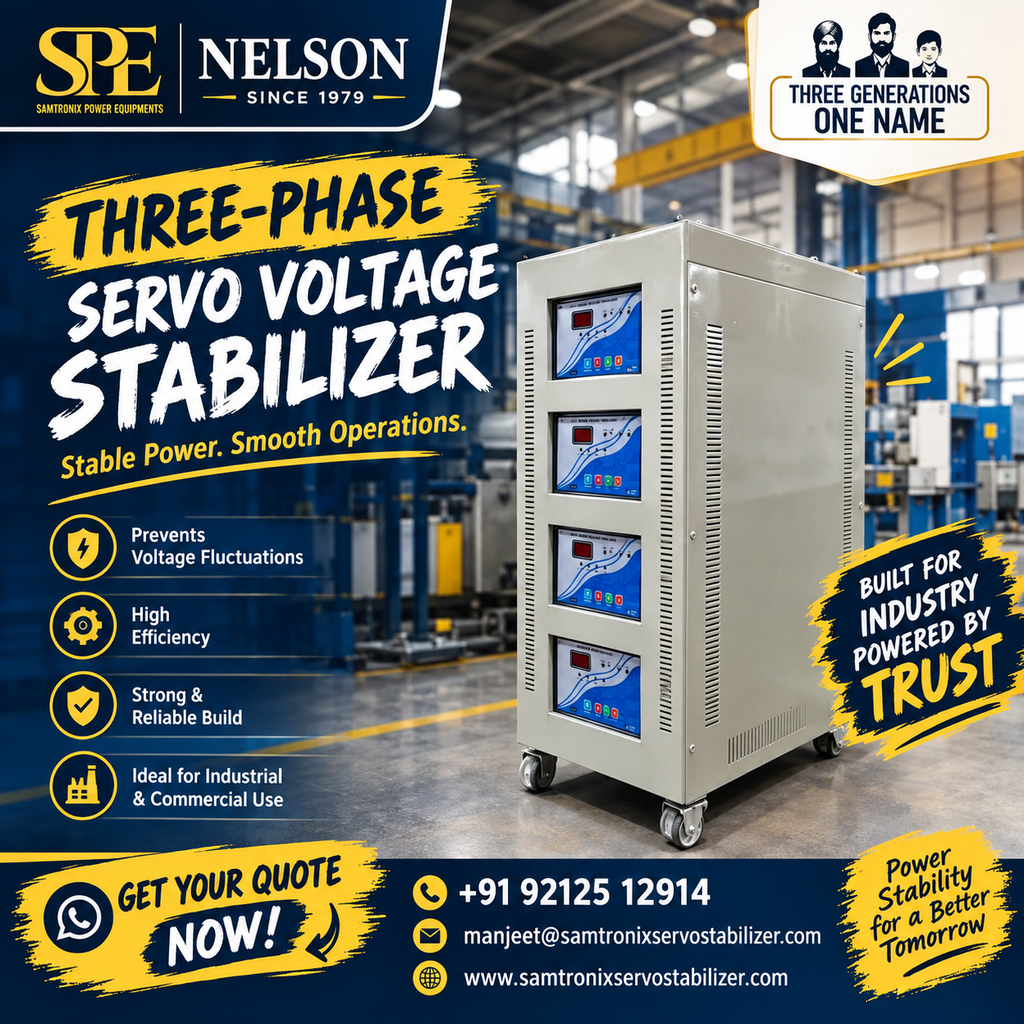
A Three Phase Servo Voltage Stabilizer Manufacturer is an electrical device that automatically regulates voltage supplied to connected equipment. It uses a servo motor, voltage-sensing circuitry, and a variable autotransformer arrangement to correct voltage variations. Depending on the design, the system adjusts the output towards its specified voltage range when the input supply rises or falls.
A Three Phase Servo Voltage Stabilizer Manufacturer must consider the incoming voltage range, required output voltage, connected load, and installation conditions while selecting a suitable configuration. These details matter because an industrial machine may draw significantly more current during startup than during normal operation.
For example, a factory receiving an unstable three-phase supply may experience variations that affect motor operation and electronic controls. A correctly sized servo voltage stabilizer helps regulate the voltage supplied to the connected load, provided the input remains within the equipment’s specified operating range.
Why Industrial Businesses Need a Servo Stabilizer
Voltage fluctuations can create several operational problems. Motors may draw excessive current under certain low-voltage conditions, control systems may reset, and sensitive electronic equipment may experience interruptions. Repeated disturbances can also lead to production delays and additional maintenance requirements.
A Three Phase Servo Voltage Stabilizer Manufacturer is designed to manage voltage variations within its rated correction range. However, it does not replace proper earthing, short-circuit protection, overload protection, or suitable electrical distribution equipment.
Businesses looking for a Three Phase Servo Voltage Stabilizer Manufacturer should evaluate the actual electrical problem before choosing a product. A site experiencing frequent undervoltage may need a different input correction range from a facility dealing mainly with occasional overvoltage.
The following table explains common industrial situations and Three Phase Servo Voltage Stabilizer Manufacturer and the factors that need attention.
| Industrial problem | Important requirement | Expected benefit |
|---|---|---|
| Frequent input voltage fluctuations | Suitable input correction range | More consistent output voltage |
| Heavy motor startup | Adequate starting-current capacity | Better handling of startup demand |
| CNC machine interruptions | Stable supply within machine specifications | Reduced voltage-related interruptions |
| Production-line shutdowns | Correct stabilizer sizing and protection | Improved operational reliability |
| Sensitive control equipment | Appropriate output accuracy | More consistent equipment supply |
| Long operating hours | Suitable cooling and ventilation | Reliable operation under rated conditions |
Selecting the Correct Stabilizer Capacity for Heavy Loads
Heavy electrical loads require careful capacity planning. Selecting a stabilizer only by looking at the machine’s kilowatt rating can result in an unsuitable installation. The engineer should also consider power factor, efficiency, starting current, simultaneous operation, and the type of connected equipment.
A Three Phase Servo Voltage Stabilizer Manufacturer should receive accurate load details before recommending a capacity. For example, a machine with a 10 kW electrical input does not automatically require a 10 kVA stabilizer. The required kVA depends on the machine’s power factor and operating characteristics.
For a Three Phase Servo Voltage Stabilizer Manufacturer system, the apparent power can be estimated using the following formula:
kVA = √3 × Line Voltage × Line Current ÷ 1,000
Here, line voltage is measured in volts and line current in amperes. For a balanced three-phase system, if the line voltage is 415 V and the operating current is 50 A, the apparent load is approximately 35.9 kVA.
This calculation gives an initial estimate, not a final Three Phase Servo Voltage Stabilizer Manufacturer selection. Starting current, load growth, harmonics, operating duty, and manufacturer recommendations must also be considered.
| Approximate load information | What should be checked |
|---|---|
| 5 kVA connected load | Input range and actual operating current |
| 10–15 kVA equipment | Load type and expected expansion |
| 20–30 kVA production equipment | Motor starting and simultaneous loading |
| 50 kVA industrial installation | Distribution arrangement and protection |
| 100 kVA or higher installation | Detailed load assessment and engineering review |
These capacities are examples for planning, not universal recommendations. A qualified electrical professional should verify the final rating for the actual installation.
Three Phase Servo Voltage Stabilizer for Industries
A Three Phase Servo Voltage Stabilizer for Industries can support applications where a controlled supply is important for continuous production. Typical applications include CNC machining, injection moulding, printing, pharmaceutical production, textile machinery, food processing, packaging equipment, and industrial automation.
In a manufacturing unit, multiple machines may operate at the same time. Their combined load can change during the production cycle, especially when motors, pumps, heaters, or compressors start and stop. Stabilizer selection should therefore account for the maximum expected simultaneous demand rather than relying only on the average load.
A Three Phase Servo Voltage Stabilizer Manufacturer should also understand whether the installation supplies one large machine or several smaller loads. A dedicated stabilizer may be appropriate for sensitive machinery, while a central stabilizer may suit a broader distribution system when the load arrangement and protection design permit it.
Samtronix Power Equipments can be contacted to discuss the application, required capacity, input voltage conditions, and suitable equipment configuration.
How a Servo Controlled Voltage Stabilizer Works
A servo controlled voltage stabilizer continuously monitors the incoming voltage. When the voltage moves away from the required level, its control circuit directs the servo motor to adjust the variable transformer mechanism. This changes the correction applied to the supply and helps maintain the specified output voltage.
The response time and correction capability depend on the stabilizer design, input disturbance, connected load, and control system. A servo mechanism cannot correct every type of power-quality issue, and it should not be treated as a substitute for a UPS where uninterrupted power is required.
When selecting a Three Phase Servo Voltage Stabilizer Manufacturer, ask for the specified input voltage range, output voltage tolerance, correction speed, rated capacity, and protection features. These specifications help determine whether the unit is suitable for the actual working environment.
Automatic Three Phase Voltage Stabilizer Manufacturer for Industrial Requirements
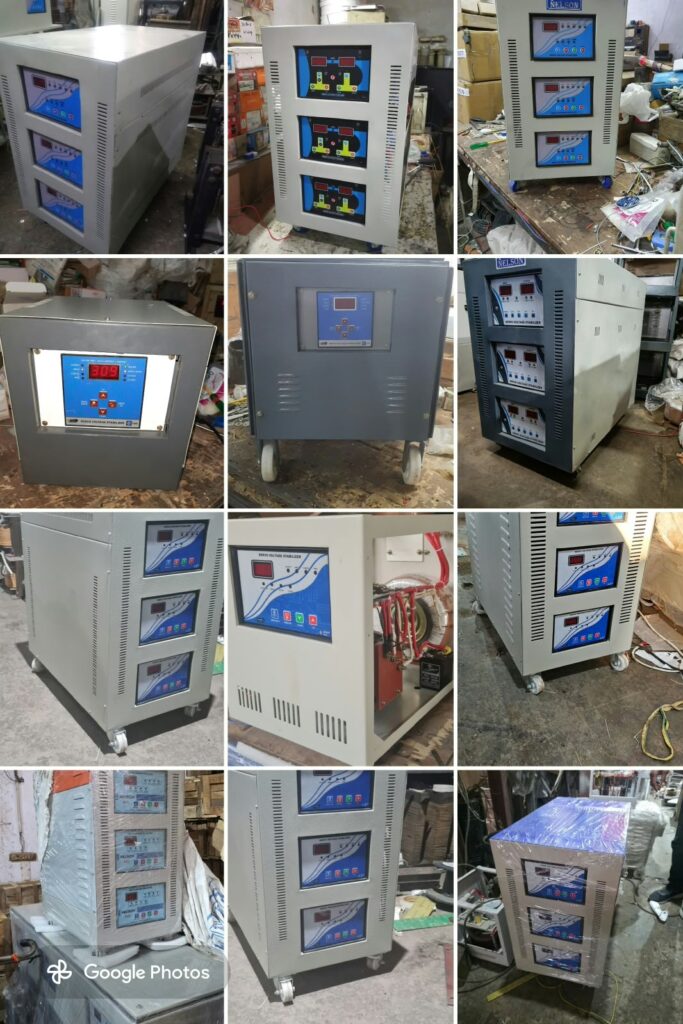
An Automatic Three Phase Voltage Stabilizer Manufacturer should take account of the voltage conditions at the installation site. For example, a factory receiving a nominal 415 V three-phase supply may experience significant voltage drops during peak demand. The stabilizer’s correction range must be suitable for the lowest and highest expected input voltages.
The output requirements should be checked against the connected machine’s nameplate and technical documentation. Some equipment allows a wider supply tolerance, while sensitive electronic systems may require tighter voltage control.
Before selecting a stabilizer, record the incoming line-to-line voltage during different operating periods. Measurements taken during peak production can reveal conditions that a single reading taken during idle hours may miss.
A suitable installation should also include correct cable sizing, protective devices, adequate ventilation, and an accessible location for inspection and maintenance. These practical details contribute to dependable long-term operation.
Choosing a Three Phase Servo Stabilizer Supplier in India
A Three Phase Servo Stabilizer Supplier in India should be able to understand the application rather than simply recommend a capacity from a short description. The supplier should request information about the load, voltage fluctuations, equipment type, operating hours, and site conditions.
For industrial buyers, the technical documentation is particularly important. The rated capacity, input range, output voltage, operating frequency, cooling arrangement, and protection provisions should be clearly established before the equipment is installed.
Businesses searching for servo stabilizer manufacturers should also verify the available service arrangements, commissioning requirements, and maintenance guidance. These considerations are important when the stabilizer supports a production line where unexpected downtime affects delivery schedules.
Samtronix Power Equipments works with industrial electrical equipment requirements, including servo voltage stabilizer applications. Customers can share their electrical specifications to discuss the appropriate configuration for their facility.
Three Phase Servo Voltage Stabilizer Company for Factory Applications
Choosing a suitable Three Phase Servo Voltage Stabilizer Manufacturer involves understanding the factory’s electrical distribution system. A facility with a single large machine may need a different arrangement from a plant operating several motors, compressors, and electronic control systems across different production areas.
The load should be assessed during normal operation and during the most demanding production cycle. Engineers should identify large starting loads, uneven phase loading, and any equipment with special power-quality requirements. These checks help reduce the risk of selecting an undersized or unsuitable stabilizer.
For factories, the installation environment also matters. Dust, high ambient temperatures, restricted airflow, moisture, and poor access can affect maintenance and operating conditions. The stabilizer should be installed according to its specified environmental and clearance requirements.
An experienced Three Phase Servo Voltage Stabilizer Manufacturer can use these details to help identify a configuration that suits the intended application.
Three Phase Servo Stabilizer Manufacturer in India for Different Capacities
Different industries require different Three Phase Servo Voltage Stabilizer Manufacturer ratings. Smaller equipment may operate with a lower-capacity stabilizer, while production facilities with heavy machinery may require larger three-phase units. The correct capacity depends on the actual load and operating conditions rather than the industry name alone.
A 5 kva servo stabilizer may be considered for a suitable smaller load, but a 5 kva servo stabilizer is not automatically appropriate for every three-phase machine. Buyers searching for servo stabilizer 5kva or servo stabilizer 5kva price should first confirm whether they need a single-phase or three-phase model and calculate the equipment’s actual demand.
The term Three Phase Servo Voltage Stabilizer Manufacturer price is also frequently used by buyers during product research. However, the technical requirements should be established before requesting a quotation, as capacity, voltage range, configuration, and protection requirements affect the specification.
For larger installations, a Three Phase Servo Voltage Stabilizer Manufacturer should assess the complete load profile, especially where motors and other heavy loads operate together. This ensures that the proposed equipment is based on realistic electrical requirements.
Three Phase Servo Stabilizer Manufacturer in Delhi and Nearby Industrial Areas
Businesses searching for servo stabilizer manufacturers in Delhi often need support for factories, workshops, commercial buildings, and industrial machinery. A Three Phase Servo Voltage Stabilizer Manufacturer in India should understand the voltage conditions and operating requirements of the intended site, whether the installation is in Delhi, Noida, Haryana, or another industrial location.
Before contacting a Three Phase Servo Voltage Stabilizer Manufacturer, prepare the equipment nameplate details, supply voltage readings, connected load list, and any record of voltage-related faults. These details make the initial technical discussion more useful and help avoid incorrect assumptions about stabilizer capacity.
Samtronix Power Equipments welcomes enquiries from businesses seeking a Three Phase Servo Voltage Stabilizer Manufacturer for industrial applications. Customers can share their application requirements, operating voltage, and expected load to discuss a suitable solution.
Installation and Maintenance for Reliable Performance
Correct installation is as important as selecting the right stabilizer. The equipment should be positioned on a suitable surface with enough clearance for ventilation, inspection, and maintenance. Electrical connections must follow the manufacturer’s wiring diagram and be completed by a qualified electrician.
The installation team should verify phase sequence, earthing, cable sizing, protective devices, and output voltage before connecting sensitive machinery. Commissioning should include checks under appropriate operating conditions, with particular attention to voltage behaviour when the load changes.
Routine maintenance should follow the manufacturer’s schedule. Depending on the stabilizer design, inspections may include checking terminals, ventilation openings, cooling fans, control connections, and mechanical components. Any unusual noise, overheating, repeated alarms, or unstable output should be investigated rather than ignored.
A reliable Three Phase Servo Voltage Stabilizer Manufacturer should provide clear operating and maintenance guidance for the supplied equipment. Keeping installation records and recording voltage readings can also help technicians identify developing problems more quickly.
Why Consider Samtronix Power Equipments?
Samtronix Power Equipments serves industrial electrical equipment requirements with a focus on practical applications and suitable equipment configurations. For businesses seeking an Industrial Three Phase Servo Stabilizer Manufacturer, the starting point should be a clear understanding of the machine load, supply conditions, and required output performance.
Customers looking for a Three Phase Servo Voltage Stabilizer Manufacturer can discuss their operating requirements, including whether the stabilizer will supply heavy motors, automated production equipment, or sensitive electrical systems. The technical details help determine which configuration should be considered.
For product enquiries, businesses can contact Samtronix Power Equipments by phone at +91 92125 12914 or email manjeet@samtronixservostabilizer.com. Visit www.samtronixservostabilizer.com to explore the company’s industrial voltage stabilizer solutions and share your requirements.
FAQs | Three Phase Servo Voltage Stabilizer Manufacturer
1. Why does my servo stabilizer trip when heavy machinery starts?
The motor’s starting current may exceed the stabilizer’s capacity. Check the starting-current requirements and load rating with a qualified electrician.
2. Why does the stabilizer output voltage fluctuate even after installation?
Incorrect input-range selection, loose connections, control-system faults, or sudden load changes may cause unstable output. Check the input and output readings under load.
3. Can a three-phase servo stabilizer handle an unbalanced load?
It depends on the stabilizer design and phase-wise loading limits. Check the permissible phase imbalance before connecting the equipment.
4. What happens if the incoming voltage drops below the stabilizer’s correction range?
The stabilizer may fail to maintain its specified output voltage. Select a unit with an input range suited to the site’s lowest recorded voltage.
5. Why does my stabilizer overheat during continuous factory operation?
Overloading, restricted ventilation, loose terminals, or excessive ambient temperature can cause overheating. Arrange an inspection and avoid operating unsafe equipment.
6. How do I size a servo stabilizer for multiple machines with different starting times?
Calculate the combined running load and assess which motors can start simultaneously. Include starting current and verify the stabilizer’s overload capability.
7. Why does my CNC machine stop even when the servo stabilizer is working?
The interruption may be caused by brief voltage dips, phase loss, harmonics, control-supply issues, or another machine fault. Check the machine alarms and record power-quality readings during the event.
Connect with Samtronix on LinkedIn for Industrial Power Expertise.