
Reliable Transformer Assembly Solutions for Industrial Power Systems

Industrial operations require a dependable electrical supply to keep machinery, production lines, control panels, and heavy equipment running smoothly. A transformer assembly must be designed and assembled according to the electrical requirements of the installation. Incorrect voltage selection, loose connections, inadequate insulation, or poor cooling can cause overheating, equipment interruptions, and unexpected maintenance.
Samtronix Power Equipments offers industrial power equipment solutions for customers looking for dependable transformer assemblies. As a Three Phase Transformer Assembly Manufacturer, our focus is on understanding practical industrial requirements and helping customers identify suitable configurations for their electrical systems.
A three-phase transformer assembly consists of a magnetic core, primary and secondary windings, insulation materials, electrical terminals, and a supporting structure. Each component plays an important role in transferring electrical energy safely and efficiently.
Whether your facility operates heavy motors, automated machinery, CNC equipment, or industrial control systems, choosing the right assembly starts with understanding the connected load, operating conditions, and required output voltage.
What Is a Three Phase Transformer Assembly?
A three-phase transformer assembly is an electrical unit designed to transfer energy between circuits through electromagnetic induction. Depending on its design, it can increase or decrease voltage levels or provide electrical isolation between input and output circuits.
A professional Three Phase Transformer Assembly Manufacturer considers the intended application before determining the assembly configuration. This includes voltage requirements, rated capacity, frequency, winding arrangement, insulation, cooling, and installation conditions.
For example, a factory operating several motors may require an assembly that supports continuous operation and accommodates the current demand during motor startup. An installation containing sensitive electronic equipment may also require attention to electrical disturbances and isolation requirements.
The following table explains the principal components.
| Component | Purpose |
|---|---|
| Magnetic core | Provides the magnetic path required for energy transfer. |
| Primary winding | Receives electrical power from the input supply. |
| Secondary winding | Supplies electrical power at the designed output voltage. |
| Insulation system | Separates conductive components and helps prevent electrical breakdown. |
| Terminal connections | Connect the assembly to the external electrical circuit. |
| Supporting frame | Provides mechanical support and maintains component positioning. |
| Cooling arrangement | Helps manage operating temperature under specified conditions. |
A properly assembled unit supports dependable operation when used within its designed electrical and thermal limits.
Why Choose a Three Phase Transformer Assembly Manufacturer?
Every industrial facility has different electrical requirements. A machine workshop may operate motors and welding equipment, while a production facility may depend on automated conveyors, compressors, and electronic control systems.
Working with a Three Phase Transformer Assembly Manufacturer helps customers define these requirements before selecting an assembly. The correct specification can help reduce installation difficulties, prevent avoidable electrical faults, and support reliable equipment operation.
Samtronix Power Equipments understands the importance of application-specific requirements in industrial power equipment. Customers can discuss their electrical needs and provide the technical information required to identify a suitable transformer assembly.
Important selection factors include:
| Selection factor | Why it matters |
|---|---|
| Input voltage | Must match the available electrical supply. |
| Output voltage | Must suit the connected equipment. |
| Capacity in kVA | Must support the intended electrical load. |
| Operating frequency | Must match the electrical system requirements. |
| Load characteristics | Motors and electronic equipment can have different electrical demands. |
| Insulation requirements | Must suit the voltage rating and operating environment. |
| Cooling method | Must support the expected operating temperature. |
| Installation space | Affects mounting, ventilation, and maintenance access. |
Sharing these details at the beginning helps the manufacturer understand the actual requirement instead of relying on assumptions.
Three Phase Transformer Assembly for Heavy Loads
Heavy loads require careful transformer selection because industrial machinery may draw high current during startup or sudden changes in production demand. Motors, compressors, hydraulic equipment, and industrial processing machines can place considerable demands on the electrical system.
A Three Phase Transformer Assembly Manufacturer should consider both normal running conditions and temporary increases in current. Selecting a transformer solely according to the equipment’s average power consumption may result in excessive voltage drop or overheating under demanding operating conditions.
For instance, a manufacturing unit may operate a large motor, several smaller motors, and auxiliary control equipment simultaneously. The total requirement depends on the equipment ratings, starting methods, operating schedules, and expected load variation.
| Heavy-load application | Important requirement |
|---|---|
| Industrial motors | Suitable capacity and consideration of starting current. |
| Air compressors | Reliable operation during repeated starting cycles. |
| Hydraulic machinery | Appropriate capacity for changing load demand. |
| CNC equipment | Suitable voltage characteristics and attention to harmonics. |
| Welding equipment | Consideration of fluctuating electrical demand. |
| Production conveyors | Support for continuous operation and multiple motors. |
| Industrial processing lines | Capacity suitable for simultaneous equipment operation. |
For demanding applications, a Three Phase Transformer Assembly Manufacturer should also review the ambient temperature, ventilation, duty cycle, and potential harmonic loads. These factors can influence the required design.
Samtronix Power Equipments encourages customers to share their connected equipment details so that the application can be assessed more accurately.
Transformer Assembly Quality and Electrical Reliability
The reliability of a transformer assembly depends on the quality of its components, assembly practices, insulation, and electrical connections. Even when a transformer has an appropriate capacity rating, poor connections or unsuitable installation conditions can create operating problems.
A Three Phase Transformer Assembly Manufacturer should pay attention to winding arrangements, conductor connections, core construction, mechanical stability, and insulation clearances. Correct terminal identification is also essential for establishing the intended voltage and phase relationships.
Before commissioning, the assembly should undergo the inspections and tests required by its design and applicable standards.
| Inspection or test | Purpose |
|---|---|
| Visual inspection | Identifies visible damage, assembly defects, and loose components. |
| Winding resistance test | Helps identify winding connection issues or abnormal resistance. |
| Insulation resistance test | Evaluates insulation condition between specified conductors and earth. |
| Turns-ratio test | Verifies the designed relationship between winding voltages. |
| Connection verification | Checks terminal identification and winding configuration. |
| Temperature assessment | Helps evaluate thermal performance under specified conditions. |
| Documentation review | Confirms that relevant test records and technical specifications are available. |
The applicable test programme depends on the type and rating of the transformer. Customers should request the appropriate test documentation for the assembly being supplied.
Understanding Isolation Transformer Technology
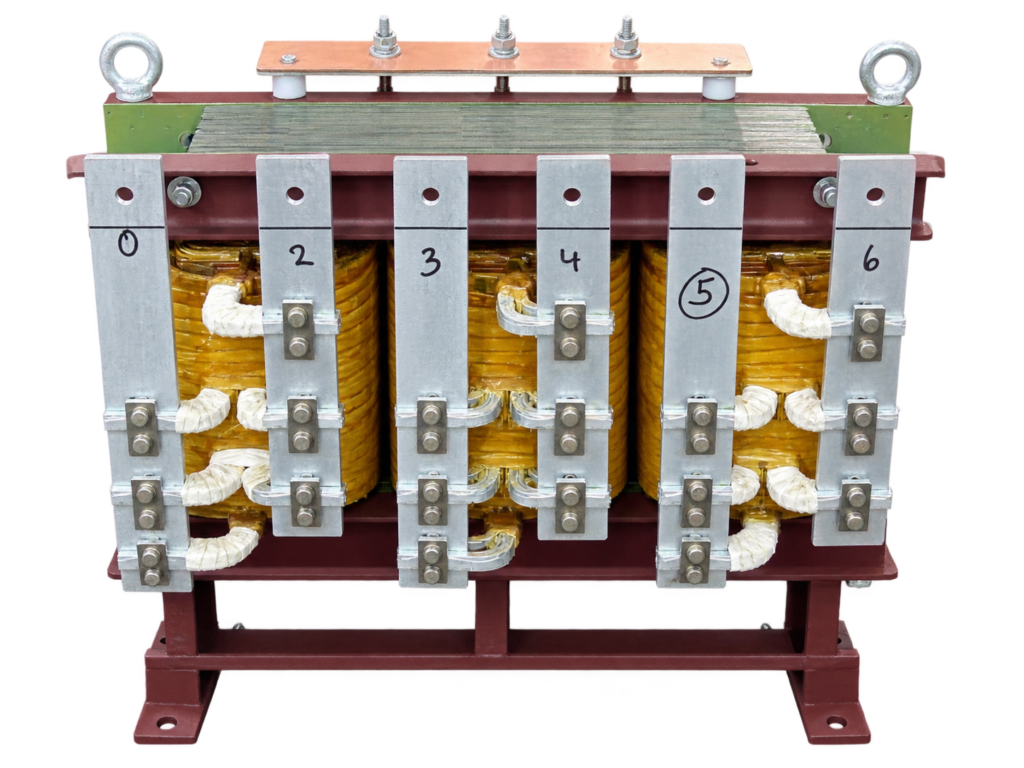
A Three Phase Transformer Assembly Manufacturer provides transformer assemblies designed for industrial applications requiring reliable power transfer and electrical isolation. An isolation transformer transfers energy between electrically separated windings, providing galvanic isolation without a direct conductive connection.
The isolation transformer working principle is based on electromagnetic induction, where alternating current in the primary winding creates a changing magnetic field that induces voltage in the secondary winding. This arrangement can support specific electrical safety requirements and help manage certain electrical disturbances, depending on the design and installation.
The isolation transformer purpose depends on the application. It may include separating sensitive control equipment from another circuit, supporting a specified earthing arrangement, or providing an isolated electrical supply for selected machinery.
A Three Phase Transformer Assembly Manufacturer should assess whether isolation is actually required and determine the appropriate winding configuration, insulation level, and output arrangement.
| Isolation transformer component | Function |
|---|---|
| Primary winding | Receives power from the supply circuit. |
| Secondary winding | Provides power to the separated output circuit. |
| Magnetic core | Transfers magnetic flux between the windings. |
| Insulation barrier | Maintains electrical separation between circuits. |
| Earthing arrangement | Supports the intended installation safety design. |
An isolation transformer does not automatically eliminate all voltage surges, harmonics, or supply disturbances. Additional protective or power-conditioning equipment may be necessary for particular installations.
Isolation Transformer Application in Industrial Facilities
A Three Phase Transformer Assembly Manufacturer provides solutions for applications requiring reliable power transfer and electrical separation. Isolation transformers are used in industrial automation panels, instrumentation systems, laboratory equipment, and specialised machinery where electrical isolation is required.
The isolation transformer use should be determined by the actual electrical problem rather than by assuming that every industrial machine requires one. Voltage fluctuations, grounding issues, harmonics, and electromagnetic interference can have different causes and may require different solutions.
A Three Phase Transformer Assembly Manufacturer should receive details of the connected equipment and existing electrical arrangement before recommending an isolation configuration.
| Application | Potential reason for isolation |
|---|---|
| Industrial control panels | Electrical separation for specified control circuits. |
| Instrumentation systems | Support for the intended measurement circuit arrangement. |
| Automated machinery | Isolation where required by the equipment design. |
| Selected laboratory equipment | Separation of circuits according to application requirements. |
| Industrial testing stations | A defined isolated supply for testing equipment. |
| Sensitive electronic installations | Support for a carefully designed electrical interface. |
Correct earthing, protective devices, and installation practices remain essential. Isolation should be incorporated into a properly engineered electrical system.
Isolation Transformer in UPS Systems
An isolation transformer in UPS systems may provide galvanic separation, support a particular output voltage arrangement, or meet installation-specific electrical requirements. Its use depends on the UPS topology and the connected load.
Not every uninterruptible power supply requires a separate isolation transformer. Some systems incorporate transformer-based arrangements, while others use different electrical configurations.
Before selecting a Three Phase Transformer Assembly Manufacturer for a UPS installation, customers should confirm the UPS model, input and output voltages, rated capacity, neutral arrangement, earthing requirements, and load characteristics.
| UPS consideration | What should be verified |
|---|---|
| UPS configuration | Whether the design requires an external transformer. |
| Output voltage | Whether it matches the connected equipment. |
| Load capacity | Whether the transformer supports the required load. |
| Neutral arrangement | Whether the configuration suits the UPS and installation. |
| Harmonic characteristics | Whether the load creates additional electrical demands. |
| Earthing | Whether the complete arrangement follows the required safety design. |
The isolation transformer diagram in technical documentation generally shows separate primary and secondary windings coupled through a common magnetic core. The diagram should identify the winding terminals, voltage ratings, phase arrangement, and relevant earthing connections.
Samtronix Power Equipments can discuss your application requirements and the technical details needed to identify a suitable transformer assembly.
Three Phase Transformer Manufacturer in India for Industrial Applications
Industrial customers need reliable transformer assemblies suited to their machinery, electrical systems, and operating conditions. As a Three Phase Transformer Assembly Manufacturer, Samtronix Power Equipments serves industrial requirements across manufacturing, automation, engineering, and processing applications.
We help customers identify suitable transformer assemblies based on their specific installation needs. Options include dry-type transformers, oil-immersed transformers, isolation transformers, and specialised assemblies, each with different cooling, insulation, installation, and maintenance requirements.
The following information helps define the requirement.
| Technical detail | Example of information to provide |
|---|---|
| Phase | Single-phase or three-phase. |
| Input voltage | Available supply voltage. |
| Output voltage | Voltage required by the equipment. |
| Rated capacity | Required kVA rating. |
| Frequency | Applicable supply frequency. |
| Load type | Motors, CNC machines, control panels, or mixed loads. |
| Installation | Indoor, outdoor, panel-mounted, or designated equipment area. |
| Duty cycle | Intermittent, regular, or continuous operation. |
A clear specification helps reduce uncertainty during selection and installation. It also allows the technical requirements to be reviewed before the assembly is ordered.
Industrial Transformer Assembly Manufacturer for Custom Requirements
Some industrial installations need a transformer assembly with specific dimensions, terminal positions, winding connections, or voltage arrangements. A standard configuration may not suit every machine or electrical panel.
An Industrial Transformer Assembly Manufacturer considers these practical requirements when developing an assembly for a particular application. Relevant details include available mounting space, cable access, operating temperature, ventilation, and access for maintenance.
A Three Phase Transformer Assembly Manufacturer should also consider whether the equipment operates continuously or experiences repeated load changes. For example, an assembly supporting an industrial machine that runs for 16 hours daily may have different operating considerations from equipment used intermittently.
| Custom requirement | Information needed |
|---|---|
| Special input voltage | Available supply details. |
| Specific output voltage | Equipment nameplate or approved electrical drawing. |
| Restricted dimensions | Available installation space. |
| Special terminal layout | Cable entry and connection requirements. |
| High-duty operation | Daily operating hours and load profile. |
| Special insulation needs | Voltage, temperature, and environmental conditions. |
| Existing replacement unit | Original nameplate and connection details. |
Samtronix Power Equipments welcomes enquiries from customers who need to discuss a particular industrial transformer assembly requirement. Providing drawings, photographs, or the existing equipment nameplate can help clarify the application.
Power Transformer Assembly Manufacturer for System Integration
A Power Transformer Assembly Manufacturer supports applications where electrical energy must be transferred between circuits at specified voltage levels. The appropriate configuration depends on the intended use, capacity, installation location, and relevant technical requirements.
Transformer assembly selection should account for how the equipment will connect to the wider electrical system. Incorrect phase connections, unsuitable voltage ratios, or incompatible electrical characteristics can cause equipment faults and commissioning delays.
A Three Phase Transformer Assembly Manufacturer should be given the details of existing equipment whenever the new assembly will connect to an established installation. This is especially important when transformers are being replaced or when more than one transformer is intended to operate in parallel.
| System integration check | Why it is important |
|---|---|
| Voltage ratio | Helps ensure the required output voltage. |
| Phase sequence | Supports correct three-phase equipment operation. |
| Winding configuration | Establishes the intended electrical connection. |
| Impedance | Affects fault current and system performance. |
| Protective devices | Helps provide appropriate fault protection. |
| Earthing arrangement | Supports the installation’s electrical safety design. |
| Physical dimensions | Helps confirm fit and access for installation. |
Qualified electrical personnel should verify the installation and complete the required commissioning checks before the equipment is energised.
Three Phase Transformer Supplier for Replacement and Maintenance

Choosing a Three Phase Transformer Supplier for a replacement project requires careful verification of the original unit’s specifications. A transformer with the same nominal capacity may still have different voltage ratings, winding connections, impedance, dimensions, or cooling requirements.
Before requesting a replacement, record the details on the existing nameplate. If the nameplate is missing or unreadable, an electrical engineer should establish the requirements from approved drawings and the installed system.
A Three Phase Transformer Assembly Manufacturer should also be informed about any existing operating problems. Repeated overheating, abnormal noise, loose connections, or frequent protective-device trips may indicate an underlying fault that needs investigation.
| Observed problem | What should be investigated |
|---|---|
| Excessive heating | Overload, ventilation, connections, and harmonics. |
| Unusual humming or vibration | Mounting, core condition, and operating conditions. |
| Output voltage outside specification | Input supply, loading, and winding connections. |
| Repeated protective-device trips | Faults, overload, or incorrect protection settings. |
| Burning smell | Possible overheating or insulation damage. |
| Corroded terminals | Environmental exposure and connection condition. |
Potentially dangerous faults should be assessed by qualified personnel before the equipment is returned to service. Replacing a transformer without identifying the original problem may lead to another failure.
Installation and Maintenance of Transformer Assemblies
Correct installation supports safe and reliable transformer operation. The unit should be mounted securely, connected using appropriately rated cables, and installed with the required protective devices and ventilation.
A Three Phase Transformer Assembly Manufacturer should provide the relevant specifications and installation information for the supplied equipment. Before commissioning, the installation team should verify terminal markings, input and output voltage requirements, protective earthing, and connection integrity.
Maintenance requirements depend on the transformer design and operating environment. Dust, moisture, high ambient temperatures, loose connections, and excessive loading can affect long-term reliability.
| Maintenance activity | Recommended purpose |
|---|---|
| Visual inspection | Identify damage, contamination, or loose components. |
| Connection inspection | Detect corrosion or signs of overheating. |
| Temperature monitoring | Identify unusual heating during normal operation. |
| Insulation checks | Assess insulation condition when required. |
| Voltage verification | Confirm output remains within the specified range. |
| Cooling inspection | Ensure the designed cooling arrangement works correctly. |
| Record keeping | Track maintenance findings and recurring faults. |
Inspection intervals should follow the manufacturer’s instructions, site conditions, and applicable safety requirements. Electrical tests must be performed using suitable procedures by competent personnel.
Why Choose Samtronix Power Equipments?
Finding a suitable Three Phase Transformer Assembly Manufacturer starts with a clear understanding of your electrical requirements. Samtronix Power Equipments supports customers looking for industrial power equipment solutions for machinery, control panels, production facilities, and other industrial applications.
We understand that the correct transformer assembly must suit the intended voltage, load, installation conditions, and operating schedule. Providing accurate technical details helps make the selection process more efficient and reduces the risk of avoidable installation problems.
As a trusted Three Phase Transformer Assembly Manufacturer, Samtronix Power Equipments offers industrial transformer solutions for heavy loads, replacement requirements, specialised winding arrangements, and galvanic isolation applications.
For a suitable recommendation, share your input voltage, output voltage, required capacity, phase configuration, load type, operating hours, and installation details. You can also send your existing transformer’s nameplate photograph or technical drawing to help us understand your requirements.
Contact Samtronix Power Equipments for your industrial transformer assembly enquiry.
NELSON Since 1979 | Three Generations, One Name
Call: +91 92125 12914
Email: manjeet@samtronixservostabilizer.com
Website: www.samtronixservostabilizer.com
FAQs | Three Phase Transformer Assembly Manufacturer
1. How do I choose a Three Phase Transformer Assembly Manufacturer for heavy loads?
Check load capacity, motor starting current, voltage requirements, and continuous operating conditions.
2. Why does my transformer cause CNC machine interruptions?
Incorrect voltage, loose connections, harmonics, or unsuitable transformer capacity may cause interruptions.
3. When does an industrial transformer need isolation?
Isolation is useful when the electrical system requires separation between input and output circuits.
4. Should I install an isolation transformer with my UPS?
Only when the UPS configuration, connected load, or installation requirements call for it.
5. What information helps a Three Phase Transformer Assembly Manufacturer recommend the right unit?
Provide input voltage, output voltage, kVA rating, load type, phase configuration, and operating hours.
6. Why does a transformer overheat even when the load seems normal?
Check cooling, terminal connections, harmonics, phase imbalance, and possible internal faults.
7. What should I check before replacing an existing transformer?
Verify the nameplate ratings, winding connections, impedance, dimensions, and cooling requirements.
Connect with Samtronix on LinkedIn for Industrial Power Expertise.